Several months ago I added the Blogger sidebar widget "most popular posts" and set it to show most popular posts in the past thirty days. From time to time, I check it to see what people are most interested in and which posts are taking the top four positions. I'm happy to report that presently CRANES are dominating that interest, hands down!
Sandhill Crane Displaying, watercolor by Vickie Henderson
The Asian Hooded Crane appeared at the Hiwassee Wildlife Refuge and was first reported on Dec 13th; my post on this crane has been in the top position ever since it went up on the 14th. What is more exciting are the updates provided by Charles Murray, a long-time resident of the Birchwood, TN, community, who visits the Hiwassee refuge frequently and reports activities via the TN-bird list serve. Below is his report from today, December 26th:
"...assists from a coyote and a bald eagle stirred up the sandhill cranes this afternoon and brought the hooded crane into view at the Hiwassee Wildlife Refuge. It had not been seen earlier in the day. A record number of visitors, at least 131, were present, and four more states were added--Illinois, Maine, Minnesota and Missouri. Twenty-eight states have been noted to date. Fourteen different states were represented today alone. The total number of visitors since the hooded crane was first sighted at HWR on December 13 is now AT LEAST 779! A juvenile whooping crane was still present, along with at least a few thousand sandhill cranes and at least two bald eagles. Several large and small flocks of ducks flew over or were in the slough at HWR as well."
---Charles Murray, Birchwood, TN
An awesome tribute to cranes!
Sandhill Cranes Landing, watercolor by Vickie Henderson (one of my favorite postures as they float in to land)
The second most popular post, having been in that position for the past several months, is my Whooping Crane Family post entitled, Happy Reunion. The post shows my observations of a whooping crane chick reuniting with its parents after an International Crane Foundation health check and actually shows the female parent feeding the chick while the chick swims. I attribute this post's popularity to the fact that Operation Migration is still making it's way south with the ultralight migration Whooping Crane Class of 2011, having faced one of the most difficult fall migrations thus far with lengthy weather delays. The crew is currently on holiday break and will resume the migration again in January. The migration's current stop-over site is in Franklin County, Alabama.
Thousands of people follow the progress of this migration, among them many students studying migration in their science classes. The adult whooping cranes in view at the Hiwassee Wildlife Refuge are largely present due to ultralight migration re-introduction efforts over the past ten years. The juveniles present, and a few of the adults were re-introduced through the Whooping Crane Eastern Partnership's Direct Autumn Release Program. This program allows captive-reared juvenile whooping cranes to find their southerly migration route by following other cranes on their first migration journey.
Third in popular ranking and appearing in just the past week, my post, Sandhill Crane Hunting in Tennessee? Multiple Factors Say NO", originally posted in November of 2010. This post expresses my opinion about the sandhill crane hunting proposal in Tennessee which was successfully defeated when our Tennessee Wildlife Resources Commission voted in January of 2011 to defer the proposed hunting season for two more years allowing more time to study the issue. But why has that post inched its way to the top three rankings now? My question was answered when I realized the highly opposed and unpopular Kentucky Sandhill crane hunting season is currently underway.
The season opened on December 17th and will continue through January 15th or until the 400 bird quota limit is reached. Many states are now holding sandhill crane festivals to celebrate the staging and wintering of thousands of migrating sandhill cranes and more people are becoming aware of Kentucky's hunting season.
Though Kentucky has succeeded in offering a sandhill crane hunting season, the price of that victory remains to be seen. Loss of public good-will and eco-tourism dollars may be the costly consequences of ignoring public opinion and input. And that input was received not only from Kentucky citizens, but citizens all over the country, particularly those in the Atlantic and Mississippi Flyway states and Canada. We all share the same migrating population of eastern sandhill cranes.
Below, in the links section, you will find two insightful newspaper articles recently published in Louisville, KY and Tampa Bay, FL. One an opinion letter, the other an article about reactions to hunting sandhill cranes, they highlight events occurring in many states as communities and state parks capitalize on the wildlife viewing opportunity provided by staging sandhill cranes, offering not only a thrilling opportunity for family education and entertainment, but an opportunity to promote conservation while bringing millions of dollars into the state's economy. (see article links below).
The Asian hooded crane at the Hiwassee Wildlife Refuge has given people all over the USA, and visitors from Russia and Equador, the rare opportunity to view three crane species in the wild in one place in North America, and this is possible because the refuge is a major staging area for migrating sandhill cranes and whooping cranes in the east. In Tennessee we have been celebrating the recovery of the Eastern Population of Greater Sandhill Cranes and the return of the endangered Whooping crane for many years.
The 21st annual Tennessee Sandhill Crane Festival, a free event for the public, will be taking place January 14th and 15th, 2012 at the Hiwassee Wildlife Refuge and Birchwood Tennessee. If food remains prevalent for the cranes and the winter remains as moderate as we've had thus far, you can bet we will still have three exciting crane species present for visitors to enjoy and celebrate!
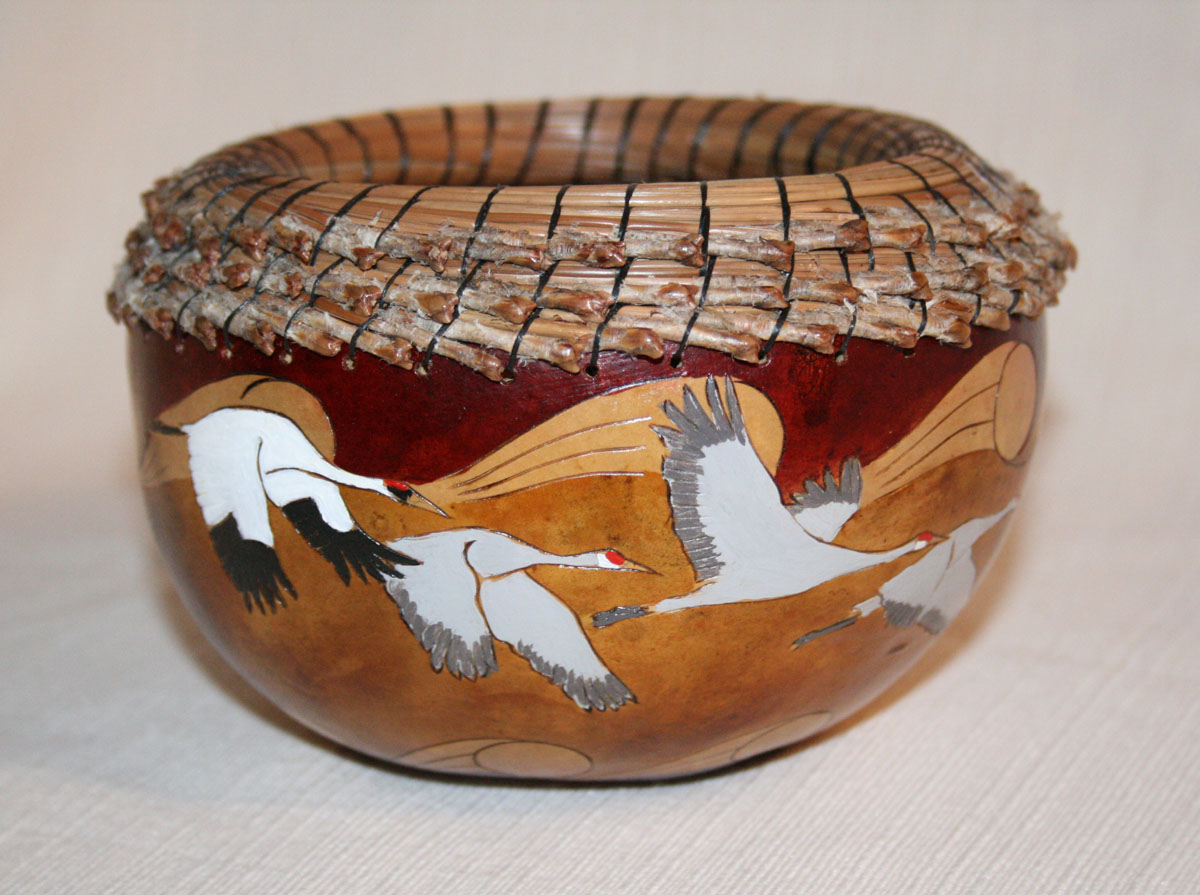
Hardshell Gourd Basket by Vickie Henderson, featuring sandhill cranes and one whooping crane.
Links and Resources:
Hiwassee's Hooded Crane on NPR with video
Nashville Tennessean article Dec 29th: Rare Crane Draws Birders from 32 states.
Make your plans to attend the Tennessee Sandhill Crane Festival
Directions to Birchwood and the Hiwassee Wildlife Refuge
Hooded Crane is Season's Gift by Marcia Davis
Times Free Press--Rare Hooded Crane Seen
Sandhill crane and Whooping crane gourd art baskets in my online shop
Top Crane Posts on this blog:
Hooded Crane at the Hiwassee Wildlife Refuge in TN
Whooping Crane Family--Happy Reunion!
Sandhill Crane Hunting in Tennesseee? Multiple Factors Say No!
Shooting Sandhill Cranes? Not in our backyard! Tampa Bay Times Dec 31st
Tampa Bay Times--Migratory Sandhill Cranes to be Hunted in Kentucky Dec 24th
Louisville Courier Journal--pg 2, Promote Eco-tourism
Kentucky Coalition for Sandhill Cranes
Petition site: No Hunting for Sandhill Cranes in the East with more than 3060 signatures.
All my blog posts opposing the hunting of eastern sandhill cranes
Whooping Crane Reintroduction links:
Operation Migration's Ultralight-led whooping crane migration--In the Field
Whooping Crane Eastern Partnership--Direct Autumn Release Program
International Crane Foundation
My Whooping Crane Family Series
Showing posts with label Kentucky sandhill crane hunt proposal. Show all posts
Tuesday, December 27, 2011
Wednesday, July 27, 2011
Intimate Visits with a Sandhill Crane Family
Sandhill cranes are loved wherever you find them. Recently I have become acquainted with several individuals who have spent many hours observing and documenting sandhill crane behavior as the families go about their daily lives. These are also talented individuals who have shared what they've learned with the rest of the world.
The image you see above is from Christy Yuncker Photo Journal, a website you will want to visit to find a wonderful collection of images and descriptions of sandhill cranes and their behavior. She and her husband, George Happ, are co-authors of the Sandhill Crane Display Dictionary.
Christy introduced me to Nina Faust, in Homer, Alaska, a videographer who has made a beautiful series of videos of a sandhill crane family living near her home. The videos are moving and intimate documentaries of a sandhill crane family engaged in its daily activities.
Before viewing, settle into your chair and relax. Each video will draw you into the moment as you hear the gentle purr of a sandhill crane parent and enjoy this intimate visit with a family of sandhills going about their daily life.
While the proposal to hunt the Eastern Population of sandhill cranes moves forward in the state of Kentucky despite overwhelming opposition, there is a parallel approval process occurring in the regulatory branch of the Migratory Bird Division of USFWS. This division reviews and approves the regulatory rules that govern proposed hunting seasons for migratory birds. Kentucky's proposed sandhill crane hunting season is currently under review and the public is invited to comment.
Two important deadlines:
August 1st--comment deadline in Kentucky.
August 5th--comment deadline for USFWS regulatory ruling.
By August 1st--KDFWR's comment period for the public to voice their opinion about the proposed sandhill crane hunting season ends August 1st, 2011. If you are opposed to the hunting of sandhill cranes in the east, please let your voice be heard. Send your comments to the following KDFWR email address: rose.mack@ky.gov
By August 5th--USFWS is holding a public comment period on the proposed sandhill crane hunt in Kentucky. Comments can be made via postal mail or online portal. You can make your comment online at the following link: Frameworks for Early Season Migratory Bird Hunting You may type your comment or provide it as an attachment. You will see a tab that provides for your comment at the top right. Click on the pdf tab to read the document. Sandhill cranes are discussed in item # 9, page 44735.
The postal mailing address is: Public Comments Processing, Attn: FWS-R9-MB-2011-0014; Division of Policy and Directives Management; US Fish and Wildlife Service; 4401 N. Fairfax Drive, MS 2042-PDM; Arlington, VA 22203
But don't stop there. Who do you know that can have an impact on this process? Role up your sleeves, make a phone call, send an email, send a letter, invite that person to discuss this issue with you. Everyone has access to their state's law makers. You will find your state's US legislators' phone numbers and mail addresses at this link. These are the people who have the power to stop a decision-making process that excludes the voice of the majority of US citizens.
Links and Resources:
Visit sandhill crane hunting for my previous posts on this issue. The most recent post will be first. When you reach the bottom of the page, click "older posts" to view more.
More on Purple Martins coming up!
Thursday, July 21, 2011
Kentucky's Sandhill Crane Hunt Proposal--Your Voice Counts
The sandhill crane hunting proposal developed by the Kentucky Department of Fish and Wildlife Resources (KDFWR) has reached the administrative approval level in the form of a proposed regulation that is moving toward a state legislative vote. If this regulation succeeds in passing and if the hunting proposal meets the regulatory standards of the USFWS, Kentucky will become the first state to open a hunting season on the eastern population of greater sandhill cranes since the population's near extinction.
As most of you know, there are a vast number of hunters and non-hunters in the east who do not want to see this happen. For many, the first reason that comes to mind springs right out of the heart. Most of us have been passionate about sandhill cranes from the moment we encountered them. They are large charismatic birds, social, highly vocal and impressive as they congregate in staging areas during their fall and spring migration. They are the kind of birds that evoke goose bumps and wonder, and the story of their recovery offers a model partnership between humans and nature. Humans protected them from hunting and conserved wetlands; sandhill cranes adapted to smaller breeding territories and learned to feed in waste grain fields adjacent to wetlands. We simply stopped harming them and they did the rest. There is a valuable lesson here for the future of wildlife stewardship in this country.
Besides my passion for sandhill cranes and my wish that this population be allowed to continue their recovery without hunting interference, I would like to share one piece of scientific information in response to those who think, "there are so many birds, how could we possibly harm the population with a limited harvest?" Jeb Barzen, Director of Field Ecology for the International Crane Foundation, the leading scientific resource for sandhill cranes in our nation, and one that is neutral on the issue of hunting, has the following to say about Kentucky's proposed harvest rate:
No population modeling has yet been done for the Eastern Population of Sandhill Cranes (EP). The harvest rate proposed for the commonwealth of Kentucky alone could consume a substantial portion of the productivity of the breeding crane population in the Upper Midwest. Data from one study in Wisconsin suggests that, in the last decade an average of one in three nests fledged a chick each year. If this rate of productivity is comparable for the EP as a whole, 1500 nesting crane territories would be needed to produce the cranes proposed for harvest in Kentucky. In addition, the fledging rate is declining so the reproduction rate seen in most recent years might be more relevant. In 2009 and 2010, approximately one in five nests fledged a chick to migration. Given this 18% fledging to migration rate, a harvest and crippling removal of 480 birds would require 2,800 nests to replace the hunting loss. Whether 1500 or 2800 nests, this represents a significant percentage of nesting pairs in Wisconsin and Michigan, likely the primary breeding areas for Sandhill Cranes that migrate through Kentucky.
Dr. Barzen's entire report is available at the link provided below and the data that supports his report is available to anyone through the International Crane Foundation. This is a valuable document to study for those who are interested in this important issue. It not only speaks to the breeding ecology of sandhill cranes in the east, but to problems in survey methods and problematic inferences that were used to support the hunting objective in the Management Plan for the Eastern Population of Sandhill Cranes.
What can you do now to help?
1) First and foremost, the KDFWR is holding an open comment period for the public to voice their opinion about this hunt proposal. This comment period lasts from July 1, 2011 to August 1st, 2011. Do not underestimate the power of your voice. If you are opposed to the hunting of sandhill cranes in the east, please let your voice be heard. You may be as detailed or as brief as you wish. Send your comments to the following KDFWR email address: rose.mack@ky.gov
2) Second, visit the petition site, "No Hunting for Sandhill Cranes in the East" and support the request that the eastern population management plan be revisited and the hunting objective excluded from this plan. As I write this post, the petition is only 89 signatures short of reaching its goal of 2500. Sign it, send it to all your networks, and ask all your friends to do the same!
3) Thirdly, stay on top of this issue by visiting the KY Coalition for Sandhill Cranes website frequently. This site is easy to navigate and is full of helpful information. Keep your comments and opposition letters handy and be ready to send them wherever they are needed.
4) Fourthly, pull out your sandhill crane hunt opposition letter, the ones you sent to Tennessee and Kentucky officials, and send it to your state's US senators and congressmen. We need their help. Let them know that you are not happy with a system that does not provide for equal representation from the non-wildlife-management, scientific community and that leaves out input from the majority of citizens when considering a new species to target for hunting. The address and email of your state's US senators and congressmen can be found here.
5) Lastly, conservation is not for the faint of heart! Congratulate yourself for your efforts, your determination, and your stewardship. Then take a deep breath and be ready to go again! Conservationists are a diverse group of people, hunters and non-hunters. We won't always agree on everything, but if we keep our focus on the real issue, the well-being of the wildlife species in question, good things will happen for our world.
Links and Resources:
Kentucky Coalition for Sandhill Cranes
International Crane Foundation
Thanks to Charlie Corbeil for permission to used his beautiful sandhill crane images. Visit Charlie's photo gallery for more stunning images.
For more ideas about what to include in your KY hunt proposal opposition comments visit Julie Zickefoose's recent post: Last Gasp for Sandhill Cranes
Recent media articles on KY's sandhill crane hunt proposal. In particular read the July 10th article by Carol Besse.
Visit sandhill crane hunting for all my posts on this issue. The most recent post will be first. Scroll down and click "older" to view older posts.
As most of you know, there are a vast number of hunters and non-hunters in the east who do not want to see this happen. For many, the first reason that comes to mind springs right out of the heart. Most of us have been passionate about sandhill cranes from the moment we encountered them. They are large charismatic birds, social, highly vocal and impressive as they congregate in staging areas during their fall and spring migration. They are the kind of birds that evoke goose bumps and wonder, and the story of their recovery offers a model partnership between humans and nature. Humans protected them from hunting and conserved wetlands; sandhill cranes adapted to smaller breeding territories and learned to feed in waste grain fields adjacent to wetlands. We simply stopped harming them and they did the rest. There is a valuable lesson here for the future of wildlife stewardship in this country.
Besides my passion for sandhill cranes and my wish that this population be allowed to continue their recovery without hunting interference, I would like to share one piece of scientific information in response to those who think, "there are so many birds, how could we possibly harm the population with a limited harvest?" Jeb Barzen, Director of Field Ecology for the International Crane Foundation, the leading scientific resource for sandhill cranes in our nation, and one that is neutral on the issue of hunting, has the following to say about Kentucky's proposed harvest rate:
No population modeling has yet been done for the Eastern Population of Sandhill Cranes (EP). The harvest rate proposed for the commonwealth of Kentucky alone could consume a substantial portion of the productivity of the breeding crane population in the Upper Midwest. Data from one study in Wisconsin suggests that, in the last decade an average of one in three nests fledged a chick each year. If this rate of productivity is comparable for the EP as a whole, 1500 nesting crane territories would be needed to produce the cranes proposed for harvest in Kentucky. In addition, the fledging rate is declining so the reproduction rate seen in most recent years might be more relevant. In 2009 and 2010, approximately one in five nests fledged a chick to migration. Given this 18% fledging to migration rate, a harvest and crippling removal of 480 birds would require 2,800 nests to replace the hunting loss. Whether 1500 or 2800 nests, this represents a significant percentage of nesting pairs in Wisconsin and Michigan, likely the primary breeding areas for Sandhill Cranes that migrate through Kentucky.
Dr. Barzen's entire report is available at the link provided below and the data that supports his report is available to anyone through the International Crane Foundation. This is a valuable document to study for those who are interested in this important issue. It not only speaks to the breeding ecology of sandhill cranes in the east, but to problems in survey methods and problematic inferences that were used to support the hunting objective in the Management Plan for the Eastern Population of Sandhill Cranes.
What can you do now to help?
1) First and foremost, the KDFWR is holding an open comment period for the public to voice their opinion about this hunt proposal. This comment period lasts from July 1, 2011 to August 1st, 2011. Do not underestimate the power of your voice. If you are opposed to the hunting of sandhill cranes in the east, please let your voice be heard. You may be as detailed or as brief as you wish. Send your comments to the following KDFWR email address: rose.mack@ky.gov
2) Second, visit the petition site, "No Hunting for Sandhill Cranes in the East" and support the request that the eastern population management plan be revisited and the hunting objective excluded from this plan. As I write this post, the petition is only 89 signatures short of reaching its goal of 2500. Sign it, send it to all your networks, and ask all your friends to do the same!
3) Thirdly, stay on top of this issue by visiting the KY Coalition for Sandhill Cranes website frequently. This site is easy to navigate and is full of helpful information. Keep your comments and opposition letters handy and be ready to send them wherever they are needed.
4) Fourthly, pull out your sandhill crane hunt opposition letter, the ones you sent to Tennessee and Kentucky officials, and send it to your state's US senators and congressmen. We need their help. Let them know that you are not happy with a system that does not provide for equal representation from the non-wildlife-management, scientific community and that leaves out input from the majority of citizens when considering a new species to target for hunting. The address and email of your state's US senators and congressmen can be found here.
5) Lastly, conservation is not for the faint of heart! Congratulate yourself for your efforts, your determination, and your stewardship. Then take a deep breath and be ready to go again! Conservationists are a diverse group of people, hunters and non-hunters. We won't always agree on everything, but if we keep our focus on the real issue, the well-being of the wildlife species in question, good things will happen for our world.
Links and Resources:
Kentucky Coalition for Sandhill Cranes
International Crane Foundation
Thanks to Charlie Corbeil for permission to used his beautiful sandhill crane images. Visit Charlie's photo gallery for more stunning images.
For more ideas about what to include in your KY hunt proposal opposition comments visit Julie Zickefoose's recent post: Last Gasp for Sandhill Cranes
Recent media articles on KY's sandhill crane hunt proposal. In particular read the July 10th article by Carol Besse.
Visit sandhill crane hunting for all my posts on this issue. The most recent post will be first. Scroll down and click "older" to view older posts.
Subscribe to:
Posts (Atom)
Ocean Trail at Palos Verdes Nature Preserve, California--2015
Bird-banding at Seven Islands State Birding Park--2014
Photo courtesy of Jody Stone
Bird-banding at Seven Islands
Photo courtesy of Karen Wilkenson
Enjoying Gray Jays in Churchill!--2014
Photo courtesy of Blue Sky Expeditions
Smithsonian National Zoo with one of my Whooping Crane banners and son, John--2014
The Incredible Muir Woods near Stinson Beach, CA--2014
Photo courtesy of Wendy Pitts Reeves
Me and Denali--2012
Photo courtesy of Bob King
For the Love of It...
...the sage sees heaven reflected in Nature as in a mirror, and he pursues this Art, not for the sake of gold or silver, but for the love of the knowledge which it reveals.
Sendivogius (1750)
Sendivogius (1750)
Your Uncapped Creativity...
"There is a vitality, a life force, an energy, a quickening that is translated through you into action; and because there is only one of you in all time, this expression is unique. If you block it, it will never exist through any other medium and it will be lost. The world will not have it. You must keep that channel open. It is not for you to determine how good it is, nor how valuable. Nor how it compares with other expressions. It is for you to keep it yours, clearly and directly." ----the great dancer, Martha Graham


