Showing posts with label hummingbird banding. Show all posts

Saturday, September 9, 2017

Hummingbirds and Hurricanes

Ruby-throated Hummingbird male.

This morning I helped trap hummingbirds for banding at Seven Islands State Birding Park in east Tennessee where local Ruby-throated Hummingbirds are preparing for migration and others are stopping to feed enroute to their wintering grounds in Central America and Southern Mexico.  At the same time, three hurricanes are churning in the south Atlantic, and as I write, hurricane Irma, originally a category 5 hurricane that has devastated many islands in the Carribean, is barreling down on Florida.
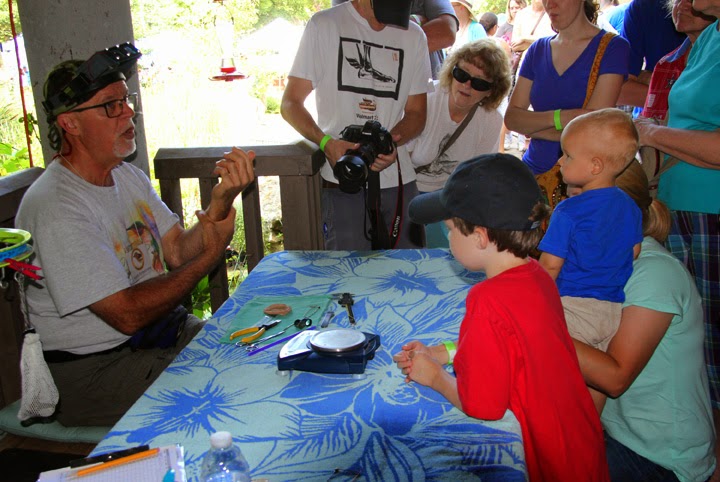
Above, Mark Armstrong demonstrates hummingbird banding at Ijams nature center, with Janie Kading assisting.

Knowing that Ruby-throated hummingbird migration is in full swing, I have wondered how these hurricanes have affected their migration.  I asked my friend and east Tennessee hummingbird expert, Mark Armstrong, to share what he knew about storm affects on migration. He answered with these comments:
"Unfortunately I don’t know much about their [hummingbird] survival in a storm.  I’ve heard of birds making landfall on the fringes of other storms and arriving thin and exhausted.  I’ve also read that migration from an evolutionary standpoint is actually across a broad front and a prolonged period so that some part of the population may be affected by adverse weather the majority will not be and survive.  I also keep thinking about Dr. Buehler’s Golden-winged warblers. They were at their breeding territories, left when tornados were heading their way, some went to the Gulf coast and one went back to Cuba.  Then they returned to breeding territories after the threat passed.  That is amazing and we really don’t know what birds may be perceiving and if they are capable of moving away from a danger like a hurricane.  Any small bird I can’t imagine would survive a direct hit from a storm with extremely high winds."
I, for one, am glad that the local hummingbirds frequenting my yard are hanging around and hope they will wait to leave until the many storm threats pass.
Meanwhile, we had a fun surprise during our banding session this morning at Seven Islands.  You may think that the hummingbird pictured above is a mature male Ruby-throat.  But surprise--this is a juvenile!  Normally, we expect to see juvenile males in their first year with scattered red throat feathers like the one pictured in image three or we might see small clusters of three or four red feathers as their gorget begins forming.
This first year male had an almost fully formed gorget, which Mark described as a rare occurrence in his experience.  Mark has banded over 4000 Ruby-throated hummingbirds since he began banding hummingbirds in 2005.  The juvenile pictured had white tail feather tips and other attributes that are the identifying characteristics of juveniles.
Most of our hummingbirds will leave Tennessee by the end of September with some late individuals departing by the second week of October.  Remember to leave at least one feeder out to feed our wintering hummingbirds that come from the west.  These birds often arrive from October to December.  If you should have a hummingbird at your feeder after November 1st, contact Mark Armstrong at Woodthrush@bellsouth.net or 865-748-2224.

Photo credit for banding images:  Mark Armstrong
Why do we band hummingbirds?
Mark Armstrong and banding at Seven Islands
Wintering Hummingbirds in Tennessee
Seven Islands State Birding Park

Wednesday, August 26, 2015

Wonder of Hummingbirds Festival Holds Outstanding Event!

Ruby-throated Hummingbird migration is in full swing in Tennessee making this an exciting time of year for hummingbird lovers!  
The male Ruby-throated Hummingbird shown above is molting feathers, meaning the old worn ones are falling out and being replaced with new ones.  Tiny white tubules, that become the feather's shaft, hold the feathers as they grow.  Molting during migration is a sign of health, according to Master Bander, Mark Armstrong.  It means the hummingbird has enough energy reserves, or fat stored, for both migration and healthy growth.
Photo credit:  Jody Stone

On Saturday, Aug 22nd, the Knoxville Chapter of the Tennessee Ornithological Society and Ijams Nature Center hosted their fifth annual Wonder of Hummingbirds Festival in Knoxville and the crowd of people attending were enthusiastic and eager to enjoy the many nature activities offered by the festival.

Photo credit:  Tom Howe

Organized by talented KTOS member, Billie Cantwell, the event attracted more than 1300 visitors who enjoyed hummingbird banding, nature walks, wildlife demonstrations, expert speakers, food and arts and crafts vendors and exciting children's activities!
Photo credit:  Susan Baumgardner

The popular highlight of the event is the hummingbird banding demonstrations offered by Mark Armstrong, Master Bander of hummingbirds and songbirds.
Photo credit:  Jody Stone.   Mark Armstrong examines a hummingbird.

Below, volunteer Andy Troutman removes a male Ruby-throated Hummingbird from one of the bander's traps.  Hummingbirds enter the trap to access the feeder and a door is lowered with an attached line.  

Photo credit:  Susan Baumgardner.  

Once removed from the trap, the hummer is placed in a mesh bag and transported to the bander.
Photo credit:  Jody Stone  

Photo credit:  Susan Baumgardner.

Mark first checks the hummers legs to be sure there is no current band.  He then secures a numbered band around its leg and examines the hummer for age, sex and health.  Measurements are recorded for the tail and beak and the belly is checked for fat to help determine overall health. If the individual is a juvenile male, he also records the number of red feathers on the throat.
Photo credit:  Jody Stone.

Above, Mark Armstrong attaches a numbered band to a hummingbird's leg.  The small stocking covers the hummers head and helps to keep it calm.  Watch the video below to see banding in progress.

 
Video credit:  Jody Stone

Photo credit:  Susan Baumgarder.

Above, Patty Ford gives visitors a close look at a hummingbird before release and below, she gently places a hummingbird in a child's hand for the release.    
Photo credit:  Jody Stone.

The banding station banded 28 hummingbirds and had one male re-capture that was originally banded at the festival three years ago.  The average life-span of a male hummingbird is 1.4 years and the oldest recorded male hummingbird was five years old.  Our re-captured bird is doing well!
I was introduced to hummingbird banding in 2009 at the first banding demonstration held at Ijams Nature Center, sponsored by KTOS, and it has been exciting to watch this event expand and attract the large crowds attending today.  
Photo credit:  Warren Hamlin.  

Above left, my exhibit table at the festival and (right) Stephen Lyn Bales, author, artist and naturalist discussing his natural history books.
             "Hummingbird and Million Bells" -- watercolor by Vickie Henderson

Links and Resources:

Tennessee Wildside video of 2013 festival

Sunday, September 7, 2014

Wonder of Hummingbirds Festival Features Banding!

One of the central attractions of the Wonder of Hummingbirds Festival each year is the hummingbird banding demonstrations given by Mark Armstrong, Master Bander of hummingbirds and songbirds.  

Small groups make it easier for everyone to hear the bander and see the banding process.  While visitors wait their turn, Oliver Lang, above, talks with visitors about hummers and banding.   In another area, Mike Nelson describes the life of hummingbirds and how they are captured for banding. In the images below, Mike shows a tiny hummingbird nest to visitors from Indiana.
Photo credit:  Billie Cantwell

Hummingbirds are captured in wire traps that surround the feeder.  The traps have a door that lifts open.  Hummingbirds seeking nectar will go inside the trap to drink and the door, connected to a long fishing line, can be lowered once the hummer is inside.
Hummingbirds are attracted to nectar feeders and flowers.  A large stand of Jewel Weed was present near the hummingbird banding area.
Photo credit:  Jody Stone               Jewel Weed is a favorite nectar blossom for hummingbirds

Hummingbirds that are captured in the traps are removed and carefully placed in a mesh bag to hold them until the bander is ready to process them.  Hummingbirds, like other birds, feed more actively in the early morning hours.
Photo credit:  Jody Stone

Master banders undergo many hours of training and receive a special certification that allows them to capture and band birds.  Data collected is reported to the Bird Banding Laboratory in Bethesda, Maryland, and contributes to scientific knowledge about bird populations and migration patterns.
Before he removes the hummer from the bag. Mark explains what he is going to do and how the band fits on the hummingbird's leg. 

He first checks to see if the hummingbird wears a band. Below, he uses a blunt darning needle as a tool to lift the hummers tiny foot and check its legs.
When no band is present, Mark places a new band on the hummer's leg with a special number series that will identify the bird if re-captured.  
The band is closed around the leg with a special set of banding plyers.
Below, you can see the band and its tiny numbers.  If Mark captures a hummer that is already wearing a band, he records the band number and checks his records to see if the band number is one of his.  This year at the hummingbird festival, he re-captured one of the hummingbirds that he banded at last year's festival, giving him an opportunity to check its health.  Hummingbirds are known to be very loyal to their feeding territories and can often be found in that territory on the same days each year.

Photo credit:  Karen Wilkinson

Above and below, Mark examines a male Ruby-throated Hummingbird using magnifying glasses. With a digital instrument, he measures the length of the beak.
Photo credit:  Karen Wilkinson

Males, females and juveniles range in the length of their beaks, with the males generally having shorter beaks.
Above, Mark uses a magnifying loop to examine a juvenile's beak for grooving to help age the bird. Juvenile bills are still growing and have grooves while adults have no grooving
When the examination is complete, Mark shows visitors the banded hummer.  Janie Kading (left) assists him during banding.
Photo credit:  Karen Wilkinson

When banding is complete, an assistant allows a young visitor to release the bird. The sensation of a hummer's wings fluttering in the hand as it buzzes away is delightful to all ages!
Photo credit:  Karen Wilkinson

Watch for next years festival date on this blog's side bar.  I will post it where you see the current year's date as soon as the 2015 date is decided!

Visit all the posts on this year's festival by clicking the link:  Wonder of Hummingbirds--2014

Wonder of Hummingbird festival on Facebook
Wonder of Hummingbird Festival Blog
Wonder of Hummingbird Festival_2013
Wonder of Hummingbird Festival 2013 on Tennessee Wildside
KTOS on Facebook
Hummingbird Banding Demonstration 2009
Mark Armstrong, Master Bander
Knoxville Chapter of Tennessee Ornithological Society
Ijams Nature Center

Friday, August 29, 2014

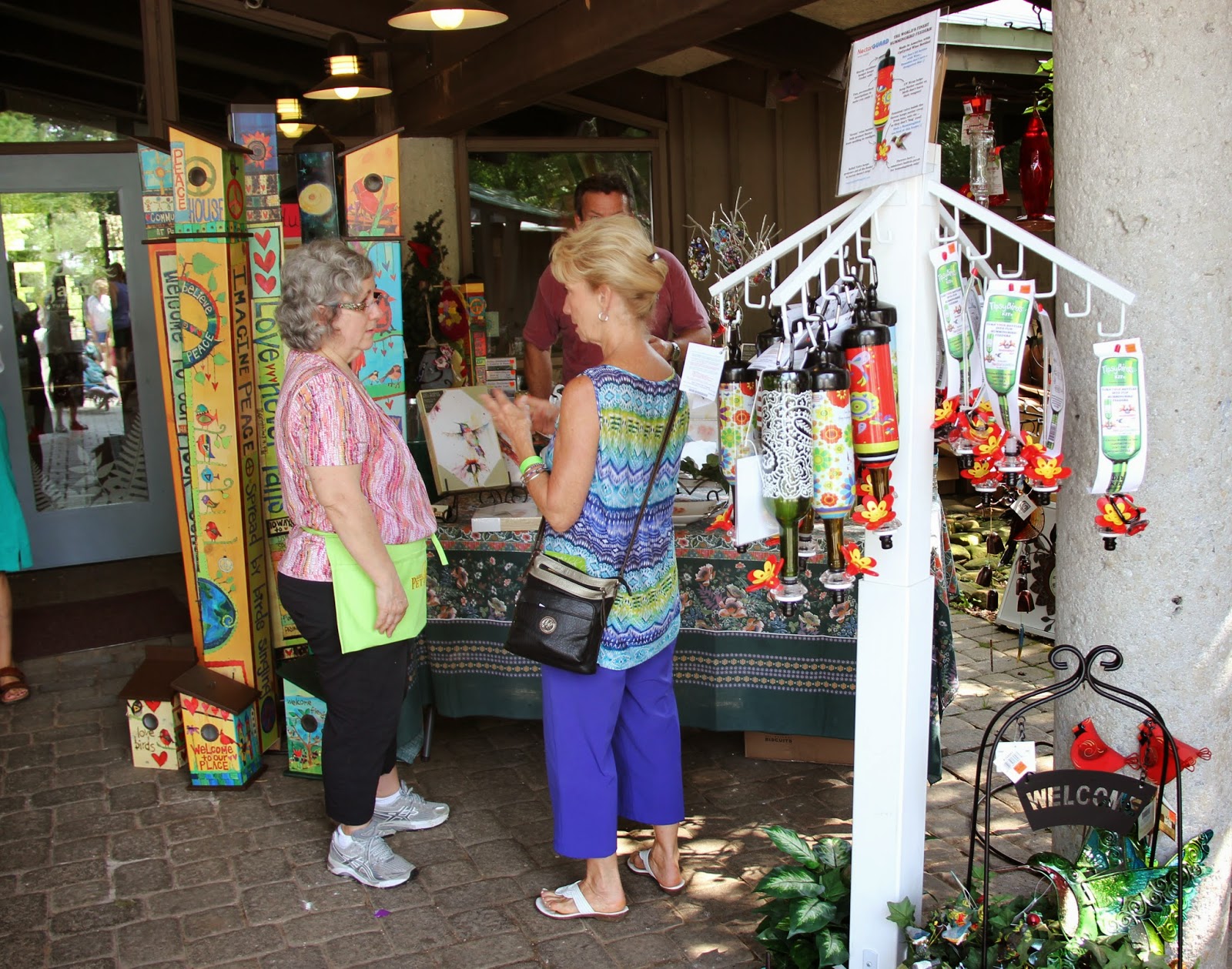
Festival Exhibits--Arts, Crafts, Plants, Food and Fun!

This is the second in a series of posts on the Wonder of Hummingbirds Festival held in Knoxville, Tennessee at Ijams Nature Center and co-sponsored by the Knoxville Chapter of the Tennessee Ornithological Society and Ijams Nature Center on August 23rd. (You will find the first post here).
At the center of the day's activities were hummingbirds, the star and inspiration for the festival.  Hummingbird banding was one of the main attractions and was demonstrated by Mark Armstrong, Master Bander of hummingbirds and song birds.
Photo credit:  Jody Stone

While people waited their turn to view the banding table, there were plenty of other activities to entertain and educate--presentations on wildlife and hummingbird gardening,  naturalist-led bird and nature walks, wildlife demonstrations, and exhibits with arts and crafts, and of course, food and drinks.
Above and below, author, illustrator and naturalist, Stephen Lyn Bales sketches at his exhibit table.  Lyn also gave a presentation on his book, Ghost Birds, Jim Tanner and His Quest for the Ivory-billed Woodpecker, 1935-1941.

And here I am, above, exhibiting art and talking with visitors!  It is always a fun surprise to meet some of the people I know from facebook, blogging and through my website! Thank you all for saying, hello!  Photo credit:  Jody Stone--creator of  the facebook community page, "Hummingbird Love"


 Agri-Feed, above and below.

Photo credit:  Jody Stone

A group of friends who traveled from Indiana planned their visit with each other around the Wonder of Hummingbirds Festival!  We also had visitors from New Jersey and Alabama who met up for a visit to the Smoky Mountains and timed their visit so they could attend the festival!     Photo credit:  Karen Wilkinson 

Mike Nelson shows our Indiana friends a tiny hummingbird nest on a twig, above.  Photo credit:  Billie Cantwell

Above, two of our hard-working KTOS volunteers, Linda Denton and Michael Plaster, providing information to visitors and selling festival t-shirts and the Discover Birds Activity Books. Festival proceeds benefit Ijams Nature Center and KTOS.  Photo credit:  Karen Wilkinson

 Photo credit:  Karen Wilkinson
 Photo credit:  Karen Wilkinson
 Tennessee Naturescapes                          Photo Credit:  Karen Wilkinson
Orchids, Cati and Tropical Plants         Photo credit:  Karen Wilkinson  

 Photo credit:  Karen Wilkinson

 Did I mention that there was great food?!                       Photo credit:  Karen Wilkinson

 Photo credit:  Karen Wilkinson

 Photo credit:  Karen Wilkinson


 KTOS volunteers, David Johnson, Mariam Fitzgerald, Harold Howell and Jeanne Alexander   Photo credit:  Karen Wilkinson

Next: Hummingbird banding!

Visit all the posts on this year's festival by clicking the link:  Wonder of Hummingbirds--2014

Wonder of Hummingbird festival on Facebook
Wonder of Hummingbird Festival Blog
Stephen Lyn Bales
Wonder of Hummingbird Festival_2013
Wonder of Hummingbird Festival 2013 on Tennessee Wildside
KTOS on Facebook
Hummingbird Banding Demonstration 2009
Mark Armstrong, Master Bander
Knoxville Chapter of Tennessee Ornithological Society
Ijams Nature Center
Related Posts Plugin for WordPress, Blogger...

Ocean Trail at Palos Verdes Nature Preserve, California--2015

Ocean Trail at Palos Verdes Nature Preserve, California--2015

Bird-banding at Seven Islands State Birding Park--2014

Bird-banding at Seven Islands State Birding Park--2014
Photo courtesy of Jody Stone

Bird-banding at Seven Islands

Bird-banding at Seven Islands
Photo courtesy of Karen Wilkenson

Enjoying Gray Jays in Churchill!--2014

Enjoying Gray Jays in Churchill!--2014
Photo courtesy of Blue Sky Expeditions

Smithsonian National Zoo with one of my Whooping Crane banners and son, John--2014

Smithsonian National Zoo with one of my Whooping Crane banners and son, John--2014

The Incredible Muir Woods near Stinson Beach, CA--2014

The Incredible Muir Woods near Stinson Beach, CA--2014
Photo courtesy of Wendy Pitts Reeves

Me and Denali--2012

Me and Denali--2012
Photo courtesy of Bob King

For the Love of It...

...the sage sees heaven reflected in Nature as in a mirror, and he pursues this Art, not for the sake of gold or silver, but for the love of the knowledge which it reveals.
Sendivogius (1750)

Your Uncapped Creativity...

Your Uncapped Creativity...
"There is a vitality, a life force, an energy, a quickening that is translated through you into action; and because there is only one of you in all time, this expression is unique. If you block it, it will never exist through any other medium and it will be lost. The world will not have it. You must keep that channel open. It is not for you to determine how good it is, nor how valuable. Nor how it compares with other expressions. It is for you to keep it yours, clearly and directly." ----the great dancer, Martha Graham