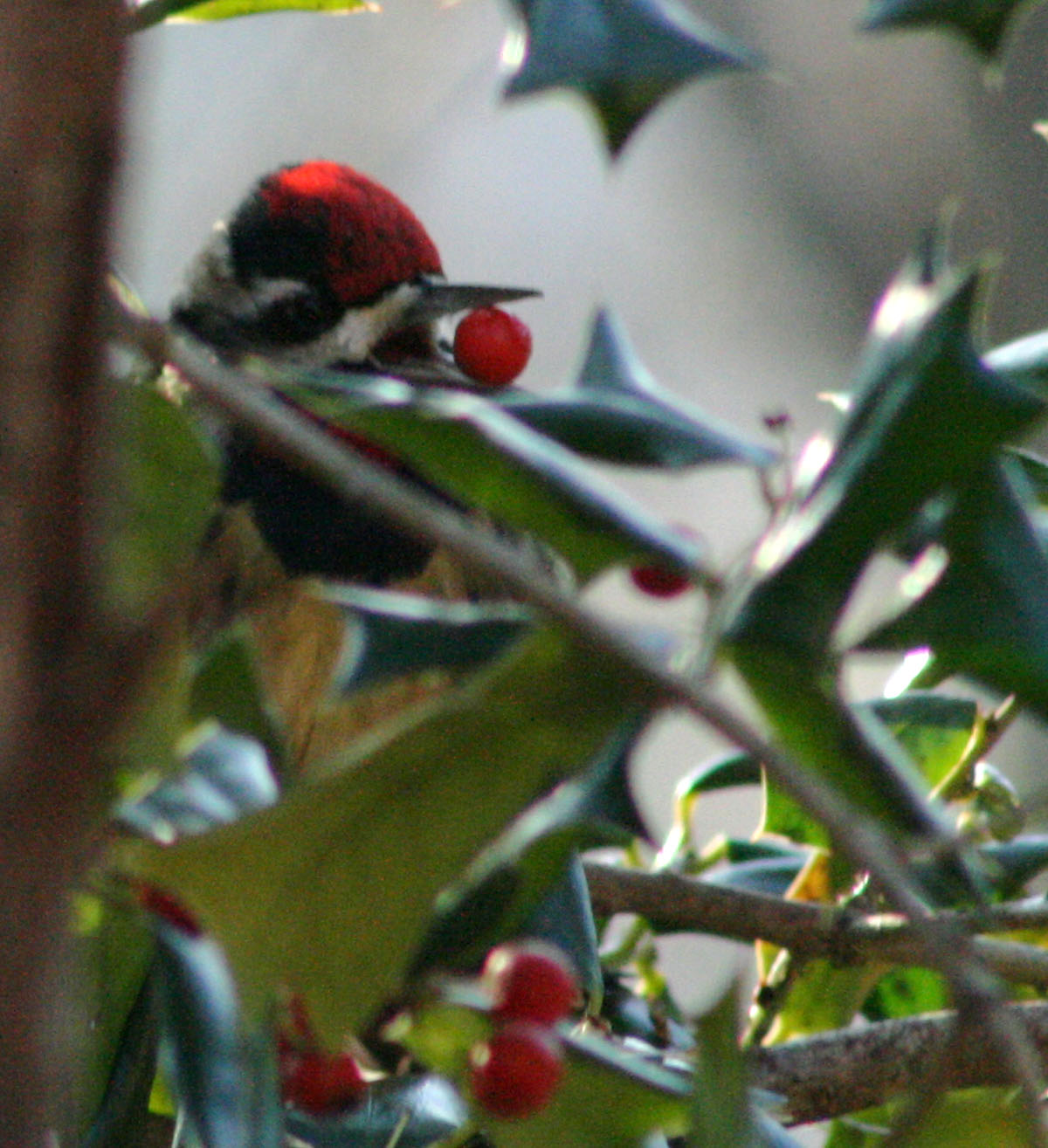
Woodpeckers are among my favorite birds, though I begin to wonder if every bird I encounter doesn't eventually fit into that category. The more I observe, photograph,
sketch and read about each species, the more I appreciate their unique characteristics and behaviors, no matter how common or uncommon.

The yellow-bellied sapsucker is common in Tennessee during wintering months which for this bird spans
September through
May. This female visited me on our sunny and warm Thanksgiving day. Above, you can see her relative size, about 9", compared to the pine trunk she's feeding on.
Males have a red throat patch while the females' throats are white.

She landed fairly close to me without a sound and immediately began her work, steadily pecking, so that my presence seemed of little concern. From the looks of the multiple lines of holes on the trunk of this tree, it must be a favorite.

Sapsuckers are known to select trees that are diseased or damaged and this is a white pine. There are few pines in TN that aren't currently weakened by
southern pine beetles due to previous years of drought followed by a season of ice storms and milder temperatures. These conditions stressed the trees and allowed the pine beetle populations to increase, causing a loss of many trees. Fortunately, this is a cycle that is expected to balance itself at some point.

According to a
Smithsonian report, the sapsucker's selective feeding has a nutritional bases. The sap of trees that are in poor health has a higher content of amino acids and protein.
The same report also gave some interesting information about the
interdependence of other species on sapsucker activity. Among those who benefit from the excavation of sap, the
Ruby-throated and rufous hummingbirds that breed in Canada may time their return to nesting grounds with peak sapsucker activity. When nectar plants are scarce, tree sap makes a suitable nectar substitute with comparable levels of sugar and nutrients.


A striking bird with her golden tint, black markings and red cap, the yellow-bellied sapsucker is considered a rare breeding bird in Tennessee's Unicoi Mountains, including the
Great Smoky Mountains. I'm located in the TN river valley at the foot of these mountains.

Since this sapsucker landed on the tree at eye-level, I had a good view. It was fun to watch her diligent excavations and to see her scooting backward down the trunk before she finally departed. And even though the image below is a blur, I like seeing the relative size of her wing span, which
Cornell measures at 13-16".

And on to the next tree.