Showing posts with label bluebird family. Show all posts

Monday, March 11, 2013

Tennessee Conservationist--Bluebirds in Your Backyard

One of the most delightful birds to welcome into your yard's habitat, the Eastern Bluebird, is the subject of my recent article in the Tennessee Conservationist Magazine, "Bluebirds in Your Backyard."  
When I embarked on the mission of attracting bluebirds to my backyard, I had only a small idea of the enjoyment I would derive from my interactions and observations of this companionable bird and its nesting activities, including offering mealworms.  Monitoring a nestbox, watching bluebird behavior, and checking the progress of nestlings, from the appearance of eggs to the days after fledging, is an enriching journey into the natural world that will alter your appreciation for nature forever.
Bluebirds require all the basics--shelter, food and water--but the central ingredient to attracting bluebirds to your yard is the nestbox.  The article includes details of placing the nestbox and one type of predator guard that has been successful in keeping bluebird families safe from cats, raccoons and snakes in my yard throughout the nesting seasons.
Louise Zepp, editor of the Tennessee Conservationist Magazine, selected "Bluebirds in Your Backyard" as the feature article for the March/April issue to help celebrate bluebirds and promote bluebird conservation.

Links and Resources:

To visit my other TN Conservationists Magazine articles click here.

The Tennessee Conservationist website.

To see my bluebird posts on this blog visit:  Bluebird family

Thursday, June 21, 2012

Bluebird Family Gathers at the Nestbox

The opportunity to closely observe behavior is one of the joys of having a bluebird family nesting close to the house.  In fact, it feels very quiet now that the nestlings have fledged.  But while they were here, I watched them at every opportunity.  In the video below you will see the whole family gathered to feed the nestlings, all of them arriving at once.
Above, a female juveniles arrives with food.

While watching the video you will have opportunity to see interesting behaviors.  The male bluebird is whistling softly and chattering to encourage the juveniles as they help him feed the young.  Notice his wing-waving as he lands which is a greeting as well as encouragement.  Notice, also, that one of the female juveniles is frequently stealing food from the other two juveniles.  As I observed this on many occasions, it was obvious that she sometimes ate what she snatched.  This persistent behavior may explain what I initially considered to be the female adult's intolerance in the days before she disappeared.  She was observed snapping her beak and lunging at a juvenile that perched too close to her or arrived at the mealworm feeder at the same time.

Later, on three occasions, the two female juveniles were observed in face-to-face aerial conflict issuing raspy sounds as they challenged each other beak to beak.  The adult male and male juvenile quickly arrived to investigate and break up the conflict on each occasion.  I couldn't help but wonder if the food-stealing behavior may have been a contributing motivation for these conflicts.

Since the nestlings have fledged, family members still visit the feeder to feed themselves and carry food to the fledglings that are scattered in the area, but their visits are less frequent.

To see a determined juvenile trying to feed the nestlings for the first time, visit:  Bluebirds Adapt to Single Parenting.  And to see last season's juveniles bathing and feeding siblings visit: Juvenile Bluebirds Enjoy the Water and Juveniles Helping Parents. To see all my bluebird posts visit:  Bluebird Family.

Visit this link to learn how to make the predator guard that protects my nestbox residents from cats and raccoons.

Monday, June 18, 2012

Eastern Bluebird Juvenile Behavior

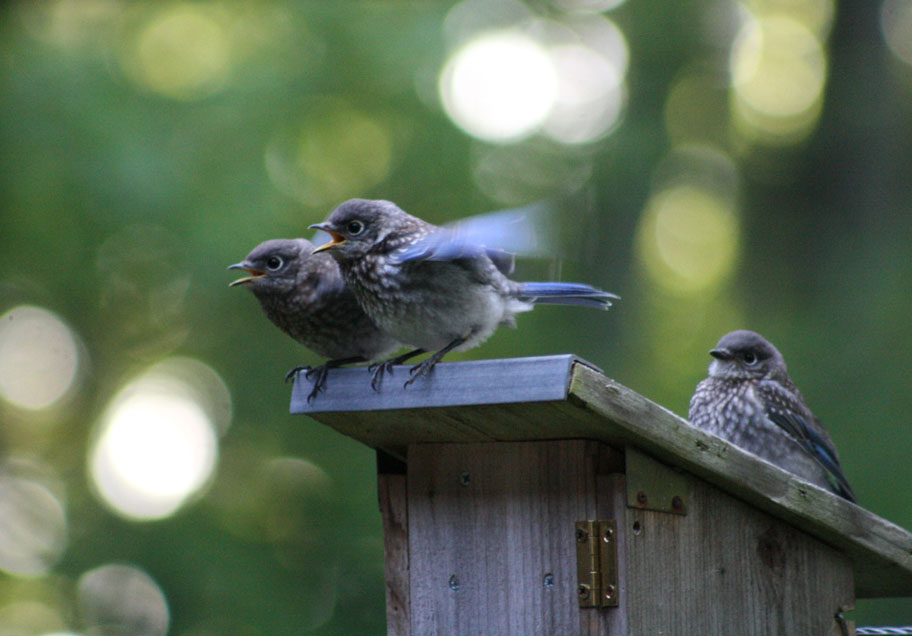
Since the second brood nestlings fledged (June 13th and 14th), I have been lucky enough to see two of the new fledglings in the trees around the yard.  The safest place for fledglings is high limbs, away from the ground and with sheltering canopy overhead.  The family often leaves the nesting area after the nestlings fledge and it's rare to see them at all in the days that follow.  
The male fledgling above happened to catch my eye while he was exploring the lichen in a tree near the patio.  His behavior, plus the rich color of his plumage and his yellow gape, helped distinguish him from his older male sibling.

A few days before fledging occurred, I captured some fun video of the first brood juveniles interacting as they came to the nestbox to feed.  The three juveniles readily cooperated in feeding with the adult male's encouragement.  The male encouraged their assistance with wing-waving, soft whistles and chattering which were also behavioral exchanges observed in the mated pair prior to the female's disappearance (last seen June 8th).  

Though they are serious about caring for their younger siblings, juveniles will be juveniles, and their interactions can be amusing.  Watch what happens when these two female juveniles land in the guard at the same time.


Below, a female juvenile feeds the nestlings, then carefully removes a fecal sac.


Next:  Watch bluebird behaviors as the whole family gathers at the nestbox to care for the nestlings!

To see nestlings as they fledge visit:  Bluebird Nestlings Fledge.  To see a determined juvenile trying to feed the nestlings for the first time, visit:  Bluebirds Adapt to Single Parenting.  And to see last season's juveniles bathing and feeding siblings visit: Juvenile Bluebirds Enjoy the Water and Juveniles Helping Parents. To see all my bluebird posts visit:  Bluebird Family.

Visit this link to learn how to make the predator guard that protects my nestbox residents from cats and raccoons.

Friday, June 15, 2012

Bluebird Nestlings Fledge

I have a bluebird treat for you in this blog post!  Two videos of beautiful nestlings as they first leave the nest.
Above:  female first brood juvenile pauses for a drink on fledging day.

After observing this bluebird family for the past month, I was determined to at least try to see these nestlings off on their fledging day.  If you've ever tried to do this you know that even with dedicated vigilance, this takes a good measure of luck.

Besides being home at the right time and counting the days from hatching (14-18 days to fledging), there are some behaviors that you can watch for that indicate fledging is near. Bluebird family members use a one note contact call to help locate each other. Several days before fledging, the nestlings and family members begin to sound these calls with greater frequency. It becomes very apparent when these calls come from the nestlings in the nestbox. Additionally, as fledging time approaches family members wait for longer intervals between feedings, the juveniles taking their cue from the parents. In this case, the male parent and juveniles visibly perched for longer periods and guarded the nest area and near by trees with greater vigilance and aggression.

It was not uncommon to see the whole family advance to drive away a poor woodpecker who happened to land on their oak tree. This tree is the preferred guard perch and preening area for family members with direct view of the nest and feeding area. It is also the tree that stands the right distance away and in front of the nest box with branches easy to reach and safe for a fledgling's first landing.  
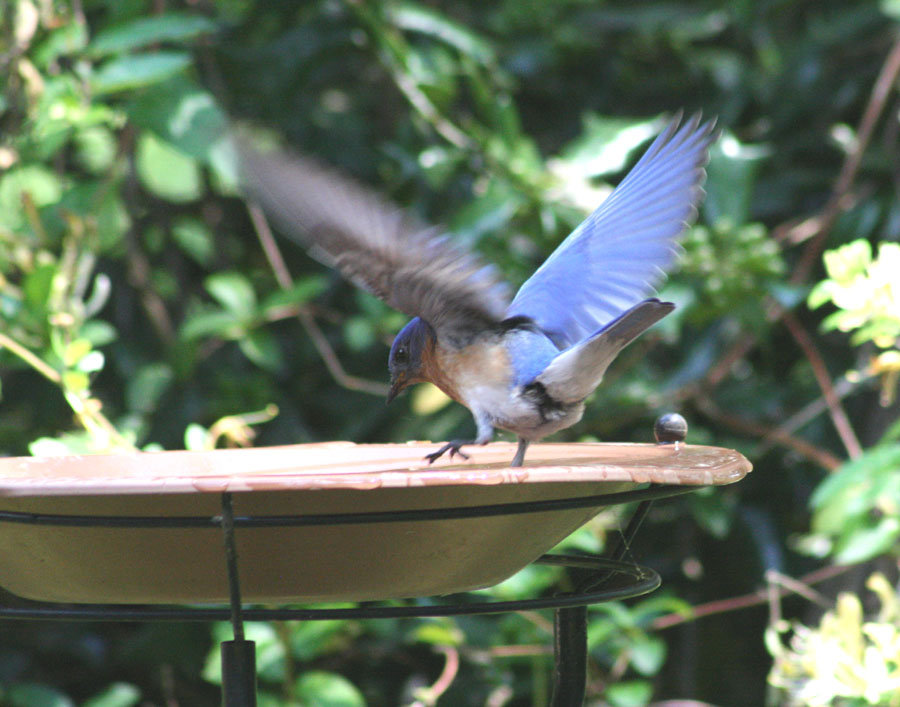
Female juvenile (left) and male juvenile visit the bird bath.  You can see the edge of the male's bright blue secondary feathers.

The two videos below represent day one and day two of fledging.  In the first video, a male is the first nestling to venture out of the nestbox.  The video was taken at 7:30 pm and an hour later, near dusk, I witnessed two male nestlings fledge and land in the limbs of the oak.
In the second video you will see the last nestling leave the box the next morning, a pretty female.  She is sounding the contact call as she looks at her new surroundings. If you listen carefully, you can also hear the male chipping in the background.  
Next post:  More fun juvenile behavior as family members feed nestlings a day before fledging.


To see a determined juvenile trying to feed the nestlings for the first time, visit:  Bluebirds Adapt to Single Parenting.  And to see last season's juveniles bathing and feeding siblings visit: Juvenile Bluebirds Enjoy the Water and Juveniles Helping Parents. To see all my bluebird posts visit:  Bluebird Family.

Visit this link to learn how to make the predator guard that protects my nestbox residents from cats and raccoons.

Monday, June 11, 2012

Bluebirds Adapt to Single Parenting

As I have watched this family of nine adapt to the loss of the female parent, I have marveled at how quickly they have reorganized their family behavior.
Prior to the loss of the female, the juveniles have wandered to hunt, but returned throughout the day to be near their parents.  Often they've perched in overhead limbs to watch the parents feed the nestlings, and on several occasions in the past week, the male juvenile has brought food to the nestlings.
On June 8th, the last day the female was present, the juveniles made quick visits to the mealworm feeder while the parents were away.  Often the female was not tolerant of them sharing that space with her and they avoided meeting either parent inside the feeder.  Later that same morning, they were seen overhead foraging for insects in the leaves trapped in the gutters.  They flipped leaves, followed each other around, ran to see what had been stirred up by a sibling, and generally entertained themselves while the parents fed the nestlings at a steady pace.
In the images above, taken yesterday, you see two juveniles arriving at the nestbox predator guard at the same time.  The one inside is the male juvenile.  I believe he is encouraging the female juvenile (who at this point had not learned how to enter the predator guard) to hand off her food.  But she didn't like that idea.

Since the female has been absent (last seen June 8th), these juveniles have rallied around the male.  Not only are they steadily present, they are keeping watch over the nest area, sounding alerts, chasing away intruders (titmice primarily).  And as of yesterday, everyone of them is feeding the nestlings and with greater proficiency.

In yesterday's video below, watch as one of the juvenile females, the last to begin feeding the nestlings, struggles to figure out how to reach the nestlings with the food she has brought.  While she is figuring this out, you will see the juvenile male enter to feed first, followed by the adult male.  The female juvenile is determined and persistent and tries every angle available to reach the nestlings from her position.

This is the stuff that tugs at the heart-strings.  It certainly suggests that there are complex emotions and motivations driving her effort.  The male is patient with juvenile efforts, waiting for them to feed, watching as they try to contribute and encouraging with chattering and wing-waving.  
The nestlings are popping their heads out of the nestbox to receive food now and are calling when they are hungry.  This call is only heard when they haven't been fed for a while and stops soon after feeding begins.  I am feeding generous quantities of mealworms several times a day and the family arrives immediately, sometimes before I leave the feeder, eager to begin feeding.  Family members are not dependent on the mealworms, however.  They are also hunting individually and bringing a variety of other foods.

Today the nestlings are sixteen days old, an age that falls within the 15-18 day range for expected fledging.

To see last year's juvenile's bathing visit:  Juvenile Bluebirds Enjoy the Water, and to see last year's juveniles feeding their younger siblings, visit:  Juveniles Helping Parents.  To see all my bluebird posts visit:  Bluebird Family.


Visit this link to learn how to make the predator guard that protects my nestbox residents from cats and raccoons.  

Sunday, June 10, 2012

Bluebird Juvenile Feeding Young

Attachments are a part of enjoying nature.  And without a doubt, that brings with it both joys and disappointments
Yesterday I watched the bluebirds throughout the morning.  About an hour into my observations, I realized the female was absent.  The male was feeding alone and the female, whom I at first assumed was out hunting, did not return to the nesting area.  

This, of course, is sad news and she is missed.  The male alternately perched, sang, and fed young throughout the day, but activity was considerably subdued without the female's persistent vigilance in both feeding and protecting the nest area.

The male stayed near the nest site and chased away intruders, clacking his beak, protecting both the nest area and the main perching tree in the yard.  At one point, as I refilled the feeder, he flew in wing-waving and chattering and brought along the male first brood juvenile.  The juvenile immediately entered the feeder and fed and then carried a mealworm to the nestlings to feed them.  He repeated this several times, while the male returned to his guard perch to survey the area.

Below is a video of the juvenile male as he brings food to the nestlings, but meets with some confusion when his sister tries to eat his worm.  He did not actually enter the guard and feed on this occasion but does so efficiently at other times.
To see last year's juvenile's bathing visit:  Juvenile Bluebirds Enjoy the Water, and to see juveniles feeding their younger siblings, visit:  Juveniles Helping Parents.  To see all my bluebird posts visit:  Bluebird Family.


Visit this link to learn how to make the predator guard that protects my nestbox residents from cats and raccoons.  

Thursday, June 7, 2012

Eastern Bluebirds Feeding Young

Falling in love with Eastern Bluebirds is the natural outcome of living near these birds.  
The bluebird's ability to adapt to human presence, and accept the closeness that you see in these images and the video is part of the reason they have gained so much popularity in past decades.  This female chirps as she eats, contented chirps, as though expressing her delight at seeing so many grubs every time she encounters them in the feeder.  And the most endearing behavior of all happens when she lands on the shepherd's perch only a few feet away, looks directly at me and wing-waves. This is her greeting in bluebird language, and among the finest greetings I've ever received!

Obviously her tolerance of me is a result of my relationship to the mealworms.  I appear and they appear. And this bluebird pair is committed to feeding their five twelve-day-old nestlings at frequent intervals. Typically bluebird nestlings fledge at around 15-18 days, so we are nearing the count down.  
First brood juvenile male in this family of ten (five in the nest, three fledglings and two parents).

This, of course, gives me mixed feelings.  When the nestlings fledge, there is no reason for the family to remain in the yard.  The fledglings will roost high in the trees and the parents will lead them away from the nesting area to avoid predators.

Below you are seeing my first video taken with my new Canon Rebel SLR with HD video capacity. You'll see both the male and female bringing mealworms to the young and leaving the nestbox a bit cleaner as they depart.      
And while the parents were feeding the nestlings, the three juveniles were hanging out together on the gutters overhead, flipping leaves and debris to stir up the insects underneath.
To see last year's juvenile's bathing visit:  Juvenile Bluebirds Enjoy the Water, and to see juveniles feeding their younger siblings, visit:  Juveniles Helping Parents.  To see all my bluebird posts visit:  Bluebird Family.

Friday, June 1, 2012

Bluebird Family Life

Breeding season is a very busy time for Eastern bluebirds.   
The adult pair, three juveniles from their first brood, and five hatchlings (hatched on May 27 and 28th) make up the bluebird family of ten that are living in and around the nestbox and mealworm feeder in my yard.  Above you see the hatchlings on May 28th. Consider that the nest cup is approximately 2.5 inches across and you will get a better sense of the size of these tiny, newly hatched babies.  
By this time, the fledged juveniles are feeding themselves.  They have received firm warnings from both parents, beginning well before the eggs hatched, so that they no longer expect to be fed when a parent arrives with food.  In fact, the juveniles are very curious about what's happening in the nest box and are watching as their parents bring food to the young in the nest.  
And the foods offered to the nestlings are very particular and tender.  In the first few days, the parents bring the tiniest spiders, worms and insects to the young.  One wonders how they ever see and capture anything that small, especially when the feeding intervals can be as frequent as four times a minute with both parents feeding.  
Above the female pauses before entering the nestbox entrance, and below she takes a break for a cool bath.  
One of the juveniles considers taking a bath, below, but was too timid on this occasion to jump in.  Perhaps she was a bit camera shy.  I suspect she drinks and bathes frequently at other times during the day since we've been having 90 F degree temperatures, much warmer than is typical for this time of year in Tennessee.  
To see last year's juvenile's bathing visit:  Juvenile Bluebirds Enjoy the Water, and to see juveniles feeding their younger siblings, visit:  Juveniles Helping Parents.  To see all my bluebird posts visit:  Bluebird Family.

Friday, May 11, 2012

Feeding Hungry Bluebird Juveniles

Early morning feedings can be mass confusion at times.  Especially when eastern bluebirds juveniles are cold and hungry.  
Such was the case on this 49° F May morning with the air so much colder than the summer-like weather we had been having.  The juveniles' feathers were fluffed up for warmth and when the male appeared with mealworms, three juveniles descended from overhead limbs, each vying for position--wings fluttering, eager cheeping, and even landing on top of a sibling if that's what it took to get near the food.    

In this case, I think the closest mouth won the meal.  Each of the above images includes three juveniles, though its not easy to sort them out, and eventually two fell off the perch during the scramble.  You have to admire the steady perseverance of parents under these circumstances.  The male fed his mealworms quickly, hopped clear, returned to the feeder, and came back with a fresh supply, feeding until calm was restored.    


Though the female was near and even landed on the garden shepherd's perch near the feeder, she did not participate in the feeding on this occasion.  A little later she flew into the nestbox.  The male was quite interested in this and flew down to the nestbox guard to peek inside and see what was happening.  

I was interested too, and later, after the family left to hunt elsewhere and the nestbox area was quiet, I checked to see if we had eggs.  And yes, we have two eggs!  
Above, three juveniles rest on a limb after being fed, huddled together to take advantage of the extra warmth.

Links and resources:

Visit my previous post, Landlord or Local Diner?  My yard and its nestboxes and mealworm feeder were part of the wintering territory of a small flock of bluebirds with one dominate male and female pair.  However, the pair did not select one of my yard's nestboxes for their first nesting this season.  I later realized that the red-shouldered hawk that had been seen perched in the yard on several occasions during early spring was the likely reason the pair chose a different nest site.  Red-shouldered hawks have fledged their young by now and are wandering beyond their nesting territories.  And, I am happy to have a nesting pair of bluebirds in my yard again!  

To see my posts on last season's nesting bluebirds, visit:  Bluebird Family

Sunday, July 17, 2011

Eastern Bluebirds--Juveniles Helping Parents Feed Nestlings

Several days ago, I noticed the bluebird juveniles, now eleven weeks old, visiting the nest box, looking in on the nestlings.
After seeing one of the juveniles fly inside the nest guard and rest there repeatedly, I wondered if she was displaying curiosity or expressing a desire to participate in caring for the young.  Yesterday, I had more time to observe and got my answer.  The juveniles are helping their parents feed the nestlings.

The efforts I observed were not always smooth, as in, multiple attempts to fly into the predator guard, and near collision with a parent while exiting the nest, but as the day progressed, the juvenile efforts became more and more efficient.  Not only were they feeding  young, they were also removing fecal sacs.

From time to time, the male took charge of activity, issuing strong warning notes that caused a juvenile to change directions in mid flight.  Sometimes the warning seemed to indicate it wasn't safe to approach the nest.  At other times, the reason was not apparent, but his authority was clearly affirmed.

The juveniles respond differently to their parents in general now, rarely expressing themselves as fledglings eager to be fed, but more as family members heeding group hierarchy. Juveniles may display an open-mouth response w/o begging vocals if a parent lands too close.  The display seems to indicate submission or a reminder, 'I'm a baby', as seen in the image below.  The female, to the right, had just landed.  The juvenile displayed an open mouth for a few seconds and quickly departed.
While watching the juveniles bring food to the nestlings, there were also occasions when the juveniles just seemed to be behaving as juveniles.  For example, in the images below, you'll see two juveniles at the nest box at the same time.  Watch what happens as the second juvenile passes the first while entering the nest box.


As the day progressed, there seemed to be more and more harmony in the efforts, with as many as three family members lined up on a limb waiting for their turn to feed the nestlings.
The nestlings are thirteen days old today.  Eastern bluebirds generally fledge at 16-22 days, according to my monitoring guide (Cornell Bird Library Guide).  The first brood fledged at 18 days.  I checked the nestbox today for the last time pre-fledging and counted four beautiful nestlings, two males, one female and one whose gender I couldn't determine because the wing feathers were hidden under piles of sibling feathers.  When these nestlings fledge, the family will scatter initially, as the fledglings fly to high perches for safety.  If I'm lucky, they will later return to visit the feeder and the bird bath, and I'll have opportunity to see how siblings of different ages interact.              

Links and Resources:

This is the fifteenth post in my series on this bluebird family.  To see all of the posts visit the link, bluebird family.   The most recent post will be first.  Click "older posts" at the bottom of the page to see earlier posts.

Find instructions for making nest box predator guards by clicking the link.  These guards have worked to keep the 9" arm of a raccoon out and have prevented prowling cat predation, as well as snakes.  A 7-inch depth is recommended.  You may also find a version of these guards at the Wild Birds Unlimited store nearest you.

Coming up:  Fun visits with purple martins!

Linked to Bird Photography Weekly #151, a reminder to help conserve our world's birds.

Friday, July 15, 2011

Eastern Bluebirds--A Family of Nine Trying to Stay Cool

I frequently fill the mealworm feeder after returning home from the office in the evenings, especially on these hot and humid summer days.  I suspect that refrigerated mealworms help cool down bluebird parents, as well as, nestlings and their juvenile siblings.  On days when the heat index passes 100, birds are affected and can be seen trying to cool themselves with mouths open.  
The bluebirds are a family of nine now, two parents, three fledged juveniles that are a little over ten weeks old, and four eleven-day-old nestlings.  On July 4th, the family's second brood of nestlings hatched.  Below you see an image I took as I discovered hatching in progress.  Notice the pipping tooth that's visible on the hatchling's beak, the tough, horn-like tooth that helps the nestling break its shell and just as efficiently dissolves after hatching.
And below you see an image taken on July 11th, at one week of age.  Eyes are open, skin is now covered with down, feather sheaths and emerging feathers, and the wary youngsters recognize the sounds of mom and dad coming to feed and no longer gape when the nestbox is opened.  In just another five to ten days, they will be ready to fledge, a marvel just as amazing as that tiny little head resting on the egg above.
It has been a joy to watch this family and see so many intimate details of their lives and behavior.  I was surprised by this opportunity, thinking initially that bluebirds would not select a nestbox so close to the house and the nestbox would remain the domain of chickadees.  But that hasn't been the case this year.  In the image below, you can see how closely the mealworm feeder, nestbox, house and patio are positioned.  You can also see the gazebo roof line where the phoebes hatched and fledged two broods on the supporting shelf underneath.  The second phoebe brood fledged just prior to the second bluebird hatch.  The limb you see on the ground is actually a tree that came down during one of our storms.  It has made a great eye-level perch for the bluebirds.  Also, between the patio (which begins at the post to the right) and the mealworm feeder you see the shepherd's hook that is frequently used by the bluebirds.
To the right and west of what you see in the image, lies the birdbath, shaded from the afternoon sun by surrounding trees and enjoyed by all, including me.
This is, of course, the other way birds stay cool.  Birds may visit the birdbath anytime for a drink, but bathing occurs especially during mid-day to late afternoon.  Here you see the male bluebird visiting the smaller birdbath I previously had.  These are some of my favorite images of the male bluebird, comical and endearing.  He visited the water several times in a brief period to bathe vigorously and granted some fun pics.  


Links and Resources:

This is the fourteenth post in my series on this bluebird family.  To see all of the posts visit the link, bluebird family.   The most recent post will be first.  Click "older posts" at the bottom of the page to see earlier posts.
You may also enjoy Wishing Upon a Bluebird at Vickie's Sketchbook and my articles for Wild Birds Unlimited, Having Fun with Bluebirds and We Have Bluebird Hatchlings.

For articles leading up to the bluebird family posts, visit my Wild Birds Unlimited articles:

The birdbath seen in the previous post is available at Wild Birds Unlimited.  The "meal worm feeder" you see in my bluebird family blog posts is also available through Wild Birds Unlimited.

Find instructions for making nest box predator guards by clicking the link.  These guards have worked to keep the 9" arm of a raccoon out and have prevented prowling cat predation, as well as snakes.  A 7-inch depth is recommended.  You may also find a version of these guards at the Wild Birds Unlimited store nearest you.

Coming up:  Fun visits with purple martins!

Monday, July 4, 2011

Juvenile Bluebirds Enjoy the Water

Most of the time, I have seen the juvenile bluebirds playing in the birdbath as I've walked by the window and glanced out.  But this was a delightful occasion two days ago when I happened to be settled on the patio when they arrived, camera ready.  What a delight.
Even though they are doing what birds naturally do in water--drinking and bathing--there is something naive and curious about the expressiveness of juveniles while they visit the birdbath, especially when more than one visits at once.  These images show the new birdbath that I purchased after the juveniles fledged in anticipation of more than one family member visiting the water at the same time.  It was a good decision.
Notice in the images below, how the young female (I think) backs into the water from her position on the rock.  All the rest is just plain fun.  Juveniles bathing and playing and sharing that time together.  


Often when they visit the birdbath, they will interrupt their visit and fly to a perch for a few minutes, possibly to affirm the safety of the area.  If all seems safe, back they come, not quite finished with their enjoyment of the water. .  


A great way to celebrate the hot days of summer and the many freedoms represented in our celebration of Independence Day!

Links and Resources:

This is the thirteenth post in my series on this bluebird family.  To see all of the posts visit the link, bluebird family.   The most recent post will be first.  Click "older posts" at the bottom of the page to see earlier posts.  You may also enjoy Wishing Upon a Bluebird at Vickie's Sketchbook and my June article for Wild Birds Unlimited, Having Fun with Bluebirds.

For articles leading up to the bluebird family posts, visit my Wild Birds Unlimited articles:

The birdbath seen in the images is available at Wild Birds Unlimited.  The "meal worm feeder" you see in my bluebird family blog posts is also available through Wild Birds Unlimited.

Find instructions for making nest box predator guards by clicking the link.  These guards have worked to keep the 9" arm of a raccoon out and have prevented prowling cat predation, as well as snakes.  A 7-inch depth is recommended.  You may also find a version of these guards at the Wild Birds Unlimited store nearest you.
Related Posts Plugin for WordPress, Blogger...

Ocean Trail at Palos Verdes Nature Preserve, California--2015

Ocean Trail at Palos Verdes Nature Preserve, California--2015

Bird-banding at Seven Islands State Birding Park--2014

Bird-banding at Seven Islands State Birding Park--2014
Photo courtesy of Jody Stone

Bird-banding at Seven Islands

Bird-banding at Seven Islands
Photo courtesy of Karen Wilkenson

Enjoying Gray Jays in Churchill!--2014

Enjoying Gray Jays in Churchill!--2014
Photo courtesy of Blue Sky Expeditions

Smithsonian National Zoo with one of my Whooping Crane banners and son, John--2014

Smithsonian National Zoo with one of my Whooping Crane banners and son, John--2014

The Incredible Muir Woods near Stinson Beach, CA--2014

The Incredible Muir Woods near Stinson Beach, CA--2014
Photo courtesy of Wendy Pitts Reeves

Me and Denali--2012

Me and Denali--2012
Photo courtesy of Bob King

For the Love of It...

...the sage sees heaven reflected in Nature as in a mirror, and he pursues this Art, not for the sake of gold or silver, but for the love of the knowledge which it reveals.
Sendivogius (1750)

Your Uncapped Creativity...

Your Uncapped Creativity...
"There is a vitality, a life force, an energy, a quickening that is translated through you into action; and because there is only one of you in all time, this expression is unique. If you block it, it will never exist through any other medium and it will be lost. The world will not have it. You must keep that channel open. It is not for you to determine how good it is, nor how valuable. Nor how it compares with other expressions. It is for you to keep it yours, clearly and directly." ----the great dancer, Martha Graham