Wednesday, April 27, 2011

My Eastern Bluebird Neighbors

I feel privileged.  That's what it's like to be a nest box landlord and have bluebirds settle in as neighbors.  I hoped for this when I put up the nest boxes, but I wasn't sure if they would succeed in attracting bluebirds.  
I love Carolina chickadees too, mind you.  I delighted in watching their nestlings change and fledge last season in this very same box.  And I'm enjoying my chickadee family in the second nest box farther from the house. Chickadee babies have to be the cutest ever! The chickadee nestlings pictured below hatched around the 15th of April and should be fledging any time.    
After believing I would have two chickadee families nesting in my nest boxes this season, a day arrived when nesting activity changed in the nest box close to the house.  On April 8th, a female chickadee was still hard at work building her nest, a full three inches of moss stacked neatly as a bottom layer, to show for her days of hard work.  Brief visits from bluebirds came and went during this time, and still she continued her nest building.  
But on April 9th, something dramatically different happened.  The bluebird pair came to visit and stayed a while.  The male went inside the nest box, while the female watched and listened from several positions outside the box.  He then came out and perched on the inside of the guard with moss in his beak.  He soon discarded it and the two flew to a dead oak limb with the male issuing thrush-y chucking sounds, as if to warn others away.  After this, I did not hear or see further chickadee activity around the nest box.  

After additional grasses were added to form the nest cup, on April 11th, just two days later, I discovered a single blue egg in the nest box.   On the 15th, there were a total of five blue eggs and the female has been incubating ever since.  Since incubation is said to take from 12-15 days, if she began on the 15th, the eggs should be hatching any day now.  
Sometimes while I'm sitting outside with morning coffee, the female will come out of the box and perch on the inside of the predator guard.  Other times the male comes to perch inside the guard and brings a breakfast offering, shown in the image below.  On other occasions, I've heard the male sing ever so softly and wing flex just outside the entrance to entice the female out of the box in the morning.    
It's been joy and a privilege to witness these activities, especially knowing that the best is yet to come.

To see earlier stories about bluebird visits to the nest boxes, visit Bluebirds and Wild Turkey and on my sketch blog, Wishing Upon Bluebirds.  For articles leading up to the story on this post, visit my Wild Birds Unlimited articles:  Smitten with Bluebirds and April Celebrations.  And to see last season's chickadee family, visit the Secretive Chickadee Family and A Happy Fledging Time of Year.

Friday, April 1, 2011

It's April and Spring is Here

Of course April 1st isn't the official day of spring, neither is it a guarantee of anything spring about the weather. Yesterday's report called for snow in the higher elevations. And if I needed confirmation, this morning I found two "snow birds"--slate-colored juncos--foraging just outside my door. Maybe those mountain tops did get that dusting of snow.
But the story about white stuff is very different down here in the valley.
While fruit trees are still showing color everywhere, in my yard I'm also enjoying the early opening of dogwood blossoms as they overlap the sprays of purple and pink displayed by the redbud trees.  Always a spectacular combination.   
And on the ground among patches of moss and pale bluets, I searched out the Virginia bluebells and found both fresh pink buds and the delicate blue bell-shaped blossoms.

One other plant has been catching my attention lately, the wild columbine that's getting ready for its first year of bloom.  I thought it had sprouted its delicate green leaves too soon when three weeks ago it was pelted by sleet and snow.  Hard rain and high winds followed.  Despite its delicate appearance, this hardy native showed no wear from all that bluster.    
Its strong stalk shot up, seemingly overnight, and produced tiny lantern shaped buds on arched stems.  Below is an image I took today showing the immature buds with a hint of the scarlet that will eventually dominate each blossom.  While I watch it change, I think of the large clump of columbines my mother once had in her yard and the stories she told of searching for wildflowers along the banks of the Tennessee River.  I'm also reminded of the hardiness of our native plants and the perfection in nature's timing as I see these spring flowers emerge. This columbine has become like a companion, its steady progress telling a story, offering up a new treasure for me to consider with each passing day.  
And while I was out and about checking for signs of spring, I paid a visit to the nest box in the lower yard.  A little over a week ago, I noticed a Carolina chickadee gathering nesting materials and flying in and out of the box.  Today I decided to check on the progress and found six tiny speckled eggs nestled in the softly lined nest cup.  An indignant Ms.Chickadee scolded me while I snapped this image.  
Spring has arrived in the Tennessee Valley.

For a view of the nest box, visit:  Wild Turkey and Eastern Bluebirds.  And for a sketching experience with Bluets and Virginia Bluebells, visit Fumbling En Plein Air at Vickie's Sketchbook.

Sunday, March 20, 2011

Sandhill Crane Hunting in the East? Why?

What is this issue all about?
Watercolor by Vickie Henderson
Sandhill crane defining territory with aggression display on feeding grounds

Earlier this morning, I left a comment on a blog post at 10,000 Birds, authored by friend, Julie Zickefoose, revered naturalist, author, artist, nature blogger and NPR commentator. In her post she addresses the issue of sandhill crane hunting proposals developed by Tennessee, Kentucky and Wisconsin and brings into question the "non-essential, experimental population" designation for the reintroduced whooping cranes in the east. She also presents some excellent photographs showing the whooping crane and sandhill crane and how difficult it can be to distinguish these two species under certain conditions. (A link to this post is provided below.)

My comment to her post reads as follows:

"Wonderful, heartfelt and enlightening post, Julie.  Thank you so much for drawing attention to the petition site.  The "non-essential experimental" designation for whooping cranes in the east is squarely related to the hunting of sandhill cranes. These proposals to hunt sandhill cranes in the east have been perking for many years as the population began to recover and sandhill cranes became more plentiful. More than ten years ago, when permissions were negotiated for all the flyway states expected to be used by the ultralight migration project, as well as surrounding states, all of the wildlife management organizations in these states were contacted for permission and partnership.  Their willingness to give permission to the project and to cooperate was contingent on this designation.  The reason?  The presence of whooping cranes could not interfere with hunting, particularly the potential for sandhill crane hunting.

I have always supported our wildlife management organizations for the hard work they do and for their dedication to wildlife protection.  But I do think this issue of hunting sandhill cranes goes beyond the right to hunt.  It brings to question the purpose of wildlife management.  Is the purpose finding new hunting opportunities?  Or is the mandate to protect the welfare and habitat of our state's wildlife?

I know the wording of every wildlife management agency's mission will vary, but I feel confident that serving all the state's citizens fits in there somewhere."

Fearing that my comment might evolve into blog-post-size if I continued, I decided to stop there.  But I want to add a few more comments here about the eastern sandhill crane hunt issue.
Photograph by Charlie Corbeil with permission

Monitoring hunting regulations, protection of wildlife, assisting hunters, protecting lands that are habitat to game species--all of these are important and part of the roots of wildlife management. But finding new hunting opportunities? An interesting concept and tricky. And targeting a population that has just shown recovery from near extirpation over the past 70-plus years? We don't even know what that population looked like prior to its near decimation. Nor do we know how this population will regulate its own size as recovery continues.  How can we determine what is an optimal size for a wild-migrating population that we have no recorded history about prior to its low numbers when hunting was finally halted?

These are some of the questions bothering me, along with the fact that I don't want to see sandhill cranes hunted in the east.  Besides all the discussions about history and ecology, here we are, at this point in history, arbitrarily targeting a new species for hunting in the eastern states when sandhill cranes have not been hunted here since the advent of hunting regulations, nor in my life-time, nor in the life-time of many generations before me.  So the question remains, why now?
All arguments tend to center on "biology", not the biology of the species, but the biology of numbers--the population can sustain a hunt.  Arguments branch into funding, the entitlements of hunters, that the species is considered a game species in the central and western states, that you can hunt a bird on one track of land at the same time it is being viewed with binoculars and scopes a few miles down the road, and on and on.  But when you sum up all these arguments, what this issue really comes down to is ethics, personal ethics and the ethics of wildlife management.  And these ethics are not being adequately addressed by either the Flyway Councils or our Wildlife Management Organizations.

I must insert here, that I have high regard for the aforementioned agencies.  Their hard work, dedication, their very existence represents something that I will always respect and appreciate for the many years of progress our country has made in the protection and enhancement of wildlife species and their habitat.  And I also have respect and regard for the hunters who have a great love for wildlife, respect regulations and who have contributed many dollars to the protection of wildlife and habitat.  That being said, we disagree on this issue of hunting sandhill cranes.

What are the views of the people in the eastern states?  What makes sense for the Eastern Population of Sandhill Cranes?  What are the evolving ethics of our world today on revering and protecting wildlife?  How do we make a decision about whether hunting a species happens or not?  My personal conservation ethic says that sandhill cranes and their well-being come first, that there is much to learn by watching this population recover without human interference, and that we can benefit from waiting to see what happens as this population meets the limitations of eastern habitat.
Photograph by Charlie Corbeil with permission.

My understanding from the ecological research provided by the International Crane Foundation is that sandhill cranes will not nest if habitat is not optimal.  That really makes the notion that the population will continue increasing a far stretch. We have limited wetlands, limited grasslands and waste grain fields adjacent to wetlands, limited wild places far enough from people that provide optimal nesting territories for these birds--considerably less than that available in the central and western states. Why aren't we waiting to see just exactly what happens to this population in the balance of nature as it exists in the 21st century?

Compare what happened to North America's whooping crane to the recovery of the Eastern Population of sandhill cranes. Because of its sensitive nature, specialized ecology and particular vulnerability to human presence and the alteration of habitat, two countries have poured untold resources into whooping crane recovery over the decades. And the battle to safe-guard this species is far from over. Everyday something new is being learned that threatens the survival of this species. Greater Sandhill cranes, on the other hand, provide a different story, one that we can also learn lessons from.
Two fortuitous changes came together to halt the decline of this population--an end to hunting sandhill cranes and the conservation of wetlands. The rest of the sandhill crane recovery story belongs to the species itself. Sandhill cranes are a resilient and adaptive species, a characteristic that was not known about them until the population began to recover. What else can we learn?

We can now see and hear these magnificent birds in the east once again, when for decades they were silent. Many states and provinces are enjoying newly developing breeding populations for the first time in recorded history. Why would we even consider hunting them now when there is so much yet to gain by watching their natural recovery?

Related Links:

Julie Zickefoose's blog post on 10,000 Birds:  The Nonessential Whooping Crane

The Kentucky Coalition for Sandhill Cranes.  Please send letters to all of the members of Kentucky's Commission.

A special thank you to Charlie Corbeil for permission to post his beautiful images.  Please visit his gallery at Charlie Corbeil Photography

Related posts on this blog:
Kentucky Sandhill Crane Hunt Proposal--Act Now!
A New Plan for Eastern Sandhill Cranes
A Tribute to Sandhill Cranes in Tennessee
Greater Sandhill Cranes--An Intimate View of Family Life
Sandhill Crane Hunting in Tennessee?  Multiple Factors say, No!

Thursday, March 17, 2011

Raptor Walk-About at Seven Islands Wildlife Refuge

Raptors.  I love them.  Not only their grace and beauty, but the incredible stories that surround their lives.  Birds of prey not only survive on their instincts but they must learn to hunt during their fledgling year through trial and error.  And that is only one of many fascinating details that make learning about birds of prey so intriguing.  
If you are in the Knoxville area on Saturday March 19th, you have a unique opportunity to not only see raptors in their natural habitat but listen to Stephen Lyn Bales, master story-teller and naturalist from Ijams nature center, as he interprets their behavior during a Walk-About program at Seven Islands Wildlife Refuge.

Bales, a nature interpreter with Ijams Nature Center and author of two books, is also the coordinator of Knoxville's county wide Walk-Abouts sponsored by Ijams Nature Center and designed to help people get better acquainted with the nature that can be enjoyed in our city and county parks.   The possibilities for raptor species include American kestrels, wintering northern harriers, ospreys just returning from migration, bald eagles and nesting red-tailed and red-shouldered hawks.   
The program begins at 3:00 pm on Saturday and is free for Ijams members, $5 for non members.  Call 577-4717, ex 10 to register, since group size is limited.  Seven Islands Wildlife Refuge is located on the eastern edge of Knox County bordering the French Broad River.  Directions can be found at the Seven Islands Wildlife Refuge website.  I will be there.  Seven Islands Wildlife Refuge is one of my favorite places to visit for both its avian wildlife and beautiful grassland wildflowers.

Links and Resources:
Top image:  Red-tailed hawk; second:  Stephen Lyn Bales holding a non-releasable Red-tailed hawk at Ijams Nature Center.

More information about Seven Islands Wildlife Refuge in this blog:  TN Conservationist and Bird Banding

Visit Stephen Lyn Bales at Nature Calling.  There you will also find information about his books, Natural Histories--Stories of the Tennessee Valley, and Ghost Birds.

Other links you may enjoy:  Ijams Nature Center and Seven Islands Wildlife Refuge

Monday, March 14, 2011

Kentucky Sandhill Crane Hunt Proposal---Act Now!

Kentucky has initiated a proposal to hunt sandhill cranes that will be voted on by the Kentucky Wildlife Resources Commission this spring.  If passed, the hunting of sandhill cranes could start as soon as December of 2011.  
Unfinished sandhill crane watercolor by Vickie Henderson

If you responded to Tennessee's proposal, pull out your letter to the Tennessee Commissioners and send a similar letter to Kentucky Commissioners.  This is the same Eastern population of sandhill cranes that we protected from the Tennessee hunt proposal earlier this year.  The issues are the same!

Below I've included email addresses for two Kentucky Commissioners.  A link with contact information for all the commissioners is found at the end of the post, including phone numbers.

Commissioner Jon Gassett
jon.gassett@ky.gov

Commissioner Stuart Ray
stu@ray4kdfwr.com

I am also including my letter here.  Feel free to use any of the points I've included in your letter.  Act now!


March 14, 2011

Commissioner Jon Gassett
Kentucky Department of Fish and Wildlife Resources
#1 Sportsman’s Lane 
Frankfort, Kentucky 40601

As a writer, artist, and naturalist with a ten-year history of supporting crane conservation, I am writing to ask the Kentucky Wildlife Resources Commission to deny the proposed sandhill crane hunt in Kentucky.   

As you know, earlier this year the Tennessee Wildlife Resources Commission deferred the hunting of sandhill cranes in Tennessee for another two years.  One important reason is the wide discrepancy in mid-winter count survey numbers—in Tennessee those figures were 48,000 counted in 2010 versus only 12,000 counted in 2011. 

Unlike the sandhill cranes in other parts of the country, the Eastern Population of Greater Sandhill cranes is a separate and distinct population that has slowly recovered from near extirpation in the past 70 years.  According to the authors of the Mississippi and Atlantic Flyway Council’s joint management plan, there are many problems with the current survey count methods and further studies are needed. 

Additionally, sandhill cranes reproduce very slowly.  They reach breeding maturity at four to seven years of age, produce only one chick per nesting season, and only one in three offspring survive to fledging age.  This slow reproduction rate is unlike any other avian game species currently hunted.  Additionally, there have been no studies of the occurrence of fledgling offspring on wintering grounds.

Ohio has tracked two families of their state-endangered breeding sandhill cranes and found them to have wintered over in Tennessee in 2010.  Initiating a hunting season at this point can destroy the restoration of some eastern state’s breeding populations.

While crop depredation is identified as a reason to hunt sandhill cranes, there are no studies that show that hunting reduces crop depredation by sandhill cranes.  On the other hand, there are non-lethal remedies that are successfully deterring crop depredation.

As a resource, large numbers of sandhill cranes migrating through Kentucky have more value to the state of Kentucky as a wildlife attraction.  Only a small number of people in Kentucky would benefit from establishing a hunting season for sandhill cranes.  On the other hand, the negative public relations created by establishing this season would far out weigh any benefit. 

Nebraska sees the migration of more than 500,000 staging sandhill cranes in the spring, does not permit hunting, and reaps the benefit of more than $10 million dollars a year in tourism dollars. 
A five-year study of the Virginia Birding and Wildlife Trail recently reported that the trail attracts more than 640,000 visitors annually, infusing more than $8.6 million into the state economy each year.   95% of these visitors plan to visit the Trail again. 

The numbers of wildlife watchers spending dollars nationwide are steadily rising and staging sandhill cranes create a conservation spectacle that everyone loves to celebrate.  Take advantage of this opportunity and please say “no” to hunting the Eastern Population of sandhill cranes. 

Sincerely, 

Vickie Henderson
The beautiful sandhill crane image above was taken by Charlie Corbeil.  Visit his gallery at Charlie Corbeil Photography.

Links and resources:
Click here for the names and phone numbers of all Kentucky Commissioners.  If you don't like writing letters, please let the Commissioners here from you by phone.  It is always a good idea to send your letter to each Commissioner.  They are all individuals with different ideas about the issue.  I found the Tennessee Wildlife Resources Commissioners very receptive to the information they received from interested individuals.

Visit the Kentucky Coalition for Sandhill Cranes for more information about Kentucky's proposal.

Julie Zickefoose's blog post at 10,000 birds, including her letter to the commissioners:  Sandhill Crane Hunt in Kentucky?!  You can also read her comments at her blog:  The Crane Battle Moves to KY

Linked to Bird Photography Weekly #133 to promote the conservation of our world's birds.

Sunday, March 6, 2011

TN Conservationist Magazine--Helping Cavity Nesters

The March/April issue of the Tennessee Conservationist magazine is in the hands of most subscribers now and includes my article on Helping Cavity Nesters--A Nestbox Trail for Eastern Bluebirds and Tree Swallows.
The article is the result of time spent with Billie Cantwell, Vice-president of the Knoxville Chapter of the Tennessee Ornithological Society (KTOS), as she monitored the nestbox trail at Seven Islands Wildlife Refuge in Knoxville, TN.  She is part of a team that includes husband Colin Leonard, refuge manager and resource advocate, Wayne Schacher, and Mark Armstrong, KTOS President.
It was a delight to spend this time with Billie as we found and recorded eggs and nestlings in the 40-plus boxes we visited.  Carolina Chickadees, Eastern Bluebirds, Tree Swallows and Carolina Wrens all nested in the boxes along the trail last season.  I was also on hand to assist with bluebird nestling banding, a new experience for me, but one that Billie handles with skill and tenderness.
Below, I've included an exerpt from the article that includes a story told by Colin Leonard:

Monitoring begins in March, Cantwell explains, and closes in August when nesting activities have ceased.  Once nesting is underway, the boxes are checked every 10 days, or sooner if nestlings are present, and in late fall, boxes are checked to make sure old nests are removed and needed repairs are identified.  For Leonard, the challenge is often these repairs and innovative renovations, like improving predator guards.

Leonard tells the story of one of these challenges, "I wanted to make and put predator guards on the front of the boxes.  To do so, I needed to know the average length of a racoon's arm.  No one could tell me, not even Mr. Google.  One day, we were on vacation somewhere in the boonies of Georgia and stopped for a drink at a bar.  Lo and behold, on the bar was a stuffed racoon!"  Leonard improvised to take the arm measurement and says, if any one is interested, it's nine inches long.  He adds this caution, "The shop-bought predator guards are only four inches and not long enough. Ours are now six inches and our loss to predation is almost zero."

In addition to discussing the monitoring activities of the nestbox trail at the Refuge, the article focuses on the conservation history of bluebirds and why it is so important to continue providing safe, predator proof nest boxes for this species, as well as, other secondary cavity nesters.  

To read the entire article, visit the TN Conservationist website (link below) and subscribe to the magazine or contact the editor, Louise Zepp, to obtain a copy.  The award-winning magazine is funded entirely by subscriptions and is relatively inexpensive to purchase.  Published six times a year, it brings news about natural and cultural conservation efforts in Tennessee, including descriptions of parks and preserves people can visit.

A special thank you to Louise Zepp, TN Conservationist editor, and to Billie Cantwell, Colin Leonard and Wayne Schacher for their assistance in making this article possible.

Links and informaton:
Third image:  Billie Cantwell banding an Eastern bluebird nestling.  Image four:  Cantwell removing the top of a nest box to monitor its contents.

More about my articles in the TN Conservationist and about bird-banding at Seven Islands Wildlife Refuge in this blog.  You may also want to visit the Seven Islands Wildlife Refuge website.

Monday, February 21, 2011

A Spring Head-dress and a Heart-stopping Thrush

This female northern cardinal visiting the bird bath for a drink gave me my first belly laugh of the day.     
Her plumes on her crest stood up like flames in the wind.  Despite the winter-y blast of heavy snow in the mid-western states, we're having mild temperatures and blustery pre-March winds in Tennessee.  And if that weren't enough to hint of spring, birds are showing signs of spring molting.  Just twelve days ago, I snapped the image below, of a female cardinal in the snow.  She was fluffed and warm in her thick winter plumage.   But in the days since, we've had more moderate weather with some days reaching as high as the 70's F.
My Atlas of the Breeding Bird of Tennessee says, "In late February and March, cardinals form stable, monogamous pair bonds. Both the male and female defend the territory with song, displays, and mild combat."   Females pick the nest site usually in April but as early as mid-March, meaning that the tolerance of communal winter foraging is about to end, replaced by freshened spring plumage and territorial attitudes.
Along with the tattered and comical appearance of her crest, feathers have molted around this cardinal's face. New feather sheaths will emerge quickly where old feathers have been shed and fresh ones will rapidly grow to replace the lost ones.  This female's colors are beautiful, nonetheless, even though she wears a wind-blown look.  I couldn't be sure if she was on the alert or if the wind was standing her remaining crest feathers up so tall.
The watering hole is definitely a fun place to hang out, a good place to watch the tall pines, oak and maples waving in the gusting wind, as well as, to see birds that may otherwise go unseen as they come for a drink.  Several times I've seen a yellow-rumped warbler both drink and forage near the feeders but, so far, not when I'm outside with the camera.
Today I enjoyed a better look at the beautiful streaking and contrast in an American robin's plumage as she braved the birdbath for a drink.  When she flew, my heart picked up a beat, as a hermit thrush popped in to replace her, its 7-inch stature seeming exceptionally petite next to that of a robin, ranging from 9 to 11 inches.
It was special to get lingering looks at this shy bird, standing tall on tiny legs.  More often I notice her hanging out in the shadows of the hemlock, impossible conditions for a good photo, and visits to the birdbath are usually glimpsed through the window.  This made today's surprise visit exceptionally appreciated and I fell in love with the wind-blown look below!
Hermit thrushes are best known in Tennessee as a migrant and wintering resident, generally arriving in October and departing by early April.  Breeding seasons have only been sparsely recorded in Tennessee in the higher elevations of Roan Mountain and the Great Smoky Mountains (Atlas of the Breeding Birds of TN, ed. Charles P Nicholson.)

When this thrush turned, giving me nice looks at her body proportions and rust tail, I thought she was leaving.      
But she lingered a few minutes longer and reached from the side to take several more drinks.  Sigh.  One of many special moments enjoyed in the backyard.  
Links and Resources:
Atlas of the Breeding Birds of Tennessee, edited by Charles P. Nicholson.  This book is out of print and pricey on the secondary market, but with patience, you may find lowered pricing on Amazon with time.  
And more about cardinals and molting in A Day-making Family of Cardinals

If you have not already signed the petition requesting a new management plan for the Eastern Population of Sandhill cranes, visit the petition site right now and voice your opinion on this important conservation issue.  Kentucky is battling a sandhill crane hunting proposal similar to the one deferred in Tennessee.  We have a lot of work left to do to protect this population that has only recently recovered from near extirpation.  To read more visit A New Plan for Eastern Sandhills.    

Linked to Bird Photography Weekly #130 at Birdfreak.com to promote the conservation of our world's birds.

Friday, February 4, 2011

Wild Turkey and Eastern Bluebirds

What could they possibly have in common? My yard comes to mind at the moment.
It was the turkeys that caused me to grab my camera and step outside. They were headed around the front of the house. I caught the tail end of the parade and since pursuit is a doomed activity, I didn't follow them. I paused instead and looked around. That's when I discovered a family of Eastern bluebirds dining on privet growing at the edge of the yard.
What is glorious about this, I've seen a pair, or possibly more than one pair, frequent the yard to hunt and check out my two nest boxes, one near the house, the other lower in the yard near the woods.
After this pair foraged on berries, they moved about the yard selecting various perches for hunting.  I captured the female hunting from the nest box near the woods. Dandy!  The more she likes the nest box, the happier I am. Now whether selection as a hunting perch has any relationship to nest box selection, I have no idea. I suspect not. But I'm optimistic just because of the frequency with which I'm seeing them.

As I was watching the bluebirds and snapping images, I noticed movement in the woods. The flock of turkeys had circled around the house and into the woods. But something changed their direction and suddenly out into the open yard they came. Ah! Look at the displaying that begins as the Toms encounter the flock of hens.
I have been privileged to see Toms displaying twice this winter, but this was the most spectacular. The beauty of the morning light against their fanned tails as they puffed up to more than twice their size was magical.
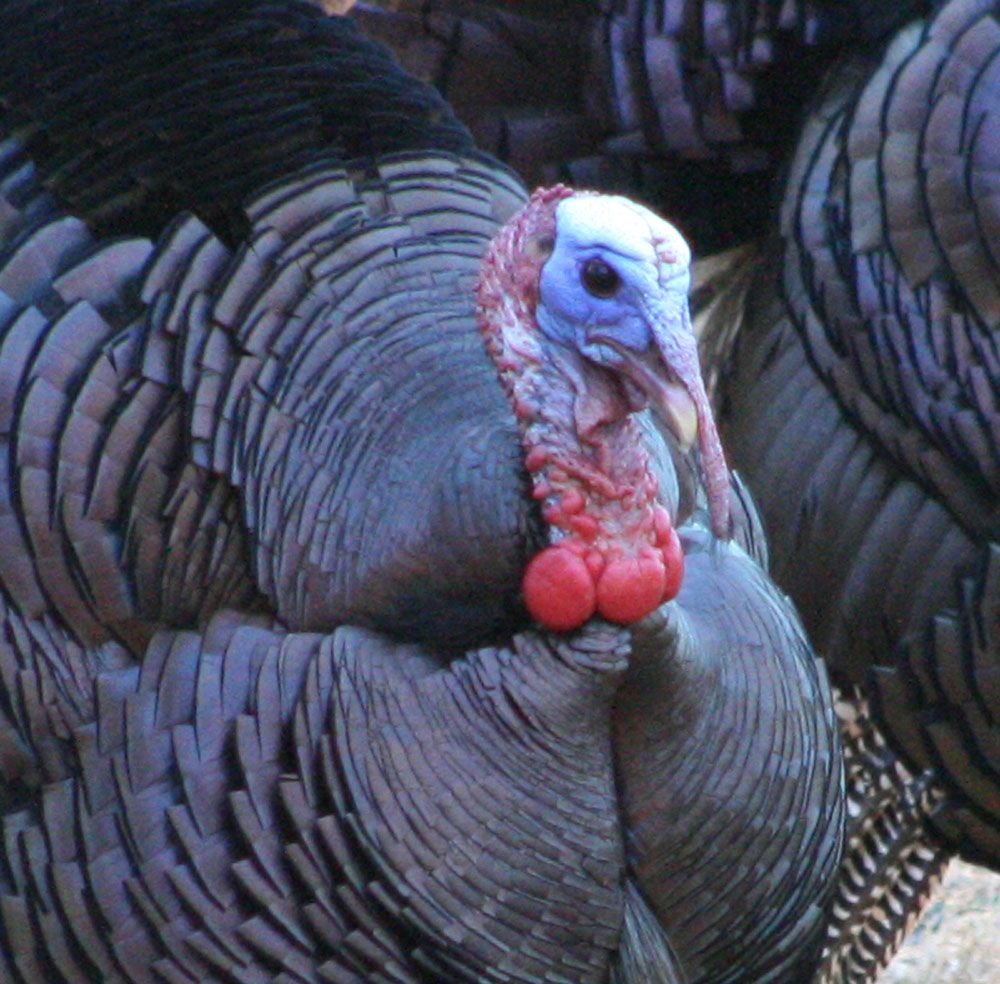
Not a combination I would have expected, bluebirds and wild turkeys.  But I will say, it made for a very satisfying morning in the yard! And when I looked through the photos later, I became intrigued with the Tom's faces. What a menacing expression they create by engorging their skin and enhancements.
I didn't quite capture that expression in my sketch, mostly because I think they are so much fun! I'll show you a portrait still in progress. There is nothing like the wonder and the intimacy of trying to capture a turkey's expression in watercolor!
Related Links:
More about the turkey's anatomy with sketch: A Turkey Work of Art
Click here to see Wild turkey in the snow and learn about their unique feather characteristics.
More about Eastern Bluebirds.  Watch for my upcoming article on the bluebird and Tree Swallow nestbox trail at Seven Islands Wildlife Refuge in the March/April issue of the TN Conservationist.
Related Posts Plugin for WordPress, Blogger...

Ocean Trail at Palos Verdes Nature Preserve, California--2015

Ocean Trail at Palos Verdes Nature Preserve, California--2015

Bird-banding at Seven Islands State Birding Park--2014

Bird-banding at Seven Islands State Birding Park--2014
Photo courtesy of Jody Stone

Bird-banding at Seven Islands

Bird-banding at Seven Islands
Photo courtesy of Karen Wilkenson

Enjoying Gray Jays in Churchill!--2014

Enjoying Gray Jays in Churchill!--2014
Photo courtesy of Blue Sky Expeditions

Smithsonian National Zoo with one of my Whooping Crane banners and son, John--2014

Smithsonian National Zoo with one of my Whooping Crane banners and son, John--2014

The Incredible Muir Woods near Stinson Beach, CA--2014

The Incredible Muir Woods near Stinson Beach, CA--2014
Photo courtesy of Wendy Pitts Reeves

Me and Denali--2012

Me and Denali--2012
Photo courtesy of Bob King

For the Love of It...

...the sage sees heaven reflected in Nature as in a mirror, and he pursues this Art, not for the sake of gold or silver, but for the love of the knowledge which it reveals.
Sendivogius (1750)

Your Uncapped Creativity...

Your Uncapped Creativity...
"There is a vitality, a life force, an energy, a quickening that is translated through you into action; and because there is only one of you in all time, this expression is unique. If you block it, it will never exist through any other medium and it will be lost. The world will not have it. You must keep that channel open. It is not for you to determine how good it is, nor how valuable. Nor how it compares with other expressions. It is for you to keep it yours, clearly and directly." ----the great dancer, Martha Graham