Showing posts with label Rose-breasted grosbeak. Show all posts

Sunday, October 11, 2020

Rose-breasted Grosbeaks, Red-breasted Nuthatches and a Hairy Woodpecker!

Juvenile Rose-breasted Grosbeak watercolor sketch by Vickie Henderson

For those of us who love birds and love to watch them, we have a ready-made source of enjoyment no matter where we are. Autumn, a season of migration, presents delightful opportunities to see birds that only visit our yards briefly enroute to wintering grounds. This season, the birds that caught my eye were the colorful Rose-breasted Grosbeaks.
Even though Rose-breasted Grosbeaks are feeder friendly, they are also shy, a shyness almost equal to our flighty American Goldfinches. Definitely not the boldness of the Carolina Chickadees, Tufted Titmice or Northern Cardinals that frequent the feeders. I had snapped a couple of grosbeak images through the window, but did not find these very satisfying, especially since the red, brown and black patterns on each immature bird varied so greatly and were so much fun. Natural birdy watercolors. Splashes of color and unique shapes while feathers morph into patterns that more resemble parents. 
Hoping to be as non-threatening as the stone wall behind me, I settled myself on my porch a distance away, camera in hand. Being still has its rewards! My first surprise was the arrival of our resident male Hairy Woodpecker. He alerts all to his presence with his loud chirps, much to my appreciation. I loved that he hung around on a trunk for a few photos while he checked out the rainy day crowd at the feeders.  
Next, Red-breasted Nuthatches! An irruptive species that we only see in Tennessee when conditions bring them farther south for food.  Fiesty little nuthatches with distinctive personalities, they fly in fearlessly and leave just as swiftly except when they want to display a nut meat? 
This nuthatch held his nut piece high in the air and turned his head this way and that way, as though displaying it to other nuthatches? 
Later I heard a "convention" of nuthatches over my head having a big discussion, everybody "talking at once"! "Toutie, tou, tou, tou, toutie-tou." I even searched for an owl as a possible reason for their excited vocalizations. I would have loved to have been able to count them. Just how many nuthatches was I seeing and hearing? Was it just two or a whole flock?  
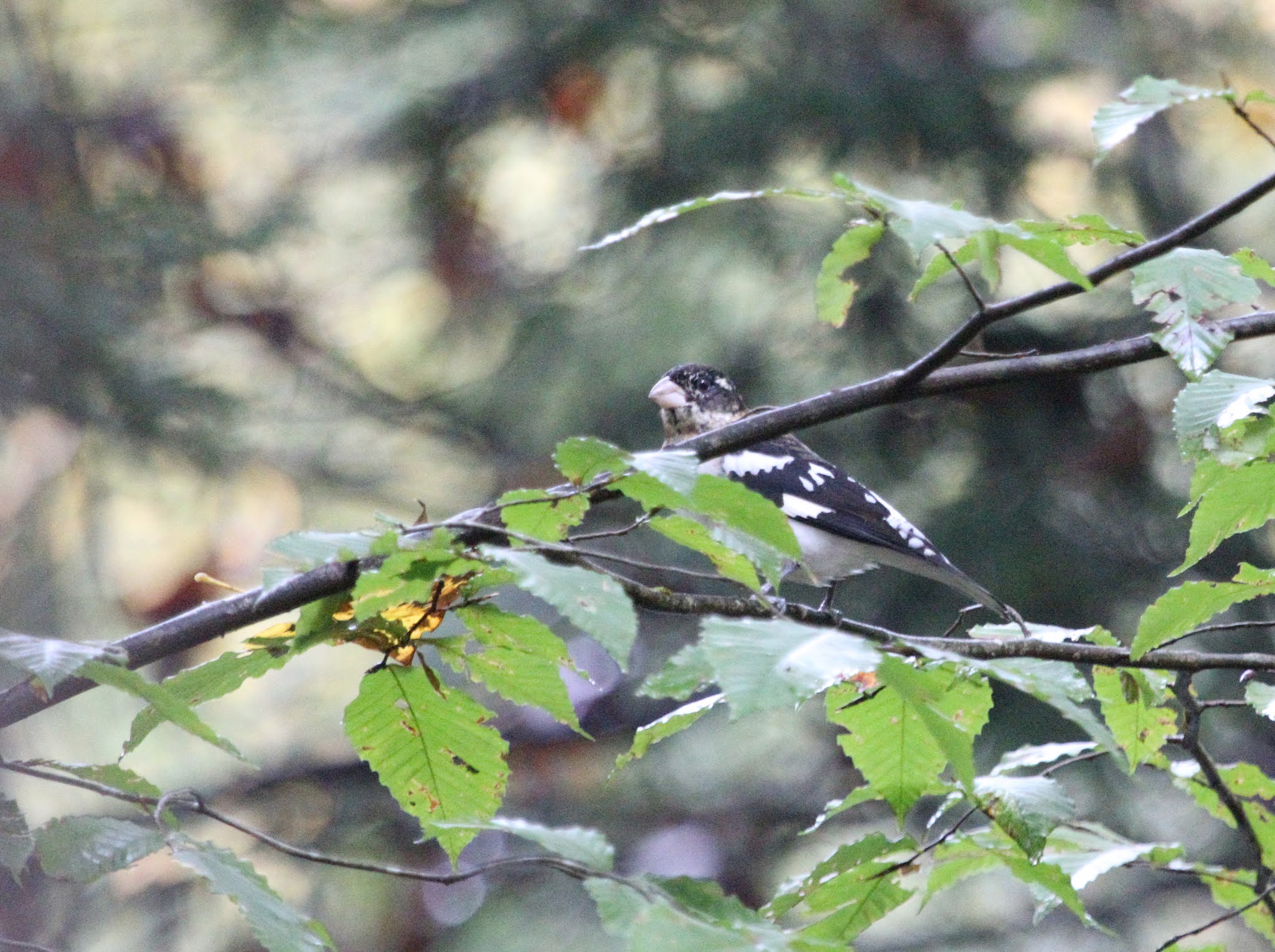
I did find a shy immature male Rose-breasted Grosbeak, hiding in the leaves near the feeders. Patience rewarded me with a clear view as he finally ventured more into the open after a few minutes. 
Without a doubt, being still draws you deeper into the natural world around you, stirring renewal and wonder. For an instant, you are present, transported, and a part of it. Alive and curious.  Armed with more questions than answers, you leave that moment reluctantly but satisfied and eager to do it again!

Tuesday, October 18, 2011

The Excitement of Fall

I love fall. I love the crisp air, the changing leaves, the migrating birds passing through. And I love my patio and my bird bath. The patio with the deck overhead provides a sheltered place for me to relax and take everything in, even when its raining. And I never know what I might see. Sunday, for example, the unexpected.
Already seated, I had looked down at something, then up again to find a male bluebird drinking from the birdbath right in front of me.  I caught my breath, feeling so excited to see a bluebird so close again.  My resident bluebirds hatched their second brood in late summer.  When the juveniles fledged, the parents only brought them back to the feeder area a couple of times, then they were gone.  I mean, completely gone.
Without the need to protect their nesting territory for another nesting attempt, they had no reason to stay once the second brood juveniles fledged. This movement to different hunting grounds is an important survival behavior. The longer the bluebird family stayed in the nesting area, the more likely predators would detect the inexperienced fledglings.    
The male flew up to a low branch and perched for a while, partially concealed by the leaves. I picked up my camera thinking he might return for another drink, but instead, his companion, a female, landed on the birdbath and drank.  What a pleasure.  It may seem like such a simple thing, but there are few things more beautiful or peaceful than sharing an intimate moment with a bird as it goes about its ordinary daily activities, seemingly undisturbed by your presence.  (All the Eastern bluebird images you see here are of the female.)  
And bluebirds are so quiet when they approach.  They land with no fuss, no scolding, utter silence.  And just as quietly, the female departed, joined in flight by the male as they flew in the direction of the front yard.  They did not visit the mealworm feeder even though it had mealworms in it.  I added them earlier when I first heard a bluebird singing near the yard.  Maybe this pair was not familiar with mealworm feeders or maybe food is too plentiful this time of year for the feeder to draw their interest.  But that's okay.  The mealworms are not wasted.  Most of the time, the titmice empty the feeder.  Sunday, Carolina wrens also shared in the feast.  It was while watching the Carolina wren at the feeder, that I spotted the hummingbird that also visited that morning.    
A shy visitor, female or juvenile, she came back to the feeders several times but did not linger very long during any one visit. I was glad I happened to see her since she was the first hummingbird I've seen since Oct 9th. There are fewer and fewer hummers coming through now, generally late juveniles and late nesting females.  It's easy to miss them and mistakenly think all the Ruby-throated hummingbirds have departed.  This sighting on the16th of October is actually the latest date I've recorded a hummingbird in my yard in east TN in the fall.  But even after November 1st, it is a good idea to leave at least one feeder out through the winter months.  Other species of hummers have been documented in the east in the winter, and there are even a few records of Ruby-throats. In all, fourteen species have been documented in the eastern United states: Ruby-throated, Black-chinned, Rufous, Allen's, Broad-tailed, Anna's, Costa's, Calliope, Buff-bellied, White-eared, Green Violet-ear, Magnificent, Broad-billed and Green-breasted Mango.  If you see a hummingbird after November 1st, contact Bob and Martha Sargent at Rubythroat@aol.com or 205-681-2888.
I certainly don't need three feeders out this time of year, but I think of them as welcome flags, along with the flowers that are still blooming, advertising an oasis for thirsty, late travelers.  Below, a female Rose-breasted grosbeak that visited my sunflower feeder a week ago.  She is just passing through, on her way to the West Indies, Mexico or South America to spend her winter. Many migrants are passing through our yards this time of year, both seen and unseen.  
Fall is a beautiful, exciting time of year!

Next post: Fall color and more fun around the bird bath.

Links and Resources:
Blog posts on the bluebird family that nested in my yard during the 2010 breeding season.
Visit these links to see juvenile bluebirds enjoying a bath and my experience with feeding mealworms.

Learn more about how bird banding helps us learn about hummingbirds.  
Visit the Hummingbird Study Group to learn more about hummingbird species.
Contacts for reporting sightings of hummingbirds during winter months in the east: Bob and Martha Sargent, Rubythroat@aol.com or 205-681-2888
Posts about Ruby-throated hummingbirds on this blog.
Related Posts Plugin for WordPress, Blogger...

Ocean Trail at Palos Verdes Nature Preserve, California--2015

Ocean Trail at Palos Verdes Nature Preserve, California--2015

Bird-banding at Seven Islands State Birding Park--2014

Bird-banding at Seven Islands State Birding Park--2014
Photo courtesy of Jody Stone

Bird-banding at Seven Islands

Bird-banding at Seven Islands
Photo courtesy of Karen Wilkenson

Enjoying Gray Jays in Churchill!--2014

Enjoying Gray Jays in Churchill!--2014
Photo courtesy of Blue Sky Expeditions

Smithsonian National Zoo with one of my Whooping Crane banners and son, John--2014

Smithsonian National Zoo with one of my Whooping Crane banners and son, John--2014

The Incredible Muir Woods near Stinson Beach, CA--2014

The Incredible Muir Woods near Stinson Beach, CA--2014
Photo courtesy of Wendy Pitts Reeves

Me and Denali--2012

Me and Denali--2012
Photo courtesy of Bob King

For the Love of It...

...the sage sees heaven reflected in Nature as in a mirror, and he pursues this Art, not for the sake of gold or silver, but for the love of the knowledge which it reveals.
Sendivogius (1750)

Your Uncapped Creativity...

Your Uncapped Creativity...
"There is a vitality, a life force, an energy, a quickening that is translated through you into action; and because there is only one of you in all time, this expression is unique. If you block it, it will never exist through any other medium and it will be lost. The world will not have it. You must keep that channel open. It is not for you to determine how good it is, nor how valuable. Nor how it compares with other expressions. It is for you to keep it yours, clearly and directly." ----the great dancer, Martha Graham