Showing posts with label spring. Show all posts

Sunday, April 1, 2012

Eastern Bluebirds--Landlord or Local Diner?

Bluebirds can leave you scratching your head from day to day, wondering what their plans are for that empty nest box.
This morning a pair of Eastern bluebirds landed on the limbs overhead almost instantly when I signaled with a whistle that the mealworm diner was now open for customers.  I had barely closed the feeder top when the pair appeared, singing softly.  I sat on the patio and watched as first the male and then the female visited the dish of mealworms. It was especially gratifying to hear the female's contented chirps as she fed.

The male patiently waited for her to finish, and then, poof, they were gone, the nest box serving as nothing more than a perch in route to the feeder.
After they left, I watched a male tufted titmouse repeatedly visit the feeder and return to a limb to feed his waiting mate.  This was definitely a smile-worthy observation.  I have no idea where they are nesting but it is certainly somewhere nearby.  The male frequently declares his territory with song and raspy scolding notes.  The bluebirds, on the other hand, make me wonder if they are nesting elsewhere and simply stopping by for a snack at the local diner.
As recently as a week ago, the male and female landed on the nest box together and exchanged excited communications, both chattering and wing-waving.  Above, you see the male wing-waving to encourage the female to join him on the next box.  And below, she has landed on the guard, preparing to check out the nest box.  Wing-waving, an alternating series of wing lifts, is expressed by both the male and the female and seems to signal a greeting and encouragement that reinforces the pair bond during the breeding season.
If it were not for last year's records, I would have given up hope that I will have a nesting pair of bluebirds this season.  My notes show that on April 8th of 2011, the pair that raised two broods last season in this nest box had not yet claimed it.  In mid March the wintering flock dispersed as one pair of bluebirds in their midst vigorously chased away flock mates and flock members dispersed in search of breeding territories and mates.  And while some bluebirds may still be searching for nest sites, many pairs in our area have already nested and are incubating eggs.
On the other hand, I have a decisive pair of chickadees in charge of my second nest box.  A Carolina chickadee (above) is building her nest right on schedule with last year's nesting record.  When I last checked the box on March 30th, the female had completed her thick base of moss and was placing a layer of soft grasses, hair, downy feathers, and other soft materials over it to begin forming the nest cup.
Chickadee nests are so soft and neat, astoundingly lovely.

Links and resources:

For stories and images of last season's nesting bluebirds, visit:  Bluebird Family.  And for more on Carolina chickadees visit my chickadee posts.

Also please visit my new book:  Red-shouldered Hawk Territory, A sketchbook journey through nesting season.  The book will be ready for shipping by April 12th and contains my sketches, field notes and the stories and photos that unfolded during four-months of observing a nesting pair of red-shouldered hawks.  You can visit some of those stories and images on this blog by clicking: Red-shouldered hawks. Scroll to the bottom to read earliest posts first.

Friday, April 1, 2011

It's April and Spring is Here

Of course April 1st isn't the official day of spring, neither is it a guarantee of anything spring about the weather. Yesterday's report called for snow in the higher elevations. And if I needed confirmation, this morning I found two "snow birds"--slate-colored juncos--foraging just outside my door. Maybe those mountain tops did get that dusting of snow.
But the story about white stuff is very different down here in the valley.
While fruit trees are still showing color everywhere, in my yard I'm also enjoying the early opening of dogwood blossoms as they overlap the sprays of purple and pink displayed by the redbud trees.  Always a spectacular combination.   
And on the ground among patches of moss and pale bluets, I searched out the Virginia bluebells and found both fresh pink buds and the delicate blue bell-shaped blossoms.

One other plant has been catching my attention lately, the wild columbine that's getting ready for its first year of bloom.  I thought it had sprouted its delicate green leaves too soon when three weeks ago it was pelted by sleet and snow.  Hard rain and high winds followed.  Despite its delicate appearance, this hardy native showed no wear from all that bluster.    
Its strong stalk shot up, seemingly overnight, and produced tiny lantern shaped buds on arched stems.  Below is an image I took today showing the immature buds with a hint of the scarlet that will eventually dominate each blossom.  While I watch it change, I think of the large clump of columbines my mother once had in her yard and the stories she told of searching for wildflowers along the banks of the Tennessee River.  I'm also reminded of the hardiness of our native plants and the perfection in nature's timing as I see these spring flowers emerge. This columbine has become like a companion, its steady progress telling a story, offering up a new treasure for me to consider with each passing day.  
And while I was out and about checking for signs of spring, I paid a visit to the nest box in the lower yard.  A little over a week ago, I noticed a Carolina chickadee gathering nesting materials and flying in and out of the box.  Today I decided to check on the progress and found six tiny speckled eggs nestled in the softly lined nest cup.  An indignant Ms.Chickadee scolded me while I snapped this image.  
Spring has arrived in the Tennessee Valley.

For a view of the nest box, visit:  Wild Turkey and Eastern Bluebirds.  And for a sketching experience with Bluets and Virginia Bluebells, visit Fumbling En Plein Air at Vickie's Sketchbook.

Monday, February 21, 2011

A Spring Head-dress and a Heart-stopping Thrush

This female northern cardinal visiting the bird bath for a drink gave me my first belly laugh of the day.     
Her plumes on her crest stood up like flames in the wind.  Despite the winter-y blast of heavy snow in the mid-western states, we're having mild temperatures and blustery pre-March winds in Tennessee.  And if that weren't enough to hint of spring, birds are showing signs of spring molting.  Just twelve days ago, I snapped the image below, of a female cardinal in the snow.  She was fluffed and warm in her thick winter plumage.   But in the days since, we've had more moderate weather with some days reaching as high as the 70's F.
My Atlas of the Breeding Bird of Tennessee says, "In late February and March, cardinals form stable, monogamous pair bonds. Both the male and female defend the territory with song, displays, and mild combat."   Females pick the nest site usually in April but as early as mid-March, meaning that the tolerance of communal winter foraging is about to end, replaced by freshened spring plumage and territorial attitudes.
Along with the tattered and comical appearance of her crest, feathers have molted around this cardinal's face. New feather sheaths will emerge quickly where old feathers have been shed and fresh ones will rapidly grow to replace the lost ones.  This female's colors are beautiful, nonetheless, even though she wears a wind-blown look.  I couldn't be sure if she was on the alert or if the wind was standing her remaining crest feathers up so tall.
The watering hole is definitely a fun place to hang out, a good place to watch the tall pines, oak and maples waving in the gusting wind, as well as, to see birds that may otherwise go unseen as they come for a drink.  Several times I've seen a yellow-rumped warbler both drink and forage near the feeders but, so far, not when I'm outside with the camera.
Today I enjoyed a better look at the beautiful streaking and contrast in an American robin's plumage as she braved the birdbath for a drink.  When she flew, my heart picked up a beat, as a hermit thrush popped in to replace her, its 7-inch stature seeming exceptionally petite next to that of a robin, ranging from 9 to 11 inches.
It was special to get lingering looks at this shy bird, standing tall on tiny legs.  More often I notice her hanging out in the shadows of the hemlock, impossible conditions for a good photo, and visits to the birdbath are usually glimpsed through the window.  This made today's surprise visit exceptionally appreciated and I fell in love with the wind-blown look below!
Hermit thrushes are best known in Tennessee as a migrant and wintering resident, generally arriving in October and departing by early April.  Breeding seasons have only been sparsely recorded in Tennessee in the higher elevations of Roan Mountain and the Great Smoky Mountains (Atlas of the Breeding Birds of TN, ed. Charles P Nicholson.)

When this thrush turned, giving me nice looks at her body proportions and rust tail, I thought she was leaving.      
But she lingered a few minutes longer and reached from the side to take several more drinks.  Sigh.  One of many special moments enjoyed in the backyard.  
Links and Resources:
Atlas of the Breeding Birds of Tennessee, edited by Charles P. Nicholson.  This book is out of print and pricey on the secondary market, but with patience, you may find lowered pricing on Amazon with time.  
And more about cardinals and molting in A Day-making Family of Cardinals

If you have not already signed the petition requesting a new management plan for the Eastern Population of Sandhill cranes, visit the petition site right now and voice your opinion on this important conservation issue.  Kentucky is battling a sandhill crane hunting proposal similar to the one deferred in Tennessee.  We have a lot of work left to do to protect this population that has only recently recovered from near extirpation.  To read more visit A New Plan for Eastern Sandhills.    

Linked to Bird Photography Weekly #130 at Birdfreak.com to promote the conservation of our world's birds.

Monday, May 12, 2008

Magnolia Warbler

Here’s my fourth warbler this week, the Magnolia warbler. In the photo he’s a speck and a bit of a fuzzy one at that, but let me tell you the story about why these photos make me so happy.
Once, about seven years ago, I went out with a group of experienced birders to find migrating warblers. I had no idea what this would be like. (Mind you, seven years ago, I wasn’t quite as hardy as I am today.) On that spring morning, person after person called out the names of warblers. They named them by song. They found them in the trees. They counted them out, one by one, by one, lots of them.

I saw nothing. I heard nothing. I found nothing, no matter how people near me tried to help. On that morning I faded away and soon left in tears.

I haven’t really thought about that experience since then--until now. To have these illusive little birds come visit me in my yard, to find them almost effortlessly and to identify them with these fuzzy photos while looking in my field guide—this gives me great joy. It’s as though they hurt my feelings on that day and have come by to mend them. And that makes me laugh.They are beautiful. And they are funny. And they travel thousands of miles against great odds to return to their breeding grounds in the spring. We are so very lucky to have them. --I think I may have to paint them one day soon.

Sunday, May 11, 2008

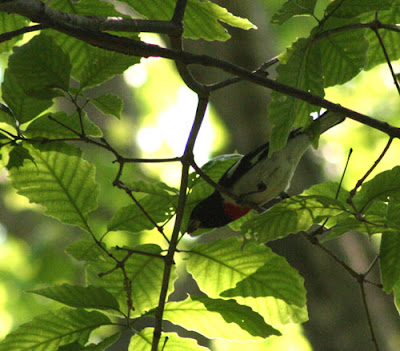
Rose-breasted Grosbeak

It was the towhee that introduced us. I see him occasionally, hear his song daily and yet, the only photo I’ve been able to capture of my towhee friend is the silhouette of him singing in the rain in early March. So now and then, when I hear him nearby, I grab my camera and out the door I go.
Last week he led me to the edge of the woods where the wood thrush was singing. Then someone landed on the limb above my head. I looked up and to my surprise, it was this rose-breasted grosbeak. And he stayed for a while. He entertained me moving about on the branches, picking and feeding. I later came back with a chair and some real shoes. (Ants love sandals.) And this is when I also met two warblers. In all I've met four new warblers right here in my own yard, migrants visiting to rest and feed.
Last evening a cat bird was calling outside my window, very mew like, as everyone was settling down for the night. Earlier that morning two brown thrashers were perched together in the dogwood, near that same spot. It’s a wonderful time of year. Expect the unexpected.

Tuesday, May 6, 2008

Global Migrants--Blackburnian Warbler

I live in a river valley, right on the edge of the Great Smoky Mountains in the Cumberland mountain range. One of the fun things about living here is the rich variety of flora and fauna and the wide diversity of climate and habitat. Besides all the plants and trees in successive bloom this time of year, it is peak migration season. Many migrants are newly arriving and others still passing through to their nesting grounds. Among these are the illusive woodland warblers, tiny little birds that you often hear but barely glimpse as they pass. But yesterday was an exceptional day. A Blackburnian Warbler, a striking little bird with a bright orange head, perched on a branch near me, flittered about and sang a whispery song that seemed to shake his whole body. Such a gift to our world. These are one of the many migrants that unite and brighten the globe with their journeys, in this case, as far south as southern Central America and northern South American in the winter, with some traveling as far north as Canada to summer breeding grounds.

Taking care of our earth and its creatures means taking care of each other.

Sunday, April 20, 2008

Witch Hobble and Practice

“Don’t be afraid to answer the questions. You will find endless resources inside yourself....Even if you are not sure of something, express it as though you know yourself. With this practice you eventually will.”
--Natalie Goldberg, Writing Down the Bones
Witch Hobble is a common name for this variety of viburnum, a native shrub that grows mostly in the northeast but extends as far south as east Tennessee. Each intriguing blossom is like a factory producing a whole village of tiny flowerettes, all of which, are encircled by graceful, snowy white petals. Witch Hobble? Don't you just wonder about the story behind this name?

Monday, April 14, 2008

Dogwood Winter

It's a wet, wintery Dogwood day. We expect this when the Dogwoods bloom, another blast of wintery cold, sometimes harsh, other times, fleeting. The native Dogwoods are a hardy bunch and what I noticed today in the cloudy gray is their crimped blossom edges have a richer, crimson hue.
Lots of cool, drippy gray to show off this blushing beauty.

Tuesday, April 8, 2008

Quaker Ladies

"Pale as noonday cloudlets are,
Floating in the blue,
This little wildwood star
Blooms in light and dew...."

--Ellen Mackay Hutchinson Cortissoz, Quaker Ladies, 1900 I found these dainty Quaker Ladies nodding with rain droplets on a sparsely wooded slope among mosses and leaves. Kin to the woodland Bluet, these exquisite little flowers dot meadows and wooded clearings from April to May with a happy sprinkling of blue sky.

Monday, April 7, 2008

Red Bud Visitor

I didn’t expect to find a snail in the tree. In fact, I missed it altogether, at first glance, its speckled brown patterns blended so well with the bark. I confess that I've never been a great fan of the slippery sluggery sorts. But then you can’t help but feel fascinated with a creature that carries its eyes at the end of tentacles and sports another set of tentacles for its sense of smell. A soft bodied gastropod that can’t hear, moves slowly and has poor sight, yet has been known to live fifteen years? There must be some wisdom we can glean from that.
--Brown Garden Snail

Saturday, April 5, 2008

Eastern Red Bud

The Eastern Red Bud parade is in progress. One of our native flowering trees, it sprinkles shades of purple and pink and magenta all over the country side, peeping out among still-bare deciduous trees, peppered along pastoral hillsides, brightening the roadsides everywhere. Native plants do that. They are happy, non intrusive and hardy. I visited several near my home between drizzling rains, just before the dark clouds moved in again. The blossoms sprout from everywhere, all over the tree’s branches, in what seems to be no particular order, although, you can be sure there is perfect order. Nature is the embodiment of order. Everything is connected to everything else, the tree, its roots, the sky, its rain, the visitor, its life cycle, and on and on it goes--a circle of connection--refreshing, renewing and alive.

Tuesday, March 18, 2008

Creative Possibilities

I had no idea I would get so caught up in this project, the changes, the variations in light, the softness captured by the macro feature of the camera (Canon Rebel Xi). It's been a study of light and of seeing--endless possibilities, endless discoveries, as if painting without a brush.
Lots of irregular shapes and leafing out in day three images.

Sunday, March 16, 2008

Drippy Crabapple Blossoms

I so enjoyed this yesterday. In only a few hours, everything had changed. Gone were the airy petals of the morning. The storm left the blossoms drippy with rain. A March wind remained, shifting the clouds, changing the light, making the limbs sway and blossoms shiver. I was glad I took the time to visit. I would have seen the tree, but missed these amazing blossoms.

Related Posts Plugin for WordPress, Blogger...

Ocean Trail at Palos Verdes Nature Preserve, California--2015

Ocean Trail at Palos Verdes Nature Preserve, California--2015

Bird-banding at Seven Islands State Birding Park--2014

Bird-banding at Seven Islands State Birding Park--2014
Photo courtesy of Jody Stone

Bird-banding at Seven Islands

Bird-banding at Seven Islands
Photo courtesy of Karen Wilkenson

Enjoying Gray Jays in Churchill!--2014

Enjoying Gray Jays in Churchill!--2014
Photo courtesy of Blue Sky Expeditions

Smithsonian National Zoo with one of my Whooping Crane banners and son, John--2014

Smithsonian National Zoo with one of my Whooping Crane banners and son, John--2014

The Incredible Muir Woods near Stinson Beach, CA--2014

The Incredible Muir Woods near Stinson Beach, CA--2014
Photo courtesy of Wendy Pitts Reeves

Me and Denali--2012

Me and Denali--2012
Photo courtesy of Bob King

For the Love of It...

...the sage sees heaven reflected in Nature as in a mirror, and he pursues this Art, not for the sake of gold or silver, but for the love of the knowledge which it reveals.
Sendivogius (1750)

Your Uncapped Creativity...

Your Uncapped Creativity...
"There is a vitality, a life force, an energy, a quickening that is translated through you into action; and because there is only one of you in all time, this expression is unique. If you block it, it will never exist through any other medium and it will be lost. The world will not have it. You must keep that channel open. It is not for you to determine how good it is, nor how valuable. Nor how it compares with other expressions. It is for you to keep it yours, clearly and directly." ----the great dancer, Martha Graham