Showing posts sorted by relevance for query spruce grouse. Sort by date Show all posts

Sunday, December 21, 2014

Spruce Grouse in Riding Mountain National Park

One of the Spruce Grouse's primary defenses against predators is the disruptive coloration of its plummage, tricking the eye and enabling the bird's shape to blend with its surroundings.  In addition to this camouflage, the grouse instinctively stops, remaining perfectly still in the presence of a predator.  This behavior makes them very hard to see!  
Christian Artuso, our guide while bird and mammal watching at Riding Mountain National Park in Manitoba, was an expert at spotting birds, both finding them as he was driving and recognizing them by sight, movement and sound.  He spotted six Spruce Grouse on the edge of the road, a very exciting moment, a bird high on my list.
We all piled out of the truck with our cameras as the birds scattered into the forest or the spruce branches on either side of the road.  Divided, they were alert and wary but did not leave the vicinity of their flock mates.
Above a male walks alertly toward the forest, and below a female sits motionless under a spruce.  If you did not know she was there, she would disappear, blending completely into the browns and grays around her.
Spruce Grouse are specialist birds that live in the northern coniferous forests, usually in remote areas, feeding on spruce and pine needles much of the year.
Our behavior giving them little reason for alarm, the birds that had flown to tree limbs, one-by-one, flew down to the ground to re-join their flock mates.  Since they seemed to be in no hurry, and even pecked at the ground around them, we, in our separate places, slowly followed.

Walking into the forest with Spruce Grouse is magical.  The thick spruce and pine needles blocked and silenced the relentless wind that had been blowing at 40 mph since our arrival.  Dense piles of peat moss and needles cushioned the forest floor so that with each step, it felt like my feet were sinking into pillows.  Even more fascinating, the grouse returned to foraging and we found ourselves walking along side them as they plucked berries and rose hips from their stems.
An example above and below, of how the female's brown, black and white markings enable her to blend right into the stems and grasses of her habitat.  Without movement, she becomes a clump of dried grass.
This is the third in a series of posts on my journey to Churchill, Manitoba to see Polar Bears including a visit to Riding Mountain National Park.
Also visit my post on the Gray Jays we encountered in RMNP:  Gray Jays--Smart, Bold, Resourceful!

More about Spruce Grouse
Camouflage and disruptive coloration in bird plumage.
Christian Artuso's blog
Riding Mountain National Park
Mooswa Resort
Learn about Polar Bears

Friday, December 26, 2014

Tail Signals from a Spruce Grouse!

I walked out of the woods and stood on the edge of the road, checking to see if any of the grouse remained in the spruce limbs.  Billie quietly alerted me, "A female just walked down to the road."  
I looked around and found her standing perfectly still, only about five feet away on a little mound of dirt and dead grass. As I mentioned in the previous post, Spruce Grouse are well camouflaged.
She clearly saw me before I saw her.  Look at the feathers standing up on her crown!  Such an intimate moment.  I enjoy observing a bird's behavior so closely.  Even though this would not be considered a "wild" interaction, she most definitely is responding to my presence, or a threat.
I stood still, but of course, raised my camera and began clicking away.  I suppose if one intends to walk away, turning your back makes sense, but that isn't all she did.  She partially fanned her tail--
--fanning one side and then the other, in alternating fashion, as she slowly walked back toward the woods to join her companions.  I wondered if the tail feathers made sounds that the birds could hear, but we couldn't.  I also wondered who the signals were intended for and what they meant.  It is possible that this is a nervous behavior, but it seemed more deliberate.  I wasn't able to find any information about this in Birds of North America, my resource for bird behavior.


I paused my camera and just followed her slowly as she re-entered the forest.  At this point I was in a different area from my own companions, and I found myself among six foraging Spruce Grouse!  I lingered until they disappeared in the brush and walked deeper into the woods.  
They were all foraging, and slowly moving, so quietly--alert, but unhurried.  A special wildlife encounter.
While visiting Riding Mountain, we enjoyed breakfast and a couple of dinners at the Fox Tail Cafe in Wasagaming, the nearest town.  Don't miss this fun cafe if you are in the area!


Fresh ingredients, cheerful, welcoming atmosphere, homemade breads, generous crisp salads and a nice selection of main dishes with pizzas served hot from the open oven shown above.
Photo credit for Foxtail images:  Foxtail Facebook page 

This is the fourth post in a series on my journey to Churchill, Manitoba, to see Polar Bears including a visit to Riding Mountain National Park.  To see all the posts click the journey to Churchill link. The most recent post will appear first.  When you reach the end of the page, click "older posts" to continue.

Next:  Moose!

Christian Artuso's blog
Riding Mountain National Park
Learn about Polar Bears

Sunday, September 2, 2018

Common Grackles Dining on Acorns

If you happen to be outside when a flock of grackles arrives, you may want to take shelter!  It may rain acorns!
When mature acorns are abundant in early autumn, flocks of grackles noisely move from tree to tree feasting on the juicy nut meats. The first time a roaming flock landed in the oaks over my house, it sounded like hail was pelting the roof.  I looked out on the deck to see leaves, twigs and pieces of acorns falling like rain from Southern Red Oaks overhanging the house and deck.
Common Grackles noisily feasting in a Red Oak.

While we usually think of grackles as feeding in fields and on the ground, they also dine in trees.  While most of the grackles were in the limbs, some were also foraging on the ground underneath, picking up fallen nut pieces. It was the nut pieces with their serrated edges that intriqued me.  I wondered how they were cracking them open. 
Some birds swallow acorns whole, like wild turkey and some species of pigeons.  They can rely on their strong gullet muscle to crush them for digestion.  Blue Jays pound the acorns with their beak to break them and eat the soft meat inside.  Grackles, on the other hand, have special mouth parts and a strong beak that equips them for breaking acorns.  Their hard palate has a projection referred to as a "keel" that extends downward.  Bird beaks are hinged but they can also flex and move side ways slightly.  Grackles push the acorn against the keel, scoring the shell until it cracks open and the soft interior is exposed.  The edges of the broken acorn look a bit like they've been primatively sawed.  The grackle eats part of the nut and the rest drops to the ground for flock mates to eat.
The acorns of the Southern Red Oak are bright orange on the inside.
The next time a flock of grackles lands in a tree in your yard, step outside to see what's going on.  It's magical.  Besides the sound of their calls and the energy of activity, they are also acrobats!  Some will be hanging upside down to reach acorns!

Resources:
A. J. Marshall, Biology and Comparative Physiology of Birds, Vol 1:  The Common Grackle (Quiscalus) has a hard keel projecting downward from the horny palate and regularly uses this in opening acorns or cracking corn.

Birds of North America/Common Grackle:  Bill has hard, internal keel projecting downward from horny palate, which is sharper and more abrupt anteriorly.  This keel extends below level of tomia [toothed projections along edge of beak] and is used as sawing adaptation to open acorns, which are often completely scored around shorter diameter and then cracked by adduction.

You may also enjoy these bird behavior posts:
Tail Signals from a Spruce Grouse
Delightful Limpkin

Tuesday, December 30, 2014

A Walk Through a Spruce Bog

Canada's boreal forests are considered to be the most intact forests on earth, with over 3 million square kilometers of intact habitat undisturbed by roads, settlements and industrial development.
Boreal forests are dominated by black and white spruce, tamarack and pine with a small proportion of deciduous trees.  The boreal forest or tiaga forms a transition zone that separates deciduous woodlands from the tundra in the north.
I enjoyed seeing the map below, showing the boreal forests around the world which helps give a perspective on how close we are to the artic region when we encounter these forests.

A spruce bog is a wetland in the boreal forest region.  


Lichen covered branches were a common sight.


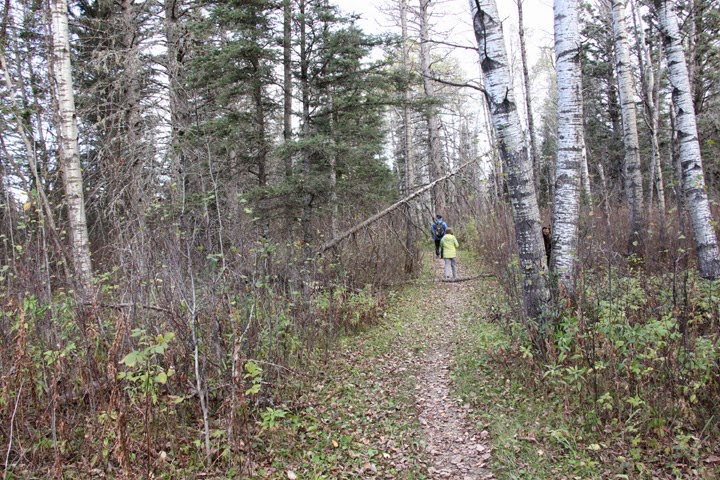
As you can see, we are still bundled up.  Strong winds continued during our entire visit to Riding Mountain, making our walk in the bog invigorating!  It was quite beautiful and serene.
In this more densely forested area, Christian pointed out trees that had been frequented by Three-toed Woodpeckers.  The outer bark of these trees is stripped from woodpeckers excavations as they uncover insect larvae.
The trees can be spotted at a distance because of their richer brown appearance.


Above and below, another site where you can identify woodpecker activity.  We wanted to SEE a Three-toed woodpecker here but did not have that good fortune.  We did see one later in another area at a distance.

We did not identify this thorny shrub above, but we did flush a couple of Ruffed Grouse, shown below, as we continued on the trail.  

When we returned to the parking area, Christian spotted a Snow Bunting. our first encounter with this species.  They are abundant in the area later in the month, and we saw many in flight as we continued on to Churchill.

This one was very cooperative!
This is the sixth post in a series on my journey to Churchill, Manitoba, to see Polar Bears including a visit to Riding Mountain National Park.  Click the journey to Churchill link to see all the posts.  The most recent post will appear first.  When you reach the end of the page, click "older post" to continue with the series.

Next:  the historic district of Winnipeg

Christian Artuso's blog
Riding Mountain National Park
More information about Boreal Bogs
Hudson Bay Buggies and Bears with Rail Travel Tours
Learn about Polar Bears
Related Posts Plugin for WordPress, Blogger...

Ocean Trail at Palos Verdes Nature Preserve, California--2015

Ocean Trail at Palos Verdes Nature Preserve, California--2015

Bird-banding at Seven Islands State Birding Park--2014

Bird-banding at Seven Islands State Birding Park--2014
Photo courtesy of Jody Stone

Bird-banding at Seven Islands

Bird-banding at Seven Islands
Photo courtesy of Karen Wilkenson

Enjoying Gray Jays in Churchill!--2014

Enjoying Gray Jays in Churchill!--2014
Photo courtesy of Blue Sky Expeditions

Smithsonian National Zoo with one of my Whooping Crane banners and son, John--2014

Smithsonian National Zoo with one of my Whooping Crane banners and son, John--2014

The Incredible Muir Woods near Stinson Beach, CA--2014

The Incredible Muir Woods near Stinson Beach, CA--2014
Photo courtesy of Wendy Pitts Reeves

Me and Denali--2012

Me and Denali--2012
Photo courtesy of Bob King

For the Love of It...

...the sage sees heaven reflected in Nature as in a mirror, and he pursues this Art, not for the sake of gold or silver, but for the love of the knowledge which it reveals.
Sendivogius (1750)

Your Uncapped Creativity...

Your Uncapped Creativity...
"There is a vitality, a life force, an energy, a quickening that is translated through you into action; and because there is only one of you in all time, this expression is unique. If you block it, it will never exist through any other medium and it will be lost. The world will not have it. You must keep that channel open. It is not for you to determine how good it is, nor how valuable. Nor how it compares with other expressions. It is for you to keep it yours, clearly and directly." ----the great dancer, Martha Graham