Showing posts sorted by relevance for query sandhill crane festival. Sort by date Show all posts

Sunday, January 8, 2012

TN Sandhill Crane Festival Celebrates Three Crane Species

Make plans to join us at the Tennessee Sandhill Crane Festival, January 14th and 15th at the Hiwassee Wildlife Refuge and celebrate three crane species!  
Photo credit: Mike Nelson (see links below).  A Greater Sandhill Crane flying over the Hiwassee Wildlife Refuge.

The Hiwassee Wildlife Refuge has had a rare visitor that has stirred excitement in the bird-watching world.  A Hooded crane, native to Asia, has found its way to the refuge, located near Dayton and Birchwood, TN, along with thousands of sandhill cranes and the endangered Whooping cranes that visit the refuge in the winter months to rest and feed.
Photo credit:  Mike Nelson.   Hooded crane (dark gray with white neck) with sandhill cranes at Hiwassee Wildlife Refuge in Tennessee. 

As of January 7th, more than 2388 visitors, representing nine countries and the Commonwealth of Puerto Rico, and 40 states and the District of Columbia, have visited the Hiwassee Wildlife Refuge since the Hooded crane was first reported on December 13th.   
As many as eight endangered Whooping cranes (above) have been present on the refuge at one time during this migration and wintering season, and usually one or more is visible from the viewing platform.  The presence of wintering Whooping cranes is attributable to the Whooping Crane Eastern Partnership's (WCEP's) two re-introduction programs:  Operation Migration's ultralight-led migration, and the Direct Autumn Release program.  

Whooping crane juveniles must learn their migration route from their parents. Beginning in 2001, Operation Migration, a founding WCEP partner, has led groups of juvenile whooping cranes each fall on their first southerly migration journey through Tennessee to wintering grounds in Florida. These cranes then find their way back to their fledging grounds in Wisconsin in the spring, unassisted by humans, and migrate on their own the next fall. The beautiful cinnamon and white juvenile whooping cranes you see on the refuge have been captive-reared by the International Crane Foundation in Wisconsin and released in the Direct Autumn Release program.  They have arrived at the Hiwassee Wildlife Refuge by following another more experienced Whooping crane or joining a flock of migrating sandhill cranes.  
Photo credit:  Mike Nelson.  Two juvenile Whooping cranes (cinnamon and white) and one mature whooping crane foraging and preening with sandhill cranes at the Hiwassee Wildlife Refuge.  

The Hiwassee Wildlife Refuge is a major staging area for migrating cranes in the east where they rest and feed along their migration journey.  Staging areas are important stop-over sights where cranes replenish nutrients, add weight, and come in contact with other cranes for potential pairing.  This is especially important for our eastern Whooping crane population which now numbers around 104 birds.  

The Tennessee Sandhill Crane Festival presents a wonderful opportunity to learn about birds and see the rare occurrence of three species of cranes foraging together in a staging wetland.  There is no other place in North America where you can see three species of cranes together, and no other place in the world where three crane species will include the endangered Whooping crane.  Add to this, the treat of seeing thousands of eastern sandhill cranes that were once on the brink of extinction, and you have a rare opportunity for winter bird viewing that you won't want to miss.
Above, you see the cover of the Discover Birds Activity Book, illustrated and authored by yours truly, as a special activity for children who attend the festival. The twelve-page booklet is sponsored by the Tennessee Ornithological Society (TOS) and was coordinated and produced by TOS member and co-chair of the festival, Cyndi Routledge.  It contains fun information about wintering birds, images for children to color and a crossword puzzle to challenge young (and adult) minds.  You will find this book at the TOS exhibit table at the festival!

The festival is co-sponsored by TOS, the Tennessee Wildlife Resources Agency (TWRA), and the Barbara J. Mapp Foundation, and is free to the public.  TWRA personnel will be available to answer questions about the refuge and the wildlife conservation work of the Agency. TOS members will be present at the viewing area to share their birding scopes and their knowledge of the birds you will find there, including bald eagles and many ducks and geese.
I am one of those TOS members and will also be available to answer questions on both days of the festival, so find me and say "hello".  I would love to meet you!

Links and Resources:

Mike Nelson's Flicker site with Hooded crane video and photo stream
Morgan Simmons Jan 10 article Knoxville News Sentinel:  Rare Crane Joins Hiwassee Flock
Make your plans to attend the Tennessee Sandhill Crane Festival
Directions to Birchwood and the Hiwassee Wildlife Refuge
Sandhill Crane Festival Schedule of Events
Tennessee Ornithological Society
Tennessee Watchable Wildlife on Sandhill Cranes
Tennessee Wildlife Resources Agency:  TN Sandhill Crane Festival
Hooded Crane is Season's Gift by Marcia Davis
Times Free Press--Rare Hooded Crane Seen
International Crane Foundation on the Hooded Crane

At my companion blog, Vickie's Sketchbook:  Sandhill Cranes and Art

Top Crane Posts on this blog:  Hooded Crane at the Hiwassee Wildlife Refuge in TN
Crane Magic--Three Crane Species at Hiwassee

Whooping Crane Reintroduction links:
The 2011 ultralight migration class is currently grounded in Alabama due to an FAA technical investigation.  We hope this issue will resolve soon so the juvenile Whooping cranes can continue their southern migration.  Stay up to date on the migration progress by visiting Operation Migration's field journal.
Whooping Crane Eastern Partnership--Direct Autumn Release Program
International Crane Foundation
On this blog:  Whooping Crane Family Series

Linked to Bird World Wednesday at The Pine River Review
Linked to Bird Photography Weekly at Bird Freak.com

Monday, January 16, 2012

Tennessee Sandhill Crane Festival and It's Cranes

A spectacular watchable wildlife event!   
Above you see thousands of sandhill cranes lifting off at the Hiwassee Wildlife Refuge as something unidentified stirs them all at once.  The rare Asian hooded crane, which was in clear view several times during the Tennessee Sandhill Crane Festival on Saturday, is among the flying birds.  

The Hiwassee Wildlife Refuge is one of the largest sandhill crane staging areas in the east, second only to Jasper-Pulaski Fish and Wildlife Area in Indiana.  Sandhill cranes stop-over at the Hiwassee Wildlife refuge near Dayton, TN to feed and rest as they migrate south to Georgia and Florida for the winter.  As many as 10,000 may remain, over-wintering in Tennessee.
Watching and listening as thousands of cranes take flight is an awe-inspiring experience.  I never fail to wonder how they keep from colliding.  With a wing span of 6-7 ft and so many in flight at once, it is certain they must bump each other. But clearly this doesn't interfere with their spectacular unison flight that at first travels in one direction, then divides into spiraling layers as they catch thermals and glide in search of another safe resting place (shown below).
More than 2200 people enjoyed the sandhill crane viewing at the festival on Saturday and close to that number were present on Sunday.

The festival was sponsored by the Tennessee Ornithological Society (TOS), Tennessee Wildlife Resources Agency (TWRA) and the Barbara J Mapp Foundation.  Two of these sponsors are represented in the image below.
From left to right:  John Noel (TOS), Melinda Welton (TOS), festival co-chair; Ed Carter, TWRA Executive Director (with raised glasses viewing the hooded crane), and Kirk Miles, TWRA Region III, Wildlife Program Manager.  Cyndi Routledge (TOS) also co-chaired the festival activities, along with Dan Hicks (TWRA).  Events were coordinated among three sites, the Birchwood School, the Hiwassee Wildlife Refuge observation area, and the Cherokee Removal Memorial, where educational displays, interpreters, presentations and refreshments were available for festival participants.
According to the 2006 USF&WS Survey of Fishing, Hunting and Wildlife Related Recreation, more than 87 million Americans or 38% of the U.S. population, age 16 or older, hunt, fish or observe wildlife, spending $120 billion.  This amount is "roughly equal to America's total spending at all spectator sports, casinos, motion pictures, golf courses, country clubs, amusement parks, and arcades combined,"  the survey reported. Within those wildlife related activities, 71 million or 31% of Americans observed wildlife and spent $45 billion.
Add to these economic benefits, known research that links positive health to nature-related activities including improved mental health, anti-aging benefits and enhanced child development, and we have a golden treasure in our migrating sandhill crane population that is truly hard to measure.

For me personally, having attended this festival since 1999, I enjoyed reuniting with many old friends and the opportunity to share crane stories with many new ones.  A special thank you to everyone that said "hello" and introduced themselves. It was a special treat to meet people who know me through my blog posts and to hear their comments!

Links and Resources:

Top Crane Posts on this blog:  Hooded Crane at the Hiwassee Wildlife Refuge in TN
Crane Magic--Three Crane Species at Hiwassee.  Other posts on:  the Tennessee Sandhill Crane Festival, Hiwassee Wildlife Refuge and sandhill cranes.

At my companion blog, Vickie's Sketchbook:  Sandhill Cranes and Art
Sandhill crane art in my website galleries

Friday, August 9, 2013

August 10th is Deadline for Comments on the Proposed Sandhill Crane Season in Tennessee

Tomorrow at midnight will be the last opportunity to submit comments to the Tennessee Wildlife Resources Agency regarding Tennessee's proposed sandhill crane season.

President Jimmy Carter, an avid hunter, urges the Commission to not approve this season because of the whooping cranes that mingle with sandhill cranes in Tennessee throughout the winter.

Dr. Jane Goodall has urged the Commission to not aprove this season because of the peaceful, watchable wildlife qualities of the species and the endangered whooping cranes that mingle with them.
 Photo credit:  Charlie Corbeil

My letter:
Dear Chairman McMillin,

I am writing to urge the Tennessee Fish and Wildlife Commission to deny approval of the proposed sandhill crane season in Tennessee, for the following reasons:  1) hunting of sandhill cranes and watching sandhill cranes cannot successful occur in close proximity; 2) a sandhill crane season would increase the danger of accidental shooting of whooping cranes; 3) there is no evidence that the Eastern Population needs to be managed; 4) there is no evidence that sandhill crane crop depredation is a significant problem in Tennessee; 5) sandhill cranes are conservation ambassadors and offer the opportunity to educate the public, attract wildlife-watchers, boost the economy, and increase the potential for funding support for the Agency.  

The Eastern Population History
Sandhill cranes have been hunted for many years in the west and mid-continent of the United States.  The majority of these cranes are of the Lesser Sandhill Crane subspecies whose population numbers are approximately 650,000.  The Eastern Population of Sandhill Cranes that migrates through Tennessee is a separate and distinct population composed of the larger, Greater Sandhill Crane subspecies, and their numbers approximate 87,000.

Sandhill cranes were once rare in our state and were on the brink of extinction in the 1930’s.  Without receiving any direct human assistance, they recovered as a result of wetland conservation, hunting regulations and their own ability to adapt to smaller breeding territories.  Their dramatic come-back has been a reason for celebration in Tennessee for 22 years and has resulted in the oldest and most well-attended wildlife festival in our state, the Tennessee Sandhill Crane Festival.

The Hiwassee Wildlife Refuge is now the second largest staging area for sandhill cranes in the east, next to the Jasper-Pulaski Wildlife Management area in Indiana.   This concentration of staging sandhill cranes attracts thousands of visitors annually to the Hiwassee Wildlife Refuge.

Why can’t the hunting of sandhill cranes and wildlife watching co-exist in Tennessee?

Our eastern migrating sandhill crane population travels through a funnel-shaped migratory corridor that concentrates the population as it stages at the Hiwassee Wildlife Refuge in search of good roosting sites and food.  Sandhill cranes must roost in shallow water for safety.  They are attracted to the vast wetland created by the confluence of the Hiwassee and Tennessee Rivers and, of course, find the grain planted by TWRA for waterfowl.  The areas designated for hunting are in close proximity to the refuge.  Visitors come to the refuge from November through February to view cranes.  It is impossible to peacefully enjoy the sight and sound of staging sandhill cranes when you also hear gun shots in the vicinity and know these guns are targeting the very birds you have come to admire.

Whooping Cranes
In 2001, the Whooping Crane Eastern Partnership began to reintroduce Whooping Cranes to the eastern United States in an effort to establish a separate breeding population of the endangered species to further protect it from extinction.  The original wild population, migrating from Canada to Texas, numbers less than 300 birds and recently faced drought conditions leading to the starvation of some and causing many of the birds to disperse beyond their traditional wintering grounds to find food and water, making the population more difficult to monitor.

The Hiwassee Wildlife Refuge and surrounding area is a major staging area for eastern Whooping Cranes as they migrate in the spring and fall where they mingle with sandhill cranes can easily be confused with sandhill cranes.

There are currently a maximum of 104 whooping cranes in the re-introduced eastern population.  The designation of “Non-essential Experimental Population” (NEP) gives states the freedom to make hunting season decisions without the burden of considering an “endangered species”.  The NEP designation, however, does not lessen the importance of each individual bird in the eastern Whooping Crane population to the survival of the species.

In the USFWS summary of the proposed Tennessee season, it is stated:   “The proposed crane hunt in Tennessee would begin in early December and continue until late January. These proposed season dates would begin approximately 2 to 3 weeks after whooping cranes are normally migrating through Tennessee and would reduce the likelihood that sandhill crane hunters would encounter whooping cranes.”

According to the Whooping Crane Eastern Partnership database, whooping crane presence in the vicinity of the Hiwassee Wildlife Refuge from December through January for the past five years is as follows:

2012/2013: 11 (2 in Davidson County, 9 in Meigs/Rhea Counties...one additional bird was released in Meigs Co in mid-Feb)
2011/2012: 11 (all in Meigs/Rhea Co area)
2010/2011: 21 (11 in Meigs/Rhea Co, 2 in Bradley Co, 8 in Hamilton Co)
2009/2010: 27 (14 in Meigs/Rhea Co, 2 in Bradley Co, 1 in Greene Co, 2 in Lawrence Co, 8 in Hamilton Co)
2008/2009: 22 (13 in Meigs/Rhea Co, 2 in Bradley Co, 2 in Davidson Co, 5 in Lawrence Co)

These numbers make it very likely that potential sandhill crane hunters will encounter whooping cranes.

The reproduction rate of the eastern whooping cranes is low, partially due to a slow maturity rate.  One of the most tragic losses to the population was the shooting death in 2009 of the “First Family” female, the first female in the population to successfully fledge a chick in 2006.  I describe this because the accidental shooting of even one whooping crane is not an ordinary loss but can represent an enormous set-back to the reproduction rate and genetic diversity of the population.

Need for Management
Research from the International Crane Foundation indicates that when breeding habitat is not optimal sandhill cranes will not breed.  The increase in the eastern sandhill crane population has resulted in expansion of the species’ breeding territories to new states and provinces.  For example, Ohio and Illinois are enjoying the return of their breeding population for the first time in over 80 years.  In 2011, one of Ohio’s radio tracked breeding pairs spent a portion of the winter months at the Hiwassee Wildlife Refuge.

Crop Depredation
There is no research that indicates hunting is beneficial in the reduction of sandhill crane crop depredation.  In Tennessee, there is no evidence that cranes are having a detrimental impact on farmers.  I have attached a summary of crop depredation complaints through 2010, provided by TWRA Region 3 Biologist, Kirk Miles.  There are very few complaints.  In 2011 and 2012 (not included in the chart), only one depredation permit was granted each year.

Sandhill cranes are majestic creatures, and their staging behavior is magical to observe and hear.  There is no other wildlife species in Tennessee that creates this kind of spectacle, offers this type of visibility, tells as compelling a conservation story, or affords us as grand a viewing opportunity to both celebrate and use to educate the public about wildlife and wildlife conservation in Tennessee.

I sincerely hope the Commission will vote to keep the sandhill crane a celebrated, watchable wildlife species in Tennessee and deny approval of a sandhill crane season.

Respectfully,
Vickie Henderson

For more information visit the following link: http://kyc4sandhillcranes.com/eastern-states/tennessee/

Send you comments to:  TWRA.Comment@tn.gov  and give the subject title:  sandhill cranes
Photo credit:  Charlie Corbeil

Charlie Corbeil Photography

International Crane Foundation
More on this issue:  http://vickiehenderson.blogspot.com/2013/07/sandhill-crane-hunting-in-tennessee.html

Julie Zickefoose:  Sandhill Cranes Need Your Voice Now

Results of Tennessee Resident and Hunter's Survey on Knowledge of and Opinions on Sandhill Cranes:  62% of residents are opposed to hunting sandhill cranes; only 42% of hunters support and 35% are opposed; 62% of wildlife watchers are opposed.

TN Ornithological Society's Position on Sandhill Crane Hunt

Report from University of Wisconsin, Madison.  Hunting could hurt genetic diversity.

Richard Simms Comments at Nooga.com
Wintering Sandhill Cranes:  three blog posts with close up photos and stories about sandhill cranes wintering at the Hiwassee Wildlife Refuge; first post is at the bottom
Tennessee Wildlife Resources Agency

Other posts on this blog discussing key issues in Tennessee's Sandhill Crane hunt proposal in 2010.
Sandhill Crane Hunting in Tennessee--Multiple Factors say No!
Greater Sandhill Crane--An Intimate View of Family Life
Links to sandhill crane posts related to hunting proposals in both Kentucky and Tennessee

The history of sandhill crane hunt initiatives in the east at the Kentucky Coalition for Sandhill Cranes website

Summary of the 2011 USFWS National Survey of Fishing, Hunting and Wildlife-Associated Activity
Tennessee's Survey Results      To find your state click here

Tuesday, December 27, 2011

Crane Magic--Three Crane Species at Hiwassee

Several months ago I added the Blogger sidebar widget "most popular posts" and set it to show most popular posts in the past thirty days.  From time to time, I check it to see what people are most interested in and which posts are taking the top four positions. I'm happy to report that presently CRANES are dominating that interest, hands down!
Sandhill Crane Displaying, watercolor by Vickie Henderson

The Asian Hooded Crane appeared at the Hiwassee Wildlife Refuge and was first reported on Dec 13th; my post on this crane has been in the top position ever since it went up on the 14th.  What is more exciting are the updates provided by Charles Murray, a long-time resident of the Birchwood, TN, community, who visits the Hiwassee refuge frequently and reports activities via the TN-bird list serve.  Below is his report from today, December 26th:

"...assists from a coyote and a bald eagle stirred up the sandhill cranes this afternoon and brought the hooded crane into view at the Hiwassee Wildlife Refuge.  It had not been seen earlier in the day.  A record number of visitors, at least 131, were present, and four more states were added--Illinois, Maine, Minnesota and Missouri.  Twenty-eight states have been noted to date.  Fourteen different states were represented today alone.  The total number of visitors since the hooded crane was first sighted at HWR on December 13 is now AT LEAST 779!  A juvenile whooping crane was still present, along with at least a few thousand sandhill cranes and at least two bald eagles.  Several large and small flocks of ducks flew over or were in the slough at HWR as well."
---Charles Murray, Birchwood, TN

An awesome tribute to cranes!
Sandhill Cranes Landing, watercolor by Vickie Henderson (one of my favorite postures as they float in to land)

The second most popular post, having been in that position for the past several months, is my Whooping Crane Family post entitled, Happy Reunion.  The post shows my observations of a whooping crane chick reuniting with its parents after an International Crane Foundation health check and actually shows the female parent feeding the chick while the chick swims.  I attribute this post's popularity to the fact that Operation Migration is still making it's way south with the ultralight migration Whooping Crane Class of 2011, having faced one of the most difficult fall migrations thus far with lengthy weather delays.  The crew is currently on holiday break and will resume the migration again in January.  The migration's current stop-over site is in Franklin County, Alabama.
Thousands of people follow the progress of this migration, among them many students studying migration in their science classes.  The adult whooping cranes in view at the Hiwassee Wildlife Refuge are largely present due to ultralight migration re-introduction efforts over the past ten years.  The juveniles present, and a few of the adults were re-introduced through the Whooping Crane Eastern Partnership's Direct Autumn Release Program.  This program allows captive-reared juvenile whooping cranes to find their southerly migration route by following other cranes on their first migration journey.
Third in popular ranking and appearing in just the past week, my post, Sandhill Crane Hunting in Tennessee? Multiple Factors Say NO", originally posted in November of 2010. This post expresses my opinion about the sandhill crane hunting proposal in Tennessee which was successfully defeated when our Tennessee Wildlife Resources Commission voted in January of 2011 to defer the proposed hunting season for two more years allowing more time to study the issue.  But why has that post inched its way to the top three rankings now?  My question was answered when I realized the highly opposed and unpopular Kentucky Sandhill crane hunting season is currently underway.

The season opened on December 17th and will continue through January 15th or until the 400 bird quota limit is reached.  Many states are now holding sandhill crane festivals to celebrate the staging and wintering of thousands of migrating sandhill cranes and more people are becoming aware of Kentucky's hunting season.
Though Kentucky has succeeded in offering a sandhill crane hunting season, the price of that victory remains to be seen.  Loss of public good-will and eco-tourism dollars may be the costly consequences of ignoring public opinion and input.  And that input was received not only from Kentucky citizens, but citizens all over the country, particularly those in the Atlantic and Mississippi Flyway states and Canada.  We all share the same migrating population of eastern sandhill cranes.    

Below, in the links section, you will find two insightful newspaper articles recently published in Louisville, KY and Tampa Bay, FL.  One an opinion letter, the other an article about reactions to hunting sandhill cranes, they highlight events occurring in many states as communities and state parks capitalize on the wildlife viewing opportunity provided by staging sandhill cranes, offering not only a thrilling opportunity for family education and entertainment, but an opportunity to promote conservation while bringing millions of dollars into the state's economy.  (see article links below).
The Asian hooded crane at the Hiwassee Wildlife Refuge has given people all over the USA, and visitors from Russia and Equador, the rare opportunity to view three crane species in the wild in one place in North America, and this is possible because the refuge is a major staging area for migrating sandhill cranes and whooping cranes in the east.  In Tennessee we have been celebrating the recovery of the Eastern Population of Greater Sandhill Cranes and the return of the endangered Whooping crane for many years.

The 21st annual Tennessee Sandhill Crane Festival, a free event for the public, will be taking place January 14th and 15th, 2012 at the Hiwassee Wildlife Refuge and Birchwood Tennessee.  If food remains prevalent for the cranes and the winter remains as moderate as we've had thus far, you can bet we will still have three exciting crane species present for visitors to enjoy and celebrate!
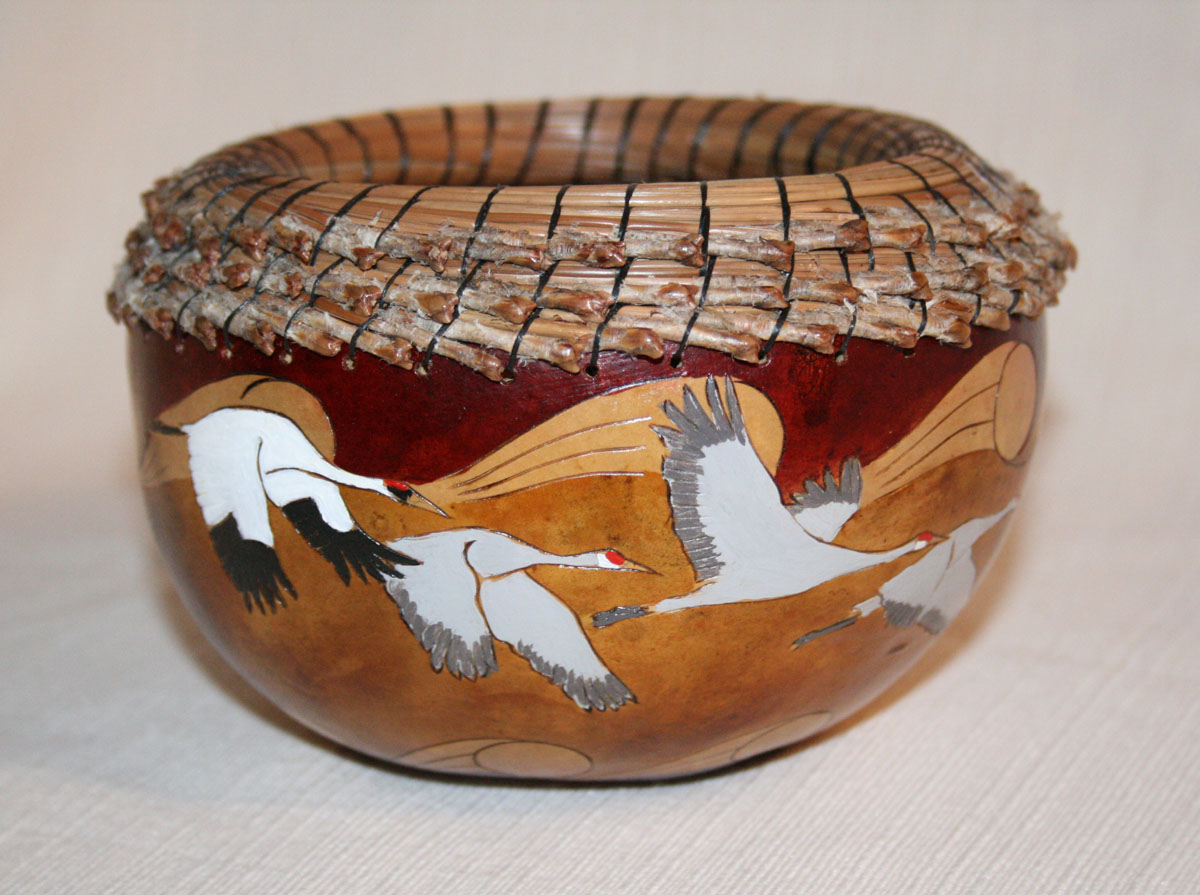
Hardshell Gourd Basket by Vickie Henderson, featuring sandhill cranes and one whooping crane.

Links and Resources:

Hiwassee's Hooded Crane on NPR with video
Nashville Tennessean article Dec 29th:  Rare Crane Draws Birders from 32 states.

Make your plans to attend the Tennessee Sandhill Crane Festival
Directions to Birchwood and the Hiwassee Wildlife Refuge
Hooded Crane is Season's Gift by Marcia Davis
Times Free Press--Rare Hooded Crane Seen

Sandhill crane and Whooping crane gourd art baskets in my online shop

Top Crane Posts on this blog:
Hooded Crane at the Hiwassee Wildlife Refuge in TN
Whooping Crane Family--Happy Reunion!
Sandhill Crane Hunting in Tennesseee?  Multiple Factors Say No!

Shooting Sandhill Cranes?  Not in our backyard!  Tampa Bay Times Dec 31st
Tampa Bay Times--Migratory Sandhill Cranes to be Hunted in Kentucky Dec 24th
Louisville Courier Journal--pg 2, Promote Eco-tourism

Kentucky Coalition for Sandhill Cranes
Petition site:  No Hunting for Sandhill Cranes in the East with more than 3060 signatures.
All my blog posts opposing the hunting of eastern sandhill cranes

Whooping Crane Reintroduction links:
Operation Migration's Ultralight-led whooping crane migration--In the Field
Whooping Crane Eastern Partnership--Direct Autumn Release Program
International Crane Foundation
My Whooping Crane Family Series

Wednesday, February 22, 2012

America's Hooded Crane--A Traveling Ambassador

Did you know that there are only 60 known breeding pairs of Hooded Cranes in the world?  And that the Hooded Crane's breeding and wintering habitats are threatened in at least three countries?   This post is the first in a three-part series on the endangered hooded crane and its appearance in North America.
Hooded Crane with young at the nest in the remote Xing'an Mountain wetlands (Lesser Khingan) of China.    
Photo credit:  Guo Yumin

Until recently, the Hooded Crane was not a well-know species in the United States.  But its mid-December arrival at Tennessee's Hiwassee Wildlife Refuge along with thousands of wintering sandhill cranes changed that status, giving it high visibility through state birding list-serves and the news media.  In fact, from the time it arrived at the Hiwassee Wildlife Refuge on December 14th, 2011 to its subsequent discovery in Indiana on February 8th, 2012, more than 4100 visitors came to the Hiwassee Wildlife Refuge to see this crane.  These visitors arrived from 47 states and 14 different nations.
Hooded Crane with staging sandhill cranes at Tennessee's Hiwassee Wildlife Refuge.     Photo credit:  Mike Nelson

The above numbers exclude the 3200 plus visitors that came to the Tennessee Sandhill Crane Festival held from January 14 to 15, 2012 at Birchwood, TN and the Hiwassee Wildlife Refuge.  The Hooded Crane made an appearance at the festival on Saturday, the 14th, and I was fortunate to be among the hundreds that viewed it through scopes as it foraged along the river shoreline.  Festival survey responses indicated that 12% of festival attendees came specifically to see the Hooded Crane.

That is quite a stir for a single bird, a rare bird that is smaller and darker than its sandhill crane cousins and often chased to the edges of the foraging flocks.  This is assumed to be one of the reasons it has been so visible and easy to find among thousands of staging sandhill cranes. The Hooded Crane often stays to the edges of the masses and may be seen on the outskirts of cranes in flight.

It is not certain how this individual found its way to the eastern United States, traveling now in the Mississippi and Atlantic Flyways with the migrating Eastern Population of Greater Sandhill Cranes.   Birders are watching for its arrival at staging areas north of its last seen location.  I wonder, also, if we should watch for it to the west.

Standing only 3.3 ft tall compared to the 4-5 ft sandhill cranes in the east, a  hooded crane has only twice before been recorded in the wild in North America, near Carey, Idaho, in April 2010, and at the Platte River in Nebraska in April of 2011.

The Hooded Crane is not only a rare species in the United States, it is an endangered species in its native breeding areas in China and Russia, with its numbers continuing to decline.  The hooded crane population is believed to be 9000 in number currently, but only 60 breeding pairs have been confirmed in the world.   Known breeding areas are limited to eastern Siberia in Russia and the boreal wetlands of the remote Xing'an Mountains in China, making it difficult to study its breeding behavior.  But that is just what Dr Guo Yumin and his team of Russian and Chinese scientists are doing--studying the breeding biology of hooded cranes so they can help this species and educate communities near its breeding habitat.

Next:  What Is Threatening the Hooded Crane's Survival?

Links and Resources:

A special thank you to Dr. Guo Yumin, College of Nature Conservation, Beijing Forestry University, for the use of his images in this post series.  The bottom left photo is one of the many annual calendars that Dr. Yumin and his colleagues publish and distribute to the communities near Hooded Crane habitat in order to help educate people about the special nature of Hooded Cranes.  Additionally, many educational brochures are printed and distributed.

Whitley Fund for Nature
Chinese ornithologist, Guo Yumin, win's Whitley Award for his research on hooded crane.

Map source:  International Crane Foundation

Mike Nelson's Flicker site with Hooded crane video and photo stream
Saga of the Hooded Crane ABA
ABA Rare Hooded Crane in Indiana

Top Crane Posts on this blog:  Hooded Crane at the Hiwassee Wildlife Refuge in TN
Crane Magic--Three Crane Species at Hiwassee.  Other posts on:  the Tennessee Sandhill Crane FestivalHiwassee Wildlife Refuge and sandhill cranes.

At my companion blog, Vickie's Sketchbook:  Sandhill Cranes and Art
Whooping cranes in watercolor

Friday, January 13, 2012

Hiwassee Wildlife Refuge and the Hooded Crane

While I'm typing this, the wind is howling outside my window and blowing snow, as though the winter has suddenly remembered Tennessee and is arriving in blustering style.  Despite the discomfort these fronts bring, they often create the best crane viewing conditions, bringing cranes and many other wintering birds down into Tennessee to escape the harsh weather in more northern states.
Photo credit:  David Roemer

To wet your appetite and prepare you for what you will see at the Tennessee Sandhill Crane Festival this weekend, January 14th and 15th, I am re-publishing last night's TN-bird post from Charles Murray.  Charles is a member of the Tennessee Ornithological Society and a resident of Birchwood, TN, and has been at the refuge daily welcoming visitors and keeping all of us posted on the most recent bird sightings there.  His latest post, Jan 12th, was especially fun to read!

Lots of things were happening at the Hiwassee Wildlife Refuge in Meigs Co. at Birchwood today.  Two whooping cranes were seen from about 8-8:30 a.m. in a winter wheat field on top of the hill across the slough from the gazebo.  A Ross's goose and 2 blue phase snow geese were noted.  Several immature bald eagles were in view, including 2 immature bald eagles which did a talon-to-talon rollover display in mid-air.  Then several of the Tennessee Wildlife Resources commissioners arrived and stayed for about an hour during which time they saw thousands of sandhill cranes and several eagles.  The hooded crane was spotted about 1:20 p.m. in the same general area that the juvenile whoopers had been in earlier in the day.  It was in and out of view until about 3 p.m. when it was chased by a sandhill crane and flew out of sight to the west.  Hopefully, the hooded crane will still be in view Saturday and Sunday for the Tennessee Sandhill Crane Festival centered at Birchwood Elementary School.  I went to the Cherokee Removal Memorial very late, about 5:50 p.m., where I shared a sighting of at least 4 whooping cranes in a flooded area on Hiwassee Island with a visitor from Oklahoma.  61 visitors included a person from Minnesota for the first time.  Eleven states, Canada, and the district of Columbia were represented among the visitors [today].  People from 42 states and 10 nations have now contributed to at least 2614 visits to the HWR since December 14, 2011

Directions to the refuge can be found at Tennessee Watchable Wildlife--Hiwassee  

Visitors to the weekend crane festival will need to park at Birchwood Elementary School and ride the shuttle buses to HWR.  The buses will run at least every 15 minutes.  Only handicap parking will be allowed at the HWR.  Shuttles will also go to the Cherokee Removal Memorial Park.  DRESS WARMLY!  Predictions are for temperatures in the 20's in the mornings and 40's in the afternoons.  

Charles Murray
Birchwood, TN
Photo credit:  David Roemer.  

See you at the festival!

Links and Resources:

Jan 12th news report and video of Hiwassee's cranes.  Best part is the voice of the cranes.  Read my previous post to learn about the sandhill crane and whooping crane migrations to the refuge.

American Birding Association blog post on hooded crane.

Mike Nelson's Flicker site with Hooded crane video and photo stream

At my companion blog, Vickie's Sketchbook:  Sandhill Cranes and Art
Sandhill crane art in my website galleries

On this blog:  Whooping Crane Family Series and Whooping Crane Ultralight Migration

Sunday, February 5, 2012

Hiwassee's Sandhill Cranes--The Stories in the Faces

"A Miocene crane fossil, thought to be about ten million years old, was found in Nebraska and is structurally identical to the modern Sandhill crane, making it the oldest known bird species still surviving!"  International Crane Foundation  

Sandhill cranes are sometimes referred to as "living fossils", but I'm not sure whether they received that label because of their pre-historic ancestors, or because of the primordial quality of their trilling calls as thousands of cranes gather to rest and feed in a wetland staging area.
Long held as symbols of longevity and prosperity in many cultures, cranes mate for life, and sandhill cranes may live as long as 20 years in the wild.  Add to these qualities, their ballerina-style grace, spreading wings like parachutes with trailing legs as they float to a landing, and you have a heart-grabbing, charismatic species. Watching the sky as sandhill cranes approach in the pale morning light is a moment guaranteed to wrap you in utter awe and silence. 
And looking through these images is taking me there again and again, and bringing into focus things I haven't noticed before.  One special enjoyment I've encountered--so many sandhill crane faces!  They're all different!  I've also noticed many variations in juvenile skin patches, as well as, what appears to be black fuzz on many of the red patches we refer to as "bald" skin.  So I consulted several of my biologists friends for answers, among them, George Happ and Christy Yuncker, authors of the Sandhill Crane Display Dictionary.  And I learned some fun new information.  
Juvenile sandhill crane, above.  The light shows the fine black bristles on the youngster's skin patch.  Notice the cinnamon feathers on the back of the head and neck. 

We experience a special treat while sandhill crane viewing in Tennessee.  While those who are privileged to have sandhill cranes during breeding season observe nesting behavior and the raising of young colts, we, who see them during migration on their staging and wintering grounds, get to see the in-between stages as the juveniles gradually change to gray plumage and develop the red skin patch that is characteristic of mature adults.  By the time they return to their breeding grounds in the spring, most of this season's young will look just like their parents, even though it will be an average of four more years before they produce off-spring.
What we typically call a bare red skin patch, is not really bald at all, but sparsely covered in fine black bristles, as shown in the adult sandhill crane, above.

You can also see that the juvenile skin patches are in various stages of maturity.  Some of them only have red skin around the eyes and brow, others have a more extensive patch but still show many gray feathers where the red skin will eventually appear.  My guess is this variation in skin patch development may be, at least in part, an indicator of the age of the juvenile, how early or late the juvenile hatched in the season.  
The juvenile above has a red-skin patch developed around his eyes and brow but the forehead and crown are still covered in gray feathers.  Below, you see two juveniles having a territorial dispute.  In the first image, you can see one adult on the left in the background focused on a crane hidden from view.  In the second, you can see the two adult sandhill cranes bill-sparring on the left, as one juvenile chases the other away.   

The two adults are vocalizing as they point their beaks at each other, a threat behavior that can escalate into more aggressive displays, including a jump-rake where the crane jumps and kicks or rakes at the other crane with his feet.  Also notice that the juvenile that remains in the foreground of the image, has a red-skin patch that is only partially developed and most noticeable around the eyes.  The rest of the patch area is still partially covered with gray feathers.
And look at this young cutie. I don't know at what point the voice of a sandhill crane changes from the peeping quality of a chick, to the more typical call of a mature adult and I couldn't find a recording for you, so we'll have to do with a description.  To hear a typical sandhill crane voice click here.  After you have heard this sound, imagine a crane near the same size with the peeping voice of a chick.  I heard one of these peeping calls as I was observing and I think it may have belonged to the youngster you see here. You can also hear these calls while cranes are flying overhead, juveniles calling to their parents in the same manner that older cranes are vocalizing.
This juvenile has lots of gray feathers covering his crown.  There is only the faintest appearance of red skin forming near the eyebrow.  And for size comparison, below you see him with an adult, likely a parent.
I believe I could spend days on end observing and learning about these birds.  

Links and Resources:

To see my entire Hiwassee Sandhill Cranes series click here.
For more information about the Sandhill Crane Display Dictionary 


At my companion blog, Vickie's Sketchbook:  Sandhill Cranes and Art
Sandhill crane art in my website galleries

Thursday, November 1, 2012

Tennessee Conservationist Features Majestic Sandhill Cranes

Louise Zepp, editor of the Tennessee Conservationist,  has selected "Tennessee's Majestic Sandhill Cranes" as the website's feature article for the November/December issue to help promote the Tennessee Sandhill Crane Festival, scheduled for January 19th and 20th, 2013.
The most exciting part about being selected as the feature article is that the entire article is available for reading on line.   So visit the link provided below and enjoy!  The article features the Eastern Population of Greater Sandhill Cranes and their spectacular migration staging each fall when they stop to rest and feed at the Hiwassee Wildlife Refuge.  That collection of thousands of sandhill cranes creates a majestic spectacle that we all enjoy seeing and celebrating each year at our Tennessee Sandhill Crane Festival.

The beautiful four-page layout includes six full color images, including my watercolor, "Sandhills Landing", depicting one of my favorite sandhill crane postures as they float down for a landing.
If you do not already subscribe to this beautiful magazine, you should, so also visit the subscription section while you are visiting the article at the website.

A special thank you, again, to Louise Zepp, TN Conservationist editor, for promoting our majestic sandhill cranes and the sandhill crane festival!
Links and Resources:
Visit my blog posts on sandhill cranes and the Tennessee Sandhill Crane Festival  .
Visit this link to see my other Tennessee Conservationist articles.
The Tennessee Conservationist website

Wednesday, November 24, 2010

Greater Sandhill Cranes--An Intimate View of Family Life

"Our ability to perceive quality in nature begins,
as in art, with the pretty.  It expands through
successive stages of beautiful to values as yet
uncaptured by language.  The quality of cranes lies,
I think, in this higher gamut, as yet beyond the reach of words.
            --Aldo Leopold--A Sand County Almanac and Sketches Here and There            
When Aldo Leopold was writing these words in the 1940's, he, as well as other leading biologists across the continent, thought Sandhill cranes would vanish along with Whooping Cranes.  "At this pivotal time, the crane's capacity to inspire human caring and action made a crucial difference to the species' future, as did the commitment of a few individuals....Sandhill populations recovered because of changes both in human behavior and crane behavior."  (Archibald and Harris in the introduction to On Ancient Wings by Michael Forsberg.)

The conservation of wetlands, the occurrence of adjacent agricultural waste grain fields, and stringent hunting restrictions were all key to this recovery.
Sandhill cranes are tenacious about their migration path and their stop-over sites.  But this behavior is known to change over time with the influence of human activity. Traditionally in the east, sandhill cranes migrated from breeding grounds in Wisconsin to wintering grounds in south Georgia and Florida.  But in recent years the planting of corn at the Hiwassee State Wildlife Refuge, intended to attract and support hunted water fowl, also attracted sandhill cranes.  Consequently, a quarter of the eastern migrating population has wintered in east Tennessee in recent years.
Sandhill cranes staging in waste grain fields adjacent to the confluence of the Hiwassee and Tennessee Rivers at the Hiwassee State Wildlife Refuge in 2004.

It is this spectacle of staging and wintering-over Sandhill cranes, along with the reintroduction of the endangered Whooping crane, that has attracted and delighted thousands of wildlife viewers to the Hiwassee Wildlife Refuge in the past nineteen years. In fact, the wildlife viewing festival that resulted, The Cherokee Heritage and Sandhill Crane Viewing Days, was named to the Top Twenty Events list in 2002 by the Southeast Tourism Society.
In this post, with the generous permission of my friend, Charlie Corbeil, naturalist and talented photographer from Brevard County, Florida, you are seeing intimate views of a Sandhill crane family.  The large gathering of cranes described above is made up of family units consisting of a pair of crane parents and usually one, sometimes two, juveniles--juveniles that have rapidly grown to nearly the size of their parents in a few short months, fledged just in time to migrate, and still retain their peeping chick voices. In fact, the cries of a juvenile sandhill crane separated from parents during migration can move an observer to tears.     

Sandhill cranes mate for life.  Young are taught their migration route by their parents and remain with their parents until the next breeding season.  It is in this family unit that young are protected, learn to find food and learn to select safe roosting sites in wetland shallows.  Here is where juveniles are socialized and learn important survival skills, including those needed for pair bonding and reproduction.  

In the beautiful slide show below, you will enjoy a rare close-up view of a sandhill crane family shortly after their two chicks hatch.  Sandhill cranes are attentive parents.  As you view the images, you will find their gentleness heart-warming, their beauty and elegance "beyond the reach of words."  
A special thank you to Charlie Corbeil for sharing his beautiful photography.

In North America there are only two true cranes--Sandhill cranes and Whooping Cranes.  In eastern North America, we enjoy the eastern population of the Greater Sandhill Crane, a subspecies of Sandhill cranes, and in recent years, the Whooping Crane, a reintroduced population whose arrival marked the first wild migration of Whooping cranes in the east in over a century.

A Sandhill Crane Hunt Proposal in Tennessee is now in its final stages and inviting public comment.  Take a moment to visit the links provided below and let the TN Wildlife Resources Commission know you DON'T want a sandhill crane hunt in Tennessee.  If the Commission passes this hunt proposal, Tennessee will be the first state in US history to initiate a hunting season for Sandhill cranes in the east (Atlantic/Mississippi Flyways).  Other states are lined up to follow (KY, MN, WI).
  
Scroll to the bottom of this page, Sandhill Crane Hunt Proposalto find TWRA's comment link.  Below I have listed some reasons that support opposition to this hunt.  Please add your own.

Reasons to oppose this hunt include but are not limited to: 
  • Sandhill cranes are a valuable wildlife watching attraction in TN.  Initiating a hunt will severely interfere with the pleasure of wildlife watchers.   
  • Hunting sandhill cranes will damage the relationships between the rapidly growing numbers of wildlife watchers in TN and the TN Wildlife Resources Agency.
  • Initiating a hunt on a species that has never been hunted in the east is a serious consideration and requires a longer period of investigation and public input than has been allowed.
  • Initiating this hunt will add an additional danger to rare Whooping cranes that have been reintroduced in the east.  
  • Size estimates for this population are not standardized or consistently measured making the assumptions supporting this hunt inadequate.  
  • Human use and consumption of wetland habitat used by this population is inadequately investigated.    
  • The nine depredation permits issues in TN over the past three years is an inadequate number to support hunting based on nuisance or population management
The Tennessee Wildlife Resources Commission will make the final decision.  The members of this commission  can be found here; email addresses and fax numbers are provided.

To read more about why this hunt is a bad idea visit:

Also visit the TN Ornithological Society's information and position on the proposed sandhill crane hunt and their well articulated letter to the Commission

Clink this link to find out what's happening in Kentucky 

Blog posts around the continent opposing the hunting of cranes in Tennessee:  
The Birder's Report:  Help Stop the Sandhill Crane Hunt
Stephen Lyn Bales, author of Ghost Birds, on Sandhill Cranes in Tennessee.
Gary Louck of Greenback, TN--Cranes in Peril
Related Posts Plugin for WordPress, Blogger...

Ocean Trail at Palos Verdes Nature Preserve, California--2015

Ocean Trail at Palos Verdes Nature Preserve, California--2015

Bird-banding at Seven Islands State Birding Park--2014

Bird-banding at Seven Islands State Birding Park--2014
Photo courtesy of Jody Stone

Bird-banding at Seven Islands

Bird-banding at Seven Islands
Photo courtesy of Karen Wilkenson

Enjoying Gray Jays in Churchill!--2014

Enjoying Gray Jays in Churchill!--2014
Photo courtesy of Blue Sky Expeditions

Smithsonian National Zoo with one of my Whooping Crane banners and son, John--2014

Smithsonian National Zoo with one of my Whooping Crane banners and son, John--2014

The Incredible Muir Woods near Stinson Beach, CA--2014

The Incredible Muir Woods near Stinson Beach, CA--2014
Photo courtesy of Wendy Pitts Reeves

Me and Denali--2012

Me and Denali--2012
Photo courtesy of Bob King

For the Love of It...

...the sage sees heaven reflected in Nature as in a mirror, and he pursues this Art, not for the sake of gold or silver, but for the love of the knowledge which it reveals.
Sendivogius (1750)

Your Uncapped Creativity...

Your Uncapped Creativity...
"There is a vitality, a life force, an energy, a quickening that is translated through you into action; and because there is only one of you in all time, this expression is unique. If you block it, it will never exist through any other medium and it will be lost. The world will not have it. You must keep that channel open. It is not for you to determine how good it is, nor how valuable. Nor how it compares with other expressions. It is for you to keep it yours, clearly and directly." ----the great dancer, Martha Graham