

 There was a constant communication between the parents and the chick, reassuring even to me as I observed. The brood call is a purring sound, deep, gutteral and constant, with the male's tone slightly deeper than the female's. The chick answers with tiny peeps and these soothing sounds assure the family that all is peaceful and safe in their world.
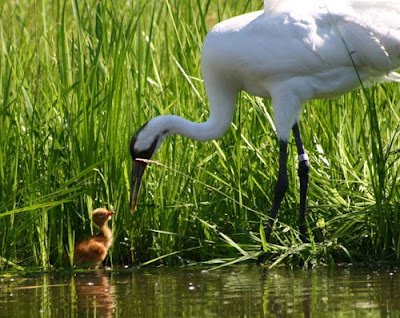
  The whooping crane is a prey species, ever vigilant for dangers and intruders. The parents working as a team, watch over their chick, in this case, the male hunting in the water, the female staying near the chick and almost exclusively presenting him with insects she catches nearby.
 Above, the chick has wandered back to the nest, a mass of plucked grasses which are now darkened by decay. As he rests, the female brings him an insect she has clasped in her bill. (The precision of these catches never ceases to fascinate me.)
 Below the male is hunting for crusteceans and tadpoles in the water. The disarray of feathers you see are molted feathers that have not fallen off yet. The whooping crane's appearance is usually sleek with its feathers neatly preened.


 The chick's chief activities include sleeping, eating and learning what to eat and how to be a crane as it exercises and grows stronger.
 The chick is moving past the male as he tries to present a morsel of food.
 Though he appears to be, the chick isn't exactly following the female above, either. He is exploring and learning to use his legs. She watches over him carefully, even while hunting, and shifts directions to stay near him.
 Oops....
 Time to rest a while.
With the exception of group tours that came through the observation area periodically, for much of the day I was alone in this exhibit wetland with the cranes and their chick. The silence gave me plenty of opportunity to forget there was another world. What I mostly heard was the vocalizations of the whooping cranes, the rippling of water, the buzz of insects and the beeping of a few swallows over head. This world that I glimpsed, at its best, was an incredibly peaceful world.
Next: Video clip! For all Whooping Crane Family posts click here.
Thanks to the International Crane Foundation for this observation opportunity. For more of my posts on whooping cranes click here.
This post has been linked to Bird Photography Weekly #6 at Birdfreak.com to promote the love of birds and conservation.


 I was speaking to George Archibald, co-founder of the
 To my surprise, he responded by saying there was a good possibility that the whooping crane pair at the Amoco Whooping Crane Exhibit at ICF might be allowed to raise their own chick within full view of the public. And so it was that this door of opportunity opened.
 It was in June of the next year, 2005, that I received the call, "we're putting a pipping egg in the nest tonight and it should be hatched by morning." With that, I dropped everything and began the twelve hour drive from Knoxville, TN to Baraboo, WI, arriving around eleven a.m. June 19.
 The image above is among my favorite photos because it captures the parents' earnest attentiveness. As the chick stirred, they moved in unison, almost as one, carefully offering th
 and you get a glimpse of how truely awe inspiring it was to witness the patience and gentleness demonstrated by these two parents.
  Next: A whooping crane chick's day.
 As a result of that inclination, I fall in love a lot. And I laugh a lot. That's what nature brings into my life. That's what the
  This was one of the most peaceful and intimate moments I've shared with a whooping crane. Many times I was alone with this family for hours on end, with no sound but the deep gutteral brood purr of the parents and the tiny peeping of the chick. The world hushed. Time stood still. And I couldn't have been more mezmerized by what I was seeing.
 I can see the
  Or other times, leaning back taking in everything around them.
  And when I look at my images, it never ceases to amaze me that their wings beat faster than the shutter speed.
 Visitors to the feeder are thinning out each day as the air is getting colder and the leaves turning to fall hues.
 But I don't lack company as I observe. My
  Humm...where does this one think he's going?
 That's my door...
 Our Atlas of the Breeding Birds of Tennessee, by Charles P. Nicholson, is non-specific about when the last ruby-throated hummers depart TN, saying, “The hummingbird…usually arrives by mid-April and departs by early October.” The former agrees with my observations this spring. And though I didn’t record my last sighting in 2007, my last photograph of a hummer was taken on the 29th of September. I’ll be observing more carefully this year.
 Some twittering in the branches also caught my attention while outside and though there was no flutey song to confirm his identity, this migrating
  It is so hushed right now while I am writing this. Even the robins, chickadees and blue jays are silently listening to the drizzle. A very wet and fall-ish feeling day.
 This post has been linked to
  These are the words of biologist, Robert Allen, in his Audubon monograph, The Whooping Crane, September 30, 1950, when this species population numbered less than 20. While working on a children’s book project about whooping cranes, I have turned to this monograph from time to time for information.
  As I did so recently, I stumbled across this account:
 The palette of cinnamon among new white feathers and black wing-tips is truly beautiful on whooping crane fledglings. Add to this combination a young peeping voice and magestic wings that span nearly seven feet and you have glimpsed some of the wonder of this tallest bird in North America.
  Gradually, by the end of their first year, these young whooping cranes lose their cinnamon feathers and develop the facial mask that is characteristic of adults.
 They also lose their peeping voice and develop the distinctive
  While visiting Necedah for
  Among the other white birds we viewed was this family of trumpeter swans.
 Not only was it a pleasant surprise to get a glimpse of this family, the photo itself was a surprise.
 It was taken from a moving vehicle with the camera stretched across another passenger to access the open window. I have to give the credit here to my talented camera, the amazing Canon Rebel Xti!
 There are three signets in the photo but you have to look a bit more carefully to find the third.
  There were many wonderful things to see at the refuge that I missed and will look forward to seeing the next visit, among them the endangered gray wolves and karner blue butterflies.
 But black-eyed Susans and blue asters were easily accessible, scattered along forest edges and meadows, never failing to catch my attention.
 Soothing to the eye and close at hand, their splash of color complimented a rich landscape rapidly changing into fall foliage.


