It was this series of sandhill crane notecard images that prompted me to ask the question, "Is there any place on earth I could view and photograph a whooping crane caring for its chick?"

I was speaking to George Archibald, co-founder of the
International Crane Foundation (ICF), during a quiet moment at a wildlife exhibit in the spring of 2004. So many times, while expressing delight over this card collection, now sold out, customers asked me, "do you have any whooping crane images like these?"

I expected George's answer to be one of amusement. The original wild population of endangered migrating whooping cranes, numbering approximately 307 today, nests in Wood Buffalo in the Northwest Territory of Canada. Their nesting sites are inaccessible except to authorized biologists who monitor their numbers. Because this population was reduced to only 15 birds in the early 40's, genetic diversity is of up-most importance to the survival of the species. Captive-reared birds are carefully monitored for genetic value to the wild population and decisions about each off-spring are made by an international recovery team.

To my surprise, he responded by saying there was a good possibility that the whooping crane pair at the Amoco Whooping Crane Exhibit at ICF might be allowed to raise their own chick within full view of the public. And so it was that this door of opportunity opened.

It was in June of the next year, 2005, that I received the call, "we're putting a pipping egg in the nest tonight and it should be hatched by morning." With that, I dropped everything and began the twelve hour drive from Knoxville, TN to Baraboo, WI, arriving around eleven a.m. June 19.
The sleeping chick had hatched in the pre-dawn hours. When it awoke and raised it's head, two very attentive parents greeted it with food.

The image above is among my favorite photos because it captures the parents' earnest attentiveness. As the chick stirred, they moved in unison, almost as one, carefully offering th

e chick the tiniest of insects held in their enormous bills.The chick toppled over on his face, so new was he to life that when he reached for the morsels he lost his balance. The parents retracted their bills, waited for him to erect himself, then ever so slowly, moved their bills toward him again to offer the food.
Keep in mind that an adult whooping crane is five ft tall and its newly hatched chick measures only about four inches, not even the size of the adult's head and bill combined...

and you get a glimpse of how truely awe inspiring it was to witness the patience and gentleness demonstrated by these two parents.

Next: A whooping crane chick's day.

 And I'm celebrating birds and migration and I'm celebrating the residents that hang out year round and brighten our world.
 Like the Carolina chickadee.


 You see why I'm celebrating?

 The wonderful thing about binoculars is that they bring the bird closer. But I think I love my camera lens the best. It’s when I’m looking at the images on the computer screen that I often see something delightful that I could not have seen before, something I would have otherwise missed…
 like these tiny little feet!
 Never mind that the images are fuzzy. Just look at those precious little feet!
 This titmouse is holding its dogwood berry like a squirrel or a mouse might except with straighter toes and unlike the furry critters, he has to perch on these same little feet. Is that not amazing?
 Well, maybe you knew that. But I guess I've never thought about how they hold a berry. I just knew they did. And when I saw these photos all I could do was stare at them and say “look at those little feet!”
 I expected something more like the position below, when the berry's almost gone.
 But then there's a lot less to hold by now. And he's not planning to leave any behind.


 A lot of stumbling takes place until the chick develops strength and awareness of both his body and his environment.
  And the parents do their best to help.
 ICF biologists at the exhibit speculated that this grass-pressing behavior helps the parents keep up with the chick in the tall grass and enables them to better see predators. It also enables the chick to move about more freely.
 As you can see in the chick

 and is even running...
 and flapping his wings!
 There was a constant communication between the parents and the chick, reassuring even to me as I observed. The
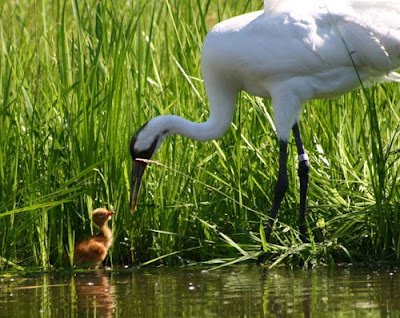
  The whooping crane is a prey species, ever vigilant for dangers and intruders. The parents working as a team, watch over their chick, in this case, the male hunting in the water, the female staying near the chick and almost exclusively presenting him with insects she catches nearby.
 Above, the chick has wandered back to the nest, a mass of plucked grasses which are now darkened by decay. As he rests, the female brings him an insect she has clasped in her bill. (The precision of these catches never ceases to fascinate me.)
 Below the male is hunting for crusteceans and tadpoles in the water. The disarray of feathers you see are molted feathers that have not fallen off yet. The whooping crane's appearance is usually sleek with its feathers neatly preened.


 The chick's chief activities include sleeping, eating and learning what to eat and how to be a crane as it exercises and grows stronger.
 The chick is moving past the male as he tries to present a morsel of food.
 Though he appears to be, the chick isn't exactly following the female above, either. He is exploring and learning to use his legs. She watches over him carefully, even while hunting, and shifts directions to stay near him.
 Oops....
 Time to rest a while.

 As a result of that inclination, I fall in love a lot. And I laugh a lot. That's what nature brings into my life. That's what the
  This was one of the most peaceful and intimate moments I've shared with a whooping crane. Many times I was alone with this family for hours on end, with no sound but the deep gutteral brood purr of the parents and the tiny peeping of the chick. The world hushed. Time stood still. And I couldn't have been more mezmerized by what I was seeing.


