Saturday, February 13, 2010

Wood Stork--Sketching a Curious Face

While sketching this Wood Stork, I couldn't help but wonder what these facial characteristics were all about--scaly bald skin, all those wrinkles, that enormous beak. What is it about this bird's life style that makes these features so important?Though related to vultures who also have bald heads, carrion is not a typical food source for Wood Storks. They are primarily fish-eating birds that also eat crayfish, shrimp, reptiles and frogs, and even small mammals. Sibley's Guide to Bird Life and Behavior says the stork's feeding habits are the key to understanding these peculiar facial features.
Wood Storks are wading birds with a specialized type of foraging called tactile feeding or "grope feeding". They don't have to see their prey but rather can catch prey by dragging their open beak in shallow, murky water where prey is concentrated, snapping their bill shut when prey is contacted. This automatic trigger-like reflex is said to be the fastest movement of any known for vertebrates, clocked at 0.025 seconds.

Wood Storks walk as they forage, sometimes foraging in groups and raising their wings, maneuvers that help to stir prey movement. But it's the shallow, muddy water that holds the key to their baldness, according to Sibley. A bald head is easier to clean than a feathered one after muddy foraging.
The Wood Stork is an endangered species in North America. Though Wood Storks are found in other areas of the world, the North American population "plummeted from an estimated 150,000 individuals in the early 1900's to about 15,000 today." (Sibley) The single most dramatic impact has been disturbance of natural water level cycles in the Florida Everglades, an area that formerly supported the majority of our North American Wood Stork population.
Fortunately, the species has shifted some of its breeding activity to more northerly wetlands in Florida, Georgia and South Carolina, but wetland preservation and close monitoring continue to be vital to the survival of this species.
I observed this particular Wood Stork at the Viera Wetlands, during my visit to Brevard County Florida and the Space Coast Birding and Wildlife festival in January. It was a thrill to view this bird at close range before he flew to rejoin his flock mates and showed me his pink feet! (Click image above to enlarge)
Wood Storks were one of the many species that I enjoyed while visiting the Ritch Grissom Memorial Wetlands with guide, photographer and Master Naturalist, Charlie Corbeil.
You will find more about Wood Storks and related information by visiting the following links:
Audubon's Wood Stork --ecology and status; Audubon Everglades Preservation
Space Coast Birding and Wildlife Festival and David McCree's festival reports at Blog the Beach.
Visit Space Coast Eco for informative descriptions of key natural areas and field trips, and Space Coast Beach Buzz and FloridaBeachBasics for more Brevard County visitor and wildlife information.
Click this link to join current political action designed to help protect wetlands.
To read about my first encounter with Wood Storks, click here. And to view all my posts related to Space Coast Birds and the Space Coast Birding and Wildlife Festival, click here.
Linked to Bird Photography Weekly #77 at Birdfreak.com, to promote the conservation of our world's birds.

Sunday, February 7, 2010

Florida Scrub-Jays--A Specialist Species

The first time a bird lands on your head, you don't know what's happening. Your hand automatically reaches up to check it out. When you hear a jay flutter away, it's an 'aha' moment.
The next time you're ready and you can't help but giggle. It's a delightful experience. And when a Scrub-Jay lands on your hand and politely looks at you with expectance--unforgettable. This was the nature of my introduction to the Florida Scrub-Jay. (Click images below to enlarge.)
My guide on this occasion was Vince Lamb, Master Naturalist, photographer and Scrub-Jay expert. We were visiting the Helen and Allan Cruickshank Sanctuary, a 160-acre preserve in Rockledge, FL, made possible by Florida's Environmentally Endangered Lands Program (EEL).
The Florida Scrub-Jay is the state's only endemic bird, occurring nowhere else and found mostly in Central Florida. In addition, this species requires a very specific habitat, oak scrub with only a scattering of tall trees. This habitat emerges in sandy soils that were once coastal dunes and its biodiversity is dependent upon natural fire cycles that prevent over-growth.
Scrub-Jays are omnivores, feeding on insects, acorns, small reptiles and amphibians. Vince pointed out another habitat that often adjoins scrub habitat, the Wet Prairie or savannah, pictured below. These prairies are characterized by low, relatively flat, treeless, and poorly drained coastal plains that support a variety of frogs, reptiles and other species that Scrub-Jays depend upon for food.
The specialist Scrub-Jay is also one of few bird species known to live in small family groups, usually consisting of a breeding pair and several of their off-spring. Group members have specific duties that they alternate, such as 'sentinel duty' and feeding young during breeding season.
The jay you see perched above is taking the job of sentinel duty seriously. While on watch, he/she sits alert and vigilant, watching for predators and intruders, untempted even by a handy meal until relieved of duty by another individual. Specific calls indicate whether an intruder or predator is present and even what kind of predator. A different call denotes a hawk overhead or a snake below, and family members are alerted to action, whether to hide or collectively mob.
Above you see four members of a family. The jay third from left holds a peanut in his mouth. Only a limited number of naturalists have permits to offer peanuts to these birds (my guide, Vince, being one of them), otherwise feeding them is illegal. The reason for feeding permits-- banding, a crucial method of periodically capturing and monitoring a bird population, helping biologists track the relative health and rise and fall of this threatened species.
In 2004 only two Scrub-Jays inhabited this sanctuary. Today their numbers have increased to thirty. Statewide, in 1992, the Scrub-Jay population was estimated to number 9,500 to 11,000. As human development encroaches on scrub areas and natural fires are suppressed, scrub habitat is rapidly disappearing, causing further decline in Florida Scrub-Jays and other scrub dependent species. This, of course, makes saving scrub habitat and closely monitoring the wildlife dependent upon this habitat even more crucial.
For more information about Florida's Scrub-Jays and related information visit the following links:
Vince Lamb (Top image of me with Scrub-Jay courtesy of Vince Lamb.)
Helen and Allan Cruickshank Sanctuary with field trip information provided by Space Coast Eco, and Location Map
My blog posts about Bird Banding and Space Coast birds.

And just a note about the above sketchbook image. One of the values of photography and especially sketching is the opportunity to intimately study a subject, its color patterns, expression and shapes. Learning happens while you work. Many of my photographs make the Scrub-Jay's cheek patch appear dark, charcoal, even black. This is also how the Florida Scrub-Jay is illustrated in my copy of the Peterson's field guide, Eastern Birds. But closer inspection of images and additional study in the Sibley's field guide, show these facial feathers to be blue, a color that seems to fall somewhere between cobalt and cerulean on the watercolor palette. Lighting changes how these colors appear to the eye, and of course, there are variations in individuals with some having more gray feathers mixed in with the blue. A close look at the cheek feathers is provided in image #four above.

This is one of the fun parts of sketching, chasing down the details, wrapping your mind and your eye around the subject and remembering all you experienced in the process. Besides being a fun way to record encounters in nature, the sketchbook gives you an even deeper appreciation for any species that has sparked your curiosity and imagination!

Linked to Bird Photography Weekly #76 at Birdfreak.com to promote the conservation of our world's birds.

Monday, January 25, 2010

The Space Coast Birding Festival--Ritch Grissom Memorial Wetlands

This morning a storm system moved through central Florida, giving me a little down time to write a quick post. The past couple of days have been busy with orientation to Brevard County, FL, as I visit Florida's wintering birds and attend the Space Coast Birding and Wildlife Festival.

Marge, of Space Coast Beach Buzz and FloridaBeachBasics, has been my gracious hostess, both making my visit here possible and especially enjoyable.

Yesterday I visited the Ritch Grissom Memorial Wetlands at Viera with photographer and Master Naturalist, Charlie Corbeil. Charlie is pictured below (courtesy of Marge). Charlie's beautiful photo decorates the wetland's welcome sign. And here is a glimpse of just a few of the birds (and critters) we enjoyed at the wetlands. Above a Wood stork pauses before rejoining his flock mates. This was undoubtedly the closest I have ever been to one of these birds. I loved seeing all the details in the image. It will be fun to sketch this curious face! (Click on the images to enlarge.)

Below, a baby alligator rests on a pond lily.A Pied-billed Grebe, just up from a dive, feeds in the water along with thousands of other waterfowl. Beautiful American Anhingas, some nesting and posturing, others resting and preening, were perched or flying around--lots of them! A male is pictured below. Enlarge to get a better look at the green markings around his eyes.There were many other beautiful birds at the wetlands that I will show you a bit later. On Wednesday, the 27th, the Space Coast Birding and Wildlife Festival will launch its activities full swing, bringing thousands of bird and nature lovers to Brevard County.

If you are attending the festival, visit Space Coast Eco for informative descriptions of key natural areas that are included in field trips, as well as directions and description of facilities. And to find reports on festival events, don't miss David's special Space Coast Festival Blog the Beach reports, including local weather conditions, event reports and all kinds of interesting festival news.

Saturday, January 16, 2010

Phoebe Allens--Incubating now!

Phoebe Allens is a female Allen's Hummingbird who lives in the Channel Islands, in Orange County, California. Her nest is located in a rose bush right next to a house and she is incubating two eggs that are expected to hatch any time now. You can see it happening right on your computer screen!Yesterday I was so taken with her--watching her wiggle to settle on the eggs, hearing her zip off for a few minutes at a time, seeing her constant vigilance, even her eye blink--that I sketched her while I watched. And I couldn't help but marvel at her life. I've known for a while that hummingbird females are the sole nest builder, incubator and caregiver of the young, but the impact of that knowledge is even greater when you see such a tiny bird actually in the midst of these labors. Yesterday I saw her bring materials to add to her nest on one of those quick flights away. And if the cam should be down, there are wonderful clips to watch, like Phoebe harrassing her juveniles of a previous year, trying to entice them to fledge. And another one that shows her laying an egg!
Phoebe's eggs are due to hatch anytime now. Historically they have begun hatching at day 17 and this is day 14. Don't miss seeing her upclose at: http://cam.dellwo.com/
She is a real treat!
Jan 20th update: Both of Phoebe's eggs hatched January 19th, one before daylight, the other later during a very stormy day. When you view the cam now, you get the added treat of seeing tiny newly hatched nestlings during the brief times she leaves the nest!

Tuesday, January 12, 2010

Winter's Simple Pleasures

Despite the aggrevation of snow and ice, especially the ice part, winter's bleak neutrals can produce incredibly beautiful backdrops for wintering birds.These Dark-eyed Juncos (also known as "slate-colored juncos") with their snowy white belly feathers puffed up for warmth, are one example of how all those elements come together to create breath-taking beauty. Quiet, simple, beauty.
The kind that requires being still to enjoy. The kind that makes winter magical.I recall thinking last year, I'll never get a good photo of a Dark-eyed Junco. They forage in groups and fly at the least provocation. But this winter has been different (and maybe I'm different, too.) Rather than being covered with an influx of finches, my feeder area is frequented by small, quiet, wintering flocks of juncos and white-throated sparrows, giving me the fun opportunity to observe different birds and their behavior at close range.
On several very cold, snow-covered days last week, I enjoyed these shy, ground-foraging birds, their beauty and softness lighting up the bare winter grays. If I stood very still, they seemed to forget I was there, landing nearby, kicking up snow, pausing to break open sunflower shells. Likewise, I forgot about the cold.
Winter's simple pleasures.

Linked to Bird Photography Weekly #73 at Birdfreak.com to promote the conservation of our world's birds.

Monday, January 11, 2010

Whooping Crane Activity Book Gets Great Review!

Marcia Davis, bird enthusiast and Birdlife columnist for the Knoxville News Sentinel, featured Operation Migration's Whooping Crane Activity Book in her column on Sunday. The article reviews the contents of the book, describes why the ultralight-led Whooping crane migration is an "against-all-odds" feat and explains why, as author and illustrator, I believe this story is a great way to inspire young minds to use their imaginations to help wildlife.

The activity book is being distributed free to classroom educators (plus $10.00 shipping) or can be ordered individually for a cost of $3.00 plus shipping. To order, visit Operation Migration's merchandise page.

And while you're there, visit the Operation Migration field journal to see the latest developments in the migration. The Whooping Crane Class of 2009 arrived in Florida today! If the weather cooperates, half of the class will arrive at their destination in St. Marks tomorrow and the other half will continue on to Chassahowitzka NWR.
Soon these twenty young Whooping Cranes will add their numbers to the wild migrating population of Whooping cranes in the east. What a great way to celebrate the power of imagination!

Thursday, January 7, 2010

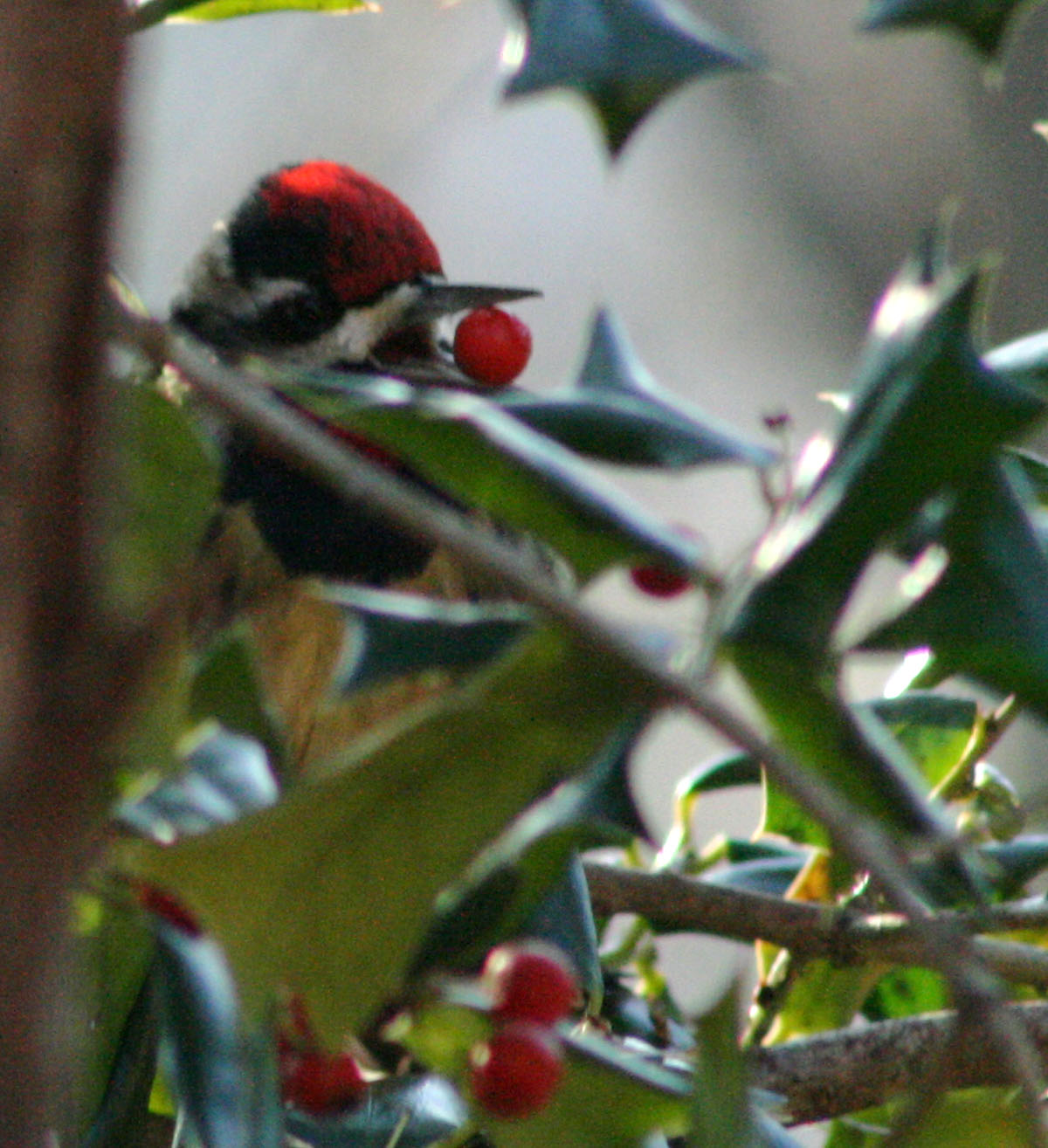
Berry Dining--Sapsucker Style

It was his soft mewy call that caught my attention, that distinctive low whine that sounds a bit like a cat's mew--the wintering call of a Yellow-bellied sapsucker.
Besides dining on sap and insects, these woodpeckers also happen to like holly berries. And since there is a holly within view of my window, its handy to look out from time to time to see whose come to dine.
Some of the sapsuckers that visit the yard have come down from the higher elevations in the nearby Smoky Mountains. Others have traveled to winter here from more northern breeding grounds. November to late March is the time of year we get to enjoy their visits in the lower elevations of the Tennessee Valley.
Watching this male forage on berries not only provided enjoyment, it raised many questions as well. Like, do birds actually loose their balance and misjudge their footing? Maybe that seems obvious, but it's not something we often see or consider. It certainly seemed to be the case with this sapsucker. In the image below you'll see one foot dangling while he appears to have caught himself with his chin. (Click the image to enlarge.)
But he recovered quickly and moved right on to pluck another berry.
And then eyed another one.

And as he plucks this berry, take a look at the image below. It appears he's holding one, maybe two, berries in his gullet while adding another one. Just how does that work? How long will he hold them there? And how many can he collect there at one time?
I don't know the answers, so if anyone one else happens to know or knows an expert who knows, or can recommend a resource, that would be great.

While browsing the subject of sapsucker dining, I did learn another new tidbit about their habits. Sapsuckers lap the sap from their excavated tree wells in much the same way as hummingbirds lap nectar from flowers or feeders. But unlike hummers, the Yellow-bellied sapsucker has hairs on his tongue that help facilitate the lapping of sap. To see an image of a sapsucker's tongue, click this link to Hilton Pond Center.
Above, is another image of the same sapsucker perched on the tree stump in front of the holly. Though Yellow-bellied sapsuckers can sometimes look drab because of their blended plumage, this backlit male was striking with his crimson throat and cap, the sharp contrast between black and white areas of plumage, and that golden glow on his belly

Besides being my first bird photographs for 2010, he earned the honor of becoming my first bird sketch of the new year, too. And I can say I am happy to hear their soft mewy calls mixed in with the other woodpecker calls in the area.

Linked to Bird Photography Weekly #72 at Birdfreak.com to promote the conservation of our world's birds.

Thursday, December 31, 2009

Welcome 2010!

The human species is programmed to examine, identify beginnings and endings, take stock of what is behind and to look ahead. It's part of our nature and our desire for meaning, contribution, purpose and participation. And because we are all unique as well, this takes different forms for each individual. I'm sometimes surprised to see how many things I actually accomplish that are on my list of goals for a new year. It's fun to review them and see how I did.Sometimes it means carrying over something that got pushed aside, like my novel query letters. That means a renewed commitment to stick with it and face those rejection letters with persistence. This is part of what commitments do for us. They move us right through the rough spots.

Here are some highlights from 2009:

Partnering with Operation Migration to make the Craniac Kids Whooping Crane Activity Book become a reality. Available to kids everywhere now--FREE!

Joining Operation Migration in Washington D.C. for the presentation of the Partners in Conservation Award.
Participating in bird banding at the Seven Islands Wildlife Refuge in Knoxville, TN

Observing a nesting pair of Red-shouldered Hawks and creating a sketchbook about my experience.

Plenty of painting, sketching and learning about art and how much I love it.

Enjoying a fun canoe drift down the French Broad River with bird-loving friends.
Learning to make a sketchbook loaded with watercolor paper. (More on this later).

And here is a short list of activities and events I'm looking forward to in 2010:

Monitoring Bluebird boxes at SIWR
Writing articles for the TN Conservationist
More bird banding at SIWR
Sketching in nature
The Space Coast Birding Festival, Titusville, FL
Launching another book project
Lots of watercolor and nature journaling!
Happy New Year everyone!
Related Posts Plugin for WordPress, Blogger...

Ocean Trail at Palos Verdes Nature Preserve, California--2015

Ocean Trail at Palos Verdes Nature Preserve, California--2015

Bird-banding at Seven Islands State Birding Park--2014

Bird-banding at Seven Islands State Birding Park--2014
Photo courtesy of Jody Stone

Bird-banding at Seven Islands

Bird-banding at Seven Islands
Photo courtesy of Karen Wilkenson

Enjoying Gray Jays in Churchill!--2014

Enjoying Gray Jays in Churchill!--2014
Photo courtesy of Blue Sky Expeditions

Smithsonian National Zoo with one of my Whooping Crane banners and son, John--2014

Smithsonian National Zoo with one of my Whooping Crane banners and son, John--2014

The Incredible Muir Woods near Stinson Beach, CA--2014

The Incredible Muir Woods near Stinson Beach, CA--2014
Photo courtesy of Wendy Pitts Reeves

Me and Denali--2012

Me and Denali--2012
Photo courtesy of Bob King

For the Love of It...

...the sage sees heaven reflected in Nature as in a mirror, and he pursues this Art, not for the sake of gold or silver, but for the love of the knowledge which it reveals.
Sendivogius (1750)

Your Uncapped Creativity...

Your Uncapped Creativity...
"There is a vitality, a life force, an energy, a quickening that is translated through you into action; and because there is only one of you in all time, this expression is unique. If you block it, it will never exist through any other medium and it will be lost. The world will not have it. You must keep that channel open. It is not for you to determine how good it is, nor how valuable. Nor how it compares with other expressions. It is for you to keep it yours, clearly and directly." ----the great dancer, Martha Graham