Sunday, December 7, 2014

An Intimate Visit with a Swamp Sparrow

The Swamp Sparrow is a rusty brown and gray sparrow that prefers wet habitat, such as moist, over-grown farm fields, marshes, water edges and other wet areas overgrown with briars and bushes. These conditions make Seven Islands State Birding Park a great place for wintering Swamp Sparrows!
Swamp Sparrow

The KTOS (Knoxville Chapter of TOS) banding team set up banding nets in this morning's moist cold at Seven Islands State Birding Park to document the current wintering bird population. The word for the day was wind!  BRRRR!  
The morning net captures started off slow and only got slower.  The birds seemed to be hunkering down under cover to escape the 9 mph wind.  In order to capture birds in the mist nets, the birds have to be moving around.      

This is one of the few times I have witnessed a "slow" banding morning at Seven Islands.  Most of the time we are working constantly to get the birds processed as quickly as possible, sometimes without a break until all the nets are taken down.  The good outcome of this slow morning was the ability to take a closer look at some of the birds we did band.
All of the bird images in this post are of Swamp Sparrows.  Above and below you can see the colors of the feathers on the crown of the sparrow.  The cap is considered rusty, but it can also appear almost black in some light. You can see the reason why.  Black feathers are mixed in with the rust ones.
The Swamp Sparrow has prominant rusty feathers streaked with black on its crown, shoulders and back, and has an overall rusty and gray appearance when seen in the field.    
This individual had buffy feathers mixed in with the gray on its face and had an overall lighter appearance, but the rusty features are still prominent.
Below, you can see the dull gray breast feathers with a little more white around the throat and on the lower abdomen on this individual.  These are individual characteristics that you often don't see in the field and are beautiful to observe in the hand.

Above you see the "dusty" or buffy eye-ring and an almost yellowish eye-brow on this individual. Compare the above sparrow's buffy appearance to the darker gray coloration of the sparrow below. These are both Swamp Sparrows and, in the field, they are both recognizable by their rusty cap, rusty back and shoulders and their overall gray appearance.
Below, Billie Cantwell, bander apprentice, holds a Swamp Sparrow for Mark Armstrong, our Master Bander, while he documents the plumage on this sparrow.


Above, a view of the Swamp Sparrow's rusty back with black feather streaking.  
Above and below, banding team members, dressed for the wind, visit with each other and discuss plans between net runs.

Sumac seeds below.
The French Broad River, that borders the park on three sides, is one of the features that helps attract a variety of birds and wildlife species to the park.

Visit my previous posts on bird banding.
Knoxville Chapter, Tennessee Ornithological Society
Visit the Knoxville Chapter of TOS on Facebook
Seven Islands State Birding Park

Sunday, November 30, 2014

Gray Jays--Smart, Bold, Resourceful!

The Corvidae family--jays, crows, ravens, magpies--are fast becoming one of my favorite bird families.  Each time I get acquainted with a new species, I am enamored.
I encountered my first Gray Jay in Alaska, in 2012, on the campus of the Denali National Park Visitor's Center.  Several were scavanging for crumbs around the side walk near where I waited for transportation--a day-making sighting on my last day in the park.  
Gray Jays are a wide-spread resident of North America's boreal and sub-alpine coniforest forests, where they have developed adapative characteristics that enable them to surive the hostile winters.
Gray Jay sketch by Vickie Henderson

Gray Jays feed primarily on arthropods, berries, carrion, nestling birds and fungi, such as mushrooms, but they quickly learn to recognize and seek out novel foods, like cheese, raisins, and bread. They cache food by coating the food with copious amounts of saliva produced by their large salivary glands.
After the food is coated, they tuck it under flakes of bark, lichen, or in the fork of a branch, and sometimes add another piece of bark or lichen on top to cover it.  In addition to their hoarding habits, these jays have thick, fluffy plumage that can cover their legs and feet while perched and their nares are covered with tiny feathers.  The jays in the images above were observed in Riding Mountain National Park, Manitoba, in October, flying from perch to perch as they hunted for insects.
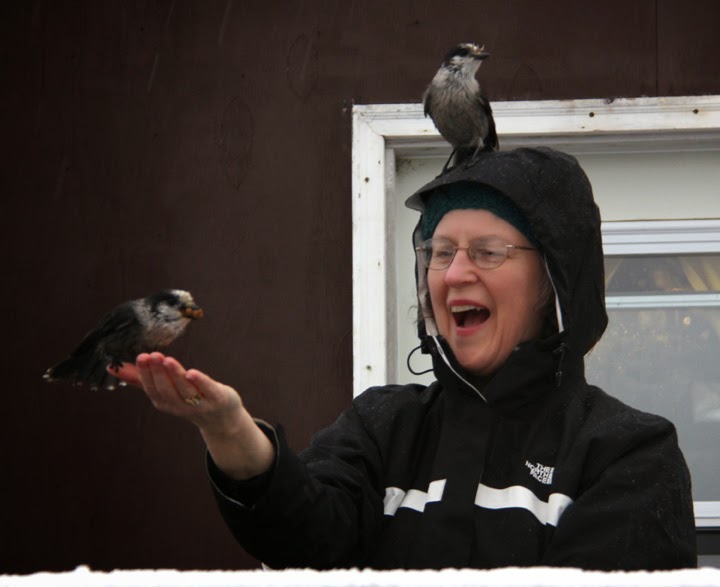
Above, you see me in Churchill, Manitoba, also in October, enjoying the surprise boldness of this species.  A succession of jays flew from the trees to take kibbles from my hand on this windy, snowy morning as I stood on the porch at Blue Sky Dog Kennels.

More about Blue Sky and my journey to Churchill to see Polar Bears coming up!
Gray Jay at Cornell
Florida Scrub Jay

Saturday, November 22, 2014

A Day of Beautiful Sparrows--Seven Islands State Birding Park

Our bird-banding morning on November 16, 2014 at Seven Islands State Birding Park was chilly but rewarding!
Sometimes its a little hard to get out of bed way before dawn, especially when you're anticipating at least four hours of being out in the cold, but seeing the wintering bird population at Seven Islands State Birding Park makes it well worth the effort.
During the winter months we have the great pleasure of hosting wintering sparrows in the grassland and shrubby habitat of the park.
Sparrows like to hang out on the stems of dead flowers and grasses eating seeds or foraging on the ground underneath. Often referred to as "little-brown-jobs", they are not really brown and dull as suggested, but display a bright array of neutral colors--brown, tan, rust, gray, cream, black and white--arranged in intricate contrasting patterns.  The nickname, of course, also refers to the fact that that they aren't the easiest of birds to see.  You may only catch a flash of brown as a shy sparrow disappears into the nearest thicket!
The Swamp Sparrow above was still growing in new feathers, shown as white around his face, but when the fresh plumage grows in fully, he will look more like the sparrow below with a mostly gray face, dark crown and rust-colored wings.  Swamp Sparrows breed in the boreal forests of Canada and the northeastern United States and prefer brushy habitat that is either wet or near water.
I was introduced to Swamp Sparrows at Seven Islands in 2009, along with the Savannah Sparrow, Grasshopper Sparrow, Fox Sparrow, White-crowned Sparrow and Field Sparrow--all at the banding table.
Above, Billie Cantwell, banding apprentice, and Mark Armstrong, Master Bander, discuss plumage characteristics that help to determine the age of this Swamp Sparrow.
While walking up and down hills and removing birds from nets, banding team members stay warm.   While waiting for the next net-run, it gets chilly and it's time to bundle up.  In the image above, Patty Ford is showing Eddy Whitson the photo she took of the Swamp Sparrow.
Above, Mark Armstrong, examines an Eastern Towhee with team member, Eddy Whitson, looking on.
Eastern Towhees, large, colorful sparrow-like birds, remain in Tennessee year around and are often found in our backyards.
Above, Mark Armstrong (left), Janie Kading and Billie Cantwell (right) at the banding table.
Above, a Field Sparrow with its new band just before release.  Field Sparrows both breed and winter in Tennessee.  The banding program at Seven Islands is giving biologists valuable information about the area's birds, the impact of changing land management practices on the bird population, and information about the health and site fidelity of the bird species.

Above and below, banding team members remove birds captured in a net.
Some net-runs, such as this one, may hold a large number of birds.  The birds are held in soft cloth bags until they are processed and released.
Below, Janie Kading helps Dawn Johnson separate the bags and safely hang them on the carousel.

When the weather is cold as it was this day, in the mid 30's F, the banders band the bird, determine its age and release it without taking the time to measure the wings and tail or weigh the bird. This allows the bird to get back to its activities more quickly. Measurements help document the bird's health and general characteristics for referrence when recaptured.

Above, a striking juvenile White-crowned Sparrow, and below, an adult White-crowned Sparrow.  
The White-crowned Sparrow breeds in northern Canada and the western United States and starts to arrive to winter in Tennessee around October.  These sparrows are most often found on the ground kicking up leaf litter with double-footed scratching.

Above and below, a Savannah Sparrow--a sparrow of open grasslands.

A Field Sparrow showing its peach-colored beak, white eye-ring and rusty plumage. Below, you see the intricate color patterns in its back and wing plumage.  
See what I mean about beauty?

Visit my previous posts on bird banding.
Knoxville Chapter, Tennessee Ornithological Society
Visit the Knoxville Chapter of TOS on Facebook
Seven Islands State Birding Park

Monday, October 27, 2014

Whooping Crane Art at the Smithsonian National Zoo

In 2013, I had the joy and privilege of working with the art curators at the Smithsonian National Zoological Park and Gardens, in Washington D.C., in the creation of the interpretive art for their new Whooping Crane Exhibit at the park.  Earlier this year, I had my first opportunity to visit this exhibit--a spectacular experience!
The art images include an identification image for the species (shown on the panel below) and four watercolors for the banners (above) that depict the story of the ultralight-led re-introduction of Whooping Cranes to eastern North America.  
The re-introduction effort began in 2001 and continues today. Now more than 100 Whooping Cranes migrate from Wisconsin to wintering grounds in Florida and other eastern states.

In the early 1940's only fifteen Whooping Cranes remained in the wild migrating population that traveled from Wood Buffalo National Park, Canada, to Aransas National Wildlife Refuge, Texas. That population was reported recently as having approximately 304 birds. Biologists have been concerned that a natural disaster, man-made disaster or disease could wipe out this entire population. To help ensure that this won't happen, they set a goal to establish a separate, migrating population in the east.

Each banner depicts one phase of the reintroduction story: captive-hatched chick, fall migration behind ultralights, the return to fledging grounds without human assistance, and the wild hatching of young.  It is the hatching of wild young that biologists hope will one day make the eastern population self-sustaining and help ensure that we continue to have wild Whooping Cranes.


When the Whooping Crane, Rocky, arrived at the Zoo in 2011, it was the first time in 88 years that the National Zoo had housed a Whooping Crane. One year later, Rocky was fortunate to receive a companion to join him at the exhibit. The female was hatched at the International Crane Foundation in 1992 and spent a period of time at the Calgary Zoo prior to joining Rocky.  Watching this pair of cranes together was fascinating.

Whooping Cranes are known for their bugle-like calls that can be heard for a distance of over a mile. Oddly enough, Rocky has no voice and no one knows why.

While visiting the exhibit in April, with my son, John, I watched the pair of cranes join each other in guard calls, a call that is given in warning and to sound a unified alert when an intruder is present--in this case, an exhibit attendant filling bird feeders.

Rocky threw his head back, pointed his beak toward the sky, and went through the motions of sounding an alarm call several times.  Within seconds of initiating this "head-thrown-back, open-mouthed" posture, his mate joined him, adding the vigorous, female companion call and making it sound as though both of them were calling.  If I had not known Rocky was mute, I would have never guessed this was so while watching their behavior.
Next time you are in our nation's capital, visit this spectacular park.  You will enjoy all of the exhibits, but especially say 'hello' to Rocky and his mate, and take in the art banners and interpretive panels. I am proud of the exhibit and proud of our international efforts to insure the survival of this spectacular species.

Visit my website gallery to see larger images of the banner art and more of my Whooping Crane art:  Whooping Cranes
You will also find Whooping Crane prints and art cards for sale at my online Shop
Visit my blog, Vickie's Sketchbook, to see more about the watercolor techniques used to create the banner art.
Go to Operation Migration’s Field Journal to learn about the current ultralight migration.
More about Whooping Cranes on this blog.
Related Posts Plugin for WordPress, Blogger...

Ocean Trail at Palos Verdes Nature Preserve, California--2015

Ocean Trail at Palos Verdes Nature Preserve, California--2015

Bird-banding at Seven Islands State Birding Park--2014

Bird-banding at Seven Islands State Birding Park--2014
Photo courtesy of Jody Stone

Bird-banding at Seven Islands

Bird-banding at Seven Islands
Photo courtesy of Karen Wilkenson

Enjoying Gray Jays in Churchill!--2014

Enjoying Gray Jays in Churchill!--2014
Photo courtesy of Blue Sky Expeditions

Smithsonian National Zoo with one of my Whooping Crane banners and son, John--2014

Smithsonian National Zoo with one of my Whooping Crane banners and son, John--2014

The Incredible Muir Woods near Stinson Beach, CA--2014

The Incredible Muir Woods near Stinson Beach, CA--2014
Photo courtesy of Wendy Pitts Reeves

Me and Denali--2012

Me and Denali--2012
Photo courtesy of Bob King

For the Love of It...

...the sage sees heaven reflected in Nature as in a mirror, and he pursues this Art, not for the sake of gold or silver, but for the love of the knowledge which it reveals.
Sendivogius (1750)

Your Uncapped Creativity...

Your Uncapped Creativity...
"There is a vitality, a life force, an energy, a quickening that is translated through you into action; and because there is only one of you in all time, this expression is unique. If you block it, it will never exist through any other medium and it will be lost. The world will not have it. You must keep that channel open. It is not for you to determine how good it is, nor how valuable. Nor how it compares with other expressions. It is for you to keep it yours, clearly and directly." ----the great dancer, Martha Graham