Showing posts sorted by relevance for query florida scrub jay. Sort by date Show all posts

Sunday, February 7, 2010

Florida Scrub-Jays--A Specialist Species

The first time a bird lands on your head, you don't know what's happening. Your hand automatically reaches up to check it out. When you hear a jay flutter away, it's an 'aha' moment.
The next time you're ready and you can't help but giggle. It's a delightful experience. And when a Scrub-Jay lands on your hand and politely looks at you with expectance--unforgettable. This was the nature of my introduction to the Florida Scrub-Jay. (Click images below to enlarge.)
My guide on this occasion was Vince Lamb, Master Naturalist, photographer and Scrub-Jay expert. We were visiting the Helen and Allan Cruickshank Sanctuary, a 160-acre preserve in Rockledge, FL, made possible by Florida's Environmentally Endangered Lands Program (EEL).
The Florida Scrub-Jay is the state's only endemic bird, occurring nowhere else and found mostly in Central Florida. In addition, this species requires a very specific habitat, oak scrub with only a scattering of tall trees. This habitat emerges in sandy soils that were once coastal dunes and its biodiversity is dependent upon natural fire cycles that prevent over-growth.
Scrub-Jays are omnivores, feeding on insects, acorns, small reptiles and amphibians. Vince pointed out another habitat that often adjoins scrub habitat, the Wet Prairie or savannah, pictured below. These prairies are characterized by low, relatively flat, treeless, and poorly drained coastal plains that support a variety of frogs, reptiles and other species that Scrub-Jays depend upon for food.
The specialist Scrub-Jay is also one of few bird species known to live in small family groups, usually consisting of a breeding pair and several of their off-spring. Group members have specific duties that they alternate, such as 'sentinel duty' and feeding young during breeding season.
The jay you see perched above is taking the job of sentinel duty seriously. While on watch, he/she sits alert and vigilant, watching for predators and intruders, untempted even by a handy meal until relieved of duty by another individual. Specific calls indicate whether an intruder or predator is present and even what kind of predator. A different call denotes a hawk overhead or a snake below, and family members are alerted to action, whether to hide or collectively mob.
Above you see four members of a family. The jay third from left holds a peanut in his mouth. Only a limited number of naturalists have permits to offer peanuts to these birds (my guide, Vince, being one of them), otherwise feeding them is illegal. The reason for feeding permits-- banding, a crucial method of periodically capturing and monitoring a bird population, helping biologists track the relative health and rise and fall of this threatened species.
In 2004 only two Scrub-Jays inhabited this sanctuary. Today their numbers have increased to thirty. Statewide, in 1992, the Scrub-Jay population was estimated to number 9,500 to 11,000. As human development encroaches on scrub areas and natural fires are suppressed, scrub habitat is rapidly disappearing, causing further decline in Florida Scrub-Jays and other scrub dependent species. This, of course, makes saving scrub habitat and closely monitoring the wildlife dependent upon this habitat even more crucial.
For more information about Florida's Scrub-Jays and related information visit the following links:
Vince Lamb (Top image of me with Scrub-Jay courtesy of Vince Lamb.)
Helen and Allan Cruickshank Sanctuary with field trip information provided by Space Coast Eco, and Location Map
My blog posts about Bird Banding and Space Coast birds.

And just a note about the above sketchbook image. One of the values of photography and especially sketching is the opportunity to intimately study a subject, its color patterns, expression and shapes. Learning happens while you work. Many of my photographs make the Scrub-Jay's cheek patch appear dark, charcoal, even black. This is also how the Florida Scrub-Jay is illustrated in my copy of the Peterson's field guide, Eastern Birds. But closer inspection of images and additional study in the Sibley's field guide, show these facial feathers to be blue, a color that seems to fall somewhere between cobalt and cerulean on the watercolor palette. Lighting changes how these colors appear to the eye, and of course, there are variations in individuals with some having more gray feathers mixed in with the blue. A close look at the cheek feathers is provided in image #four above.

This is one of the fun parts of sketching, chasing down the details, wrapping your mind and your eye around the subject and remembering all you experienced in the process. Besides being a fun way to record encounters in nature, the sketchbook gives you an even deeper appreciation for any species that has sparked your curiosity and imagination!

Linked to Bird Photography Weekly #76 at Birdfreak.com to promote the conservation of our world's birds.

Wednesday, April 30, 2014

Stinson's Gulch with Keith Hansen

Stinson's Gulch is the name for a valley in Marin County, California, that is associated with a stream that travels down Bolinas ridge and is located just north of Stinson Beach.  
Lovely, shrubby habitat with lots of berries and insect attracting spring flowers.  Above, a Western Scrub-Jay . Jays are among my favorite birds because of their assertive and inquisitive natures.  The jay above appears to be acting as a look out, though Western Scrub-Jays don't display sentinel behavior as systematically as the Florida Scrub Jay
As soon as we entered the habitat from the small parking area, warbler activity became apparent in the shrubby plants around us.  The first species was a species that I enjoy during the winter months in my yard, a Yellow-rumped Warbler, above.  
Mixed in with the yellow-rumps were Townsend's Warblers, a new species for me!  In fact, I enjoyed seeing a number of new species on our walk through this area!  One of the field marks that sets this warbler apart is that dark cheek patch you see above, that looks a bit like a black mask against the male's yellow face.
The males have a black throat, while the female's throat is yellow (above and below).  Females also have the distinguishing dark cheek patch, though its a faded version of the male's.        
If you have ever spent time straining your neck to see warblers as specks in the tip-tops of trees, you will agree that it is a real treat anytime you can view these birds at near eye-level.
Bushtits, above and below.  Though this little bird is described as "plain" and "drab-gray" in the field guides, there is nothing drab about their personalities nor was their any drabness in my reaction to seeing this bird for the first time.
Bushtits are smaller than chickadees, only 4" compared to a chickadee's 4 1/2 to 5", and their foraging habits are much like that of chickadees, including the habit of hanging upside down as they search for tiny insects. What is also delightful, they often travel and forage in flocks.  So if you miss your photo opportunity the first time, chances are you'll get a second chance!  
The females have the yellow eye, while the males have a brown eye, and look at that long tail!  Fun little birds!
Above, Keith Hansen, center, and my companions, Talissa and Wendy.

Next:  More firsts and an enchanted forest!

Visit all my posts on Stinson Beach, California
Stinson Gulch
Keith Hansen
Birds of the Sierra Nevada by Beedy and Pandolfing--Illustrated by Keith Hansen
Great book! Full of detailed life histories. As you might guess, I brought home an autographed copy!


Sunday, November 30, 2014

Gray Jays--Smart, Bold, Resourceful!

The Corvidae family--jays, crows, ravens, magpies--are fast becoming one of my favorite bird families.  Each time I get acquainted with a new species, I am enamored.
I encountered my first Gray Jay in Alaska, in 2012, on the campus of the Denali National Park Visitor's Center.  Several were scavanging for crumbs around the side walk near where I waited for transportation--a day-making sighting on my last day in the park.  
Gray Jays are a wide-spread resident of North America's boreal and sub-alpine coniforest forests, where they have developed adapative characteristics that enable them to surive the hostile winters.
Gray Jay sketch by Vickie Henderson

Gray Jays feed primarily on arthropods, berries, carrion, nestling birds and fungi, such as mushrooms, but they quickly learn to recognize and seek out novel foods, like cheese, raisins, and bread. They cache food by coating the food with copious amounts of saliva produced by their large salivary glands.
After the food is coated, they tuck it under flakes of bark, lichen, or in the fork of a branch, and sometimes add another piece of bark or lichen on top to cover it.  In addition to their hoarding habits, these jays have thick, fluffy plumage that can cover their legs and feet while perched and their nares are covered with tiny feathers.  The jays in the images above were observed in Riding Mountain National Park, Manitoba, in October, flying from perch to perch as they hunted for insects.
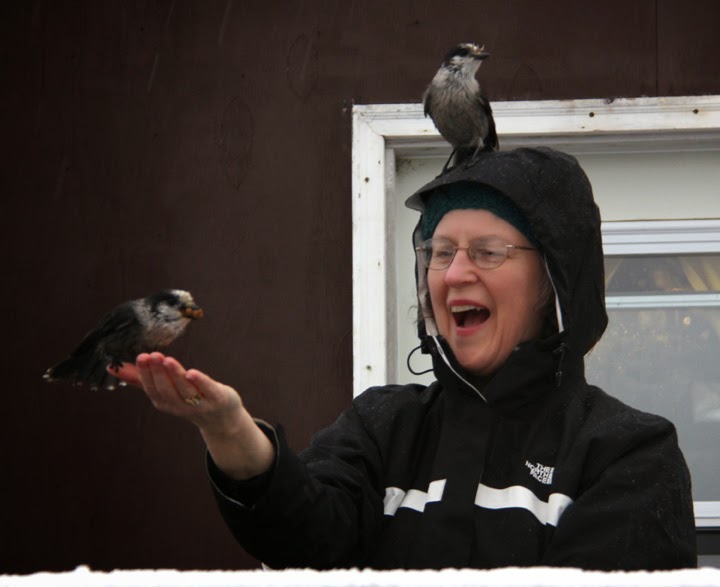
Above, you see me in Churchill, Manitoba, also in October, enjoying the surprise boldness of this species.  A succession of jays flew from the trees to take kibbles from my hand on this windy, snowy morning as I stood on the porch at Blue Sky Dog Kennels.

More about Blue Sky and my journey to Churchill to see Polar Bears coming up!
Gray Jay at Cornell
Florida Scrub Jay
Related Posts Plugin for WordPress, Blogger...

Ocean Trail at Palos Verdes Nature Preserve, California--2015

Ocean Trail at Palos Verdes Nature Preserve, California--2015

Bird-banding at Seven Islands State Birding Park--2014

Bird-banding at Seven Islands State Birding Park--2014
Photo courtesy of Jody Stone

Bird-banding at Seven Islands

Bird-banding at Seven Islands
Photo courtesy of Karen Wilkenson

Enjoying Gray Jays in Churchill!--2014

Enjoying Gray Jays in Churchill!--2014
Photo courtesy of Blue Sky Expeditions

Smithsonian National Zoo with one of my Whooping Crane banners and son, John--2014

Smithsonian National Zoo with one of my Whooping Crane banners and son, John--2014

The Incredible Muir Woods near Stinson Beach, CA--2014

The Incredible Muir Woods near Stinson Beach, CA--2014
Photo courtesy of Wendy Pitts Reeves

Me and Denali--2012

Me and Denali--2012
Photo courtesy of Bob King

For the Love of It...

...the sage sees heaven reflected in Nature as in a mirror, and he pursues this Art, not for the sake of gold or silver, but for the love of the knowledge which it reveals.
Sendivogius (1750)

Your Uncapped Creativity...

Your Uncapped Creativity...
"There is a vitality, a life force, an energy, a quickening that is translated through you into action; and because there is only one of you in all time, this expression is unique. If you block it, it will never exist through any other medium and it will be lost. The world will not have it. You must keep that channel open. It is not for you to determine how good it is, nor how valuable. Nor how it compares with other expressions. It is for you to keep it yours, clearly and directly." ----the great dancer, Martha Graham