Sunday, February 26, 2012

Keeping an Informed Eye on America's Hooded Crane

The appearance of an Asian hooded crane in southeast Tennessee in December of 2011, came as a surprise to everyone, raising much speculation about how this individual crane came to be so far from its native habitat and whether it was actually a wild crane or a previously captive one.  Questions also arose about whether this was the same individual seen at the Platte River in April (2011), or in Idaho the previous year, or whether it was a different individual.  (More on this discussion provided in the links at the end of this post.)
Hooded Crane in a corn field with staging Greater Sandhill Cranes, Goose Pond Wildlife Management Area, Green County, Indiana, February 2012.   Photo credit: Marty L. Jones

Dr. Guo Yumin, of Beijing Forestry University, a chief researcher of the hooded crane and its breeding biology, advises us that we can actually come closer to distinguishing hooded crane individuals by studying the white/gray neck line of the individual, confirming similarities and differences through photographic record.

To that end, he has sent the following slide show to demonstrate how researchers have used this distinctive neck line characteristic to help identify individuals in mated pairs as they are observed on their breeding territory and while nesting in different locations from season to season.  

(Note:  Picasa has a quirky interface. When you open this blog post, the slide show may already be in progress.  The first slide is entitled:  "How to Discriminate Different Individuals of Hooded Crane." If your browser shows distortion or disorientation of slides, or if you want to see a larger view, click on the image.   This will open a separate window and take you to the Picasa website.  Click on the words "full screen" at the top left over the image to see a larger view of the slides.  In either location, you may manually move the slides forward or set the time lapse to a preferred time by using the controls at the bottom of the screen.)

Jeff and Amy Davis traveled from Pennsylvania to Tennessee to see the Hooded Crane in December while the crane was staging with sandhill cranes at the Hiwassee Wildlife Refuge from December 14th, 2011 to February 5th, 2012.
Hooded crane among Greater Sandhill Cranes at the Hiwassee Wildlife Refuge, Tennessee, December 2011.  Photo credit:  Amy and Jeff Davis

The images they captured give nice views of the Hiwassee Hooded Crane's distinctive white/gray neckline from all sides.  I say, distinctive, because the patterns are pronounced and irregular in an identifiable way.  Below, you see a front, left and back view of the crane's white/gray neck line.  Each view holds a pattern that has the potential for identification.  Any two views would allow further confirmation that you are viewing the same individual.
I suspect that the appearance of the Hooded Crane in Idaho in the spring of 2010, and subsequently, at the Platte River in April of 2011, stirred interest similar to that experienced in Tennessee.  And I would imagine there were many images taken as a result of that interest.  These images can affirm whether this Hooded Crane is the same individual that has appeared in all three locations, or whether these sightings represent more than one individual.
Hooded Crane flying with Greater Sandhill Cranes at the Goose Pond Wildlife Management Area, Green County, Indiana, February 2012.  Photo credit:  Marty L. Jones.

This comparative data would give us more information about vagrant migration and tell us whether more than one individual has wandered into North America.  It is amazing enough that this individual has found its way into the eastern United States.  It would be even more informative to be able to track its journey, backward and forward, through photographic records, affirming its identity in each location, so we can learn what it has to teach us as it travels through North America.

No matter what combination of circumstances came together to bring our rare crane visitor to the Hiwassee Wildlife Refuge this past December, the event has ambassador qualities.  Without a doubt, the crane's appearance has raised interest and awareness for the species, its survival, and the inherent value of saving our wetland ecosystems for the benefit of wildlife, and, ultimately, for ourselves.
Above, Hooded Crane (top) and Greater Sandhill Crane in flight, showing intact primaries on the Hooded Crane and a good size comparison between the two species.  Goose Pond Wildlife Management Area, Green County, Indiana, February 2012.  Photo credit:  Ryan J. Sanderson.

"Cranes are ubiquitous in the earliest legends of the world's peoples, where they often figure as sentinels of heaven and omens of longevity and good fortune.  For their great beauty and imposing size--they are the largest of all flying birds on earth--they are held near-sacred in many lands.  Their broad wilderness habitat requirements make them "umbrella species"; protecting them ensures that other creatures and the earth and water of the ecosystem are also protected.  In addition, the enormous spans of cranes' migrations have encouraged international conservation efforts."   Peter Matthiessen, The Birds of Heaven:  Travels with Cranes

Where ever you find them, our world's cranes are ambassadors of peace, health and good will, for the earth, its wetlands, and for human kind.   Where cranes flourish, so also, the world around them will flourish.

Links and Resources:

Hooded Crane sketch by Vickie Henderson.

A special thank you to Dr. Guo Yumin, College of Nature Conservation, Beijing Forestry University, for the use of his beautiful images in this series and his slides describing the use of the white/gray neck line as an identification tool.   My appreciation also, to the photographers who have photographed the Hooded Crane in North America and granted permission for the use of their images in this series.

This is the third post in a three-part series on the endangered Hooded Crane and its appearance in North America.  To see all the posts in this series visit:  America's Hooded Crane.  The first post will appear last.

Chinese ornithologist, Guo Yumin, win's Whitley Award for his research on hooded crane.
Study of Hooded crane breeding habitat

Photography credits and information:
Amy and Jeff Davis Flickr Photostream
Marty L. Jones--Birds of Indiana Photostream and Marty Jones Photography
Ryan J. Sanderson Photostream
Mike Nelson's Flicker site with Hooded Crane video and photo stream

Peter Matthiessen:  The Birds of Heaven, Travels with Cranes

More about the Hooded Crane's appearance in the USA and opinions about this occurrence:
Saga of the Hooded Crane ABA
ABA Rare Hooded Crane in Indiana

Tennessee Watchable Wildlife on Sandhill Cranes
Hiwassee Wildlife Refuge

Top Crane Posts on this blog:  Hooded Crane at the Hiwassee Wildlife Refuge in TN
Crane Magic--Three Crane Species at Hiwassee.  Other posts on:  the Tennessee Sandhill Crane FestivalHiwassee Wildlife Refuge and sandhill cranes.

At my companion blog, Vickie's Sketchbook:  Sandhill Cranes and Art
Whooping cranes in watercolor, and America's Hooded Crane

Friday, February 24, 2012

What is Causing the Decline of the Hooded Crane?

A secretive bird whose breeding territories were only first discovered in 1974, the Hooded Crane is described as one of the least understood large birds in the world. And that is primarily because it nests in the remote and inaccessible sphagnum bogs scattered through the taiga in southeastern Russia, and in China, in forested wetlands in mountain valleys.
Hooded Cranes on their breeding territory in China.  Photo credit:  Guo Yumin

Throughout history the divergence, degradation and destruction of wetland ecosystems have threatened crane habitat around the world, including the Platte River in Nebraska, and the Guadalupe and San Antonio Rivers in Texas, USA, vital migration and wintering habitats for sandhill cranes and the world's endangered Whooping Cranes. Wetlands are often considered wastelands, areas to be modified for human consumption, development, and agriculture, despite the wetland ecosystem's important role in maintaining water quality and environmental health.
Hooded crane wetland ecosystem in Xing'an Mountains.  Photo credit:  Guo Yumin

The Ussuri, Lena, and Amur Rivers of North East Asia, are fed by the boreal wetland ecosystems of the Xang'an Mountains, which remain one of the last remote wildernesses of the area.  But wetlands are being lost in China faster than any other land type, especially lands desired for agriculture.  The greatest increase in agricultural lands, through the conversion of wetlands to agricultural usage, between 1990 to 2000, occurred in the Xing'an Mountains, a primary breeding habitat for the Hooded Crane.
Hooded Crane at its nest.   Photo credit:  Guo Yumin

Dr Guo Yumin, of the Beijing Forestry University, and his team of Chinese and Russian scientists, are studying  the breeding biology of the hooded crane and teaching area communities about the value of this species.  Below, you see one of the hundreds of annual calendars distributed in local communities to educate and raise awareness about Hooded cranes and their habitat.

The chief threats to the Hooded Crane and its habitat include:  Russia and Mongolia--loss of habitat due to the construction of gold mines and reservoirs; China--illegal hunting, poisoning and reclamation of forest wetlands; Japan--over crowding of the species on wintering grounds threatening disease.

The good news is, Dr Yumin and his team, in partnership with the Whitley Fund for Nature and Grus Monacha International Aid, have been influencing change in the hooded crane's habitat through research and the education of local governments, communities, and businesses.

Successful strategies for influencing gold mining in China are now helping scientists influence relevant parties in Russia, reducing the impact of mining on the Hooded Crane's habitat. The State Forestry Bureau of China has established two Nature Reserves in Hooded Crane breeding habitat with the goal of management for the long-term as a result of Dr Yumin's team's conservation efforts. And in Japan, scientists are studying methods of decentralization for the hooded crane population on its wintering grounds and determining ways to improve habitat management.

Hooded cranes at a wintering feeding station in Japan.  Photo credit:  Walter Sturgeon

Though much has been accomplished over the past several years, Dr Yumin affirms that hard work is yet to come. "The hooded crane still faces many threats, our protection work [has] a long way to go."

Next:  Keeping and Informed Eye on America's Hooded Crane.  Dr Yumin shows us how to distinguish individual Hooded cranes.

This is the second post in a three-part series on the endangered Hooded Crane and its appearance in North America.  To see all the posts in this series visit:  America's Hooded Crane.  The first post will appear last.

Links and Resources:

WFN--Whitley Fund for Nature
Chinese ornithologist, Guo Yumin, win's Whitley Award for his research on hooded crane.
Study of Hooded crane breeding habitat

Saga of the Hooded Crane ABA
ABA Rare Hooded Crane in Indiana
A Hooded Crane and a Local Economy--Birding is Fun blog

Recent articles on wetland habitat conservation and the whooping crane:
Crane Count Murky as Cranes Search for Food--Feb 2012, San Antonio Bay, TX
Whooping Crane Survivors--Whooping Crane's role in preservation of Platte River habitat

Whooping crane and sandhill crane posts on this blog

Hiwassee Wildlife Refuge

Top Crane Posts on this blog:  Hooded Crane at the Hiwassee Wildlife Refuge in TN
Crane Magic--Three Crane Species at Hiwassee.  Other posts on:  the Tennessee Sandhill Crane FestivalHiwassee Wildlife Refuge and sandhill cranes.

At my companion blog, Vickie's Sketchbook:  Sandhill Cranes and Art
Whooping cranes in watercolor

Wednesday, February 22, 2012

America's Hooded Crane--A Traveling Ambassador

Did you know that there are only 60 known breeding pairs of Hooded Cranes in the world?  And that the Hooded Crane's breeding and wintering habitats are threatened in at least three countries?   This post is the first in a three-part series on the endangered hooded crane and its appearance in North America.
Hooded Crane with young at the nest in the remote Xing'an Mountain wetlands (Lesser Khingan) of China.    
Photo credit:  Guo Yumin

Until recently, the Hooded Crane was not a well-know species in the United States.  But its mid-December arrival at Tennessee's Hiwassee Wildlife Refuge along with thousands of wintering sandhill cranes changed that status, giving it high visibility through state birding list-serves and the news media.  In fact, from the time it arrived at the Hiwassee Wildlife Refuge on December 14th, 2011 to its subsequent discovery in Indiana on February 8th, 2012, more than 4100 visitors came to the Hiwassee Wildlife Refuge to see this crane.  These visitors arrived from 47 states and 14 different nations.
Hooded Crane with staging sandhill cranes at Tennessee's Hiwassee Wildlife Refuge.     Photo credit:  Mike Nelson

The above numbers exclude the 3200 plus visitors that came to the Tennessee Sandhill Crane Festival held from January 14 to 15, 2012 at Birchwood, TN and the Hiwassee Wildlife Refuge.  The Hooded Crane made an appearance at the festival on Saturday, the 14th, and I was fortunate to be among the hundreds that viewed it through scopes as it foraged along the river shoreline.  Festival survey responses indicated that 12% of festival attendees came specifically to see the Hooded Crane.

That is quite a stir for a single bird, a rare bird that is smaller and darker than its sandhill crane cousins and often chased to the edges of the foraging flocks.  This is assumed to be one of the reasons it has been so visible and easy to find among thousands of staging sandhill cranes. The Hooded Crane often stays to the edges of the masses and may be seen on the outskirts of cranes in flight.

It is not certain how this individual found its way to the eastern United States, traveling now in the Mississippi and Atlantic Flyways with the migrating Eastern Population of Greater Sandhill Cranes.   Birders are watching for its arrival at staging areas north of its last seen location.  I wonder, also, if we should watch for it to the west.

Standing only 3.3 ft tall compared to the 4-5 ft sandhill cranes in the east, a  hooded crane has only twice before been recorded in the wild in North America, near Carey, Idaho, in April 2010, and at the Platte River in Nebraska in April of 2011.

The Hooded Crane is not only a rare species in the United States, it is an endangered species in its native breeding areas in China and Russia, with its numbers continuing to decline.  The hooded crane population is believed to be 9000 in number currently, but only 60 breeding pairs have been confirmed in the world.   Known breeding areas are limited to eastern Siberia in Russia and the boreal wetlands of the remote Xing'an Mountains in China, making it difficult to study its breeding behavior.  But that is just what Dr Guo Yumin and his team of Russian and Chinese scientists are doing--studying the breeding biology of hooded cranes so they can help this species and educate communities near its breeding habitat.

Next:  What Is Threatening the Hooded Crane's Survival?

Links and Resources:

A special thank you to Dr. Guo Yumin, College of Nature Conservation, Beijing Forestry University, for the use of his images in this post series.  The bottom left photo is one of the many annual calendars that Dr. Yumin and his colleagues publish and distribute to the communities near Hooded Crane habitat in order to help educate people about the special nature of Hooded Cranes.  Additionally, many educational brochures are printed and distributed.

Whitley Fund for Nature
Chinese ornithologist, Guo Yumin, win's Whitley Award for his research on hooded crane.

Map source:  International Crane Foundation

Mike Nelson's Flicker site with Hooded crane video and photo stream
Saga of the Hooded Crane ABA
ABA Rare Hooded Crane in Indiana

Top Crane Posts on this blog:  Hooded Crane at the Hiwassee Wildlife Refuge in TN
Crane Magic--Three Crane Species at Hiwassee.  Other posts on:  the Tennessee Sandhill Crane FestivalHiwassee Wildlife Refuge and sandhill cranes.

At my companion blog, Vickie's Sketchbook:  Sandhill Cranes and Art
Whooping cranes in watercolor

Wednesday, February 15, 2012

Harrison Bay Eagle Cam

We have nesting bald eagles in Tennessee, and one particular nest in southeast TN is very special.  It's visible to anyone who wants to view it 24/7 via a live cam.

The Harrison Bay eagle nest is located at Bear Trace Golf near Harrison Bay State Park on Lake Chickamauga.  With the nest located in a tall pine just 30 feet off #11 green, the nesting eagles can entertain themselves looking down on the golfers as they are putting on this green.

According to Tennessee birder, Harold Sharp, the female, Eloise, laid her second egg yesterday on Valentine's Day!  The first was laid on February 5th and should hatch around March 17.  The twenty-week nesting period lasts until approximately June 25th, providing opportunity for all of us to view the whole process from hatch to fledging via the cam.

The camera is on 24 hours a day, seven days a week and provides both a side view and an overhead view of the eagle activities.  I just watched the female move some pine straw and turn around, repositioning herself to incubate the eggs.

The cam broadcasters have to make a living, so pause for a 20-second commercial before the live viewing.  It's worth the wait!


Watchable wildlife and technology, a fun combination!

Links and resources:

Harrison Bay Eagle Cam website

Top image taken from the Hiwassee River while on a Blue Moon Cruise in 2009.  A similar cruise is taking place this weekend.  Contact Blue Moon Cruises for reservations.

More bald eagles on this blog.
Bald Eagles at Tennessee Watchable Wildlife

Sunday, February 5, 2012

Hiwassee's Sandhill Cranes--The Stories in the Faces

"A Miocene crane fossil, thought to be about ten million years old, was found in Nebraska and is structurally identical to the modern Sandhill crane, making it the oldest known bird species still surviving!"  International Crane Foundation  

Sandhill cranes are sometimes referred to as "living fossils", but I'm not sure whether they received that label because of their pre-historic ancestors, or because of the primordial quality of their trilling calls as thousands of cranes gather to rest and feed in a wetland staging area.
Long held as symbols of longevity and prosperity in many cultures, cranes mate for life, and sandhill cranes may live as long as 20 years in the wild.  Add to these qualities, their ballerina-style grace, spreading wings like parachutes with trailing legs as they float to a landing, and you have a heart-grabbing, charismatic species. Watching the sky as sandhill cranes approach in the pale morning light is a moment guaranteed to wrap you in utter awe and silence. 
And looking through these images is taking me there again and again, and bringing into focus things I haven't noticed before.  One special enjoyment I've encountered--so many sandhill crane faces!  They're all different!  I've also noticed many variations in juvenile skin patches, as well as, what appears to be black fuzz on many of the red patches we refer to as "bald" skin.  So I consulted several of my biologists friends for answers, among them, George Happ and Christy Yuncker, authors of the Sandhill Crane Display Dictionary.  And I learned some fun new information.  
Juvenile sandhill crane, above.  The light shows the fine black bristles on the youngster's skin patch.  Notice the cinnamon feathers on the back of the head and neck. 

We experience a special treat while sandhill crane viewing in Tennessee.  While those who are privileged to have sandhill cranes during breeding season observe nesting behavior and the raising of young colts, we, who see them during migration on their staging and wintering grounds, get to see the in-between stages as the juveniles gradually change to gray plumage and develop the red skin patch that is characteristic of mature adults.  By the time they return to their breeding grounds in the spring, most of this season's young will look just like their parents, even though it will be an average of four more years before they produce off-spring.
What we typically call a bare red skin patch, is not really bald at all, but sparsely covered in fine black bristles, as shown in the adult sandhill crane, above.

You can also see that the juvenile skin patches are in various stages of maturity.  Some of them only have red skin around the eyes and brow, others have a more extensive patch but still show many gray feathers where the red skin will eventually appear.  My guess is this variation in skin patch development may be, at least in part, an indicator of the age of the juvenile, how early or late the juvenile hatched in the season.  
The juvenile above has a red-skin patch developed around his eyes and brow but the forehead and crown are still covered in gray feathers.  Below, you see two juveniles having a territorial dispute.  In the first image, you can see one adult on the left in the background focused on a crane hidden from view.  In the second, you can see the two adult sandhill cranes bill-sparring on the left, as one juvenile chases the other away.   

The two adults are vocalizing as they point their beaks at each other, a threat behavior that can escalate into more aggressive displays, including a jump-rake where the crane jumps and kicks or rakes at the other crane with his feet.  Also notice that the juvenile that remains in the foreground of the image, has a red-skin patch that is only partially developed and most noticeable around the eyes.  The rest of the patch area is still partially covered with gray feathers.
And look at this young cutie. I don't know at what point the voice of a sandhill crane changes from the peeping quality of a chick, to the more typical call of a mature adult and I couldn't find a recording for you, so we'll have to do with a description.  To hear a typical sandhill crane voice click here.  After you have heard this sound, imagine a crane near the same size with the peeping voice of a chick.  I heard one of these peeping calls as I was observing and I think it may have belonged to the youngster you see here. You can also hear these calls while cranes are flying overhead, juveniles calling to their parents in the same manner that older cranes are vocalizing.
This juvenile has lots of gray feathers covering his crown.  There is only the faintest appearance of red skin forming near the eyebrow.  And for size comparison, below you see him with an adult, likely a parent.
I believe I could spend days on end observing and learning about these birds.  

Links and Resources:

To see my entire Hiwassee Sandhill Cranes series click here.
For more information about the Sandhill Crane Display Dictionary 


At my companion blog, Vickie's Sketchbook:  Sandhill Cranes and Art
Sandhill crane art in my website galleries

Wednesday, February 1, 2012

Hiwassee's Sandhill Cranes and Territorial Language

Sandhill cranes express their attitudes both vocally and behaviorally in a number of ways.  Every posture, the color and size of their red skin patch, the way they hold their head, practically every feather, offers some kind of communication to other flock members about their intent, attitude and position within the flock.    
Below you see two sandhill cranes with their skin patches showing very different attitudes.  The taller or crane with his neck stretched in back, has expanded his skin patch and flushed it with blood so that it is bright red.  This means he is excited, possibly alert to potential danger or responding to a nearby sandhill crane.  The crane in the front has the red skin patch contracted and partially covered with gray feathers. Sandhill cranes have the ability to contract their skin patch so that less of the surface is exposed to the cold.  
It's hard to imagine that sandhill cranes feeding so close together also establish territories within the feeding area.  But territorial space is as important on the feeding grounds in the winter as it is during breeding season. It means the family's survival and good reproductive health in the spring.  Feeding territories, of course, are much smaller and include only the space in which the crane family is currently foraging.    
Sandhill cranes travel together in family groups, usually two adults with one off-spring, occasionally a family of four with two off-spring.  Above you see a family of three with the mature adults on either side of a sub-adult off-spring hatched early in the season. His red facial patch is pale by comparison.  

Family groups join other families to form the flocks that we see during migration. When feeding territories are being established, sometimes the whole family gets in on the dispute, usually, male sparring with male, female with female and juvenile with juvenile. At the time I was taking the next two images below, I was still in awe of the cranes approaching, and experiencing them as cautious and alert.  But they were gathered here to forage and as soon as feeding began, territorial displays erupted.  

Following this burst of activity, I became more alert and zoomed my 300 mm lens back to better anticipate and capture these disputes!

Below, you see a sandhill crane walking with his head down showing a bright red skin patch engorged with blood.  This head position is a mild threat posture as the crane moves into an area where other cranes are feeding.  He also is displaying "plume" feathers, which are actually the raised tertiary wing feathers.  
Below, two juveniles have a dispute over their feeding territory (note the cinnamon on the back of the jumping cranes's head).  The crane on the right is in the midst of a "jump rake", one of the more aggressive behavioral displays in which the crane jumps and rakes the air with his claws.
The opposing juvenile responds with a similar jump.  Especially notice below, how the adults in the families are joining in the dispute vocally.  If the dispute does not settle quickly, they will join the juveniles in displaying to each other.

Mostly, territorial disputes include vocals and behavioral displays without physical contact.  Disputes settle quickly and the cranes go back to foraging peacefully, which is the whole purpose of their flocking together in feeding areas.  The flock serves the sandhill cranes' survival by aiding in the location of food sources and by providing many eyes on the alert for danger.  
I love observing behavior.  In the past, I have spent many hours watching herd behavior in horses, noticing how this "prey" species communicates with the most subtle of movements and gestures, creating heirarchy within the herd and a fine-tuned response to danger.  Having an opportunity to watch sandhill cranes create this same kind of order with feathers, vocals, and posturing is priceless to me, and especially gratifying knowing that Hiwassee's sandhill cranes, the Eastern Population of Greater Sandhill Cranes, was once on the brink of extinction.   

Next post:  Displays, vocals, and a late season juvenile.

Links and Resources:

To see the first post in this three-part series visit:  An Intimate Visit with Hiwassee's Sandhill Cranes

Tennessee Watchable Wildlife on Sandhill Cranes
Directions to the Hiwassee Wildlife Refuge


Sandhill crane art in my website galleries

Sunday, January 29, 2012

An Intimate Visit with Hiwassee's Sandhill Cranes

What a WOW experience this was.
I received a special invitation from a landowner in the Birchwood area, to meet in the pre-dawn hours and set up observation in a blind with the hope of seeing and photographing sandhill cranes.  Even though I live more than two hours away, and arrival by 6:45 a.m. meant getting up in the middle of the night, this is not the kind of opportunity I will pass up!  I felt privileged and full of anticipation before I even glimpsed a sandhill crane.
You never know what will happen in these circumstances, whether the birds will show up, whether equipment will work, or what the weather might bring, but every detail of this experience worked out beautifully, including the arrival of more than fifty sandhill cranes shortly after daylight.

Above you see sandhill cranes walking up the incline from the field below where they initially landed.  Unless they are migrating, sandhill cranes spend more time walking than flying, ever alert for danger as they search for foraging opportunities.  The cranes have just flown in from their roost at the Hiwassee Wildlife Refuge.  In this field they are attracted to an area where silage has been stored and have been feeding on it for several weeks.  The sandhill cranes have created the mud you see in the images below by probing the ground with their long beaks.  
A male sounding a guard call above (click the link to hear it).  This is a very loud call that was sounded by a number of cranes in the flock as groups of sandhills were flying over and more sandhills joined this feeding area.  Though we often couldn't see new arrivals until they were about to land, the whooshing and pounding of wing beats and the head movements of cranes within view kept us informed of new arrivals.
The sun burns away the dense fog and we have clear skies.  Breath-taking.
Above you see an adult sandhill crane that has been probing in the mud and calling intermittently.  Just behind the adult, you see a juvenile with the red-facial skin developed but with telling cinnamon feathers remaining on the back of the head and neck.
Above and below, the sandhill cranes forage in the mud for silage, grain, insects and worms.  While contentedly feeding, soft humming sounds could be heard occasionally, similar to that made by chickens as they scratch.  This was a delightful new discovery.
Next:  Order in the feeding territory!

Links and resources:

To see all the posts in this three-part series visit: Wintering Sandhill Cranes

At my companion blog, Vickie's Sketchbook:  Sandhill Cranes and Art
Sandhill crane art in my website galleries

Sunday, January 22, 2012

Wintering Bluebirds--the Magic and the Mystery

As I've watched bluebirds visit my mealworm feeder over the past several weeks, I've realized that this opportunity to observe and recognize members of the family that nested in my nest box this past season, is fleeting, and will never happen in quite the same way again.
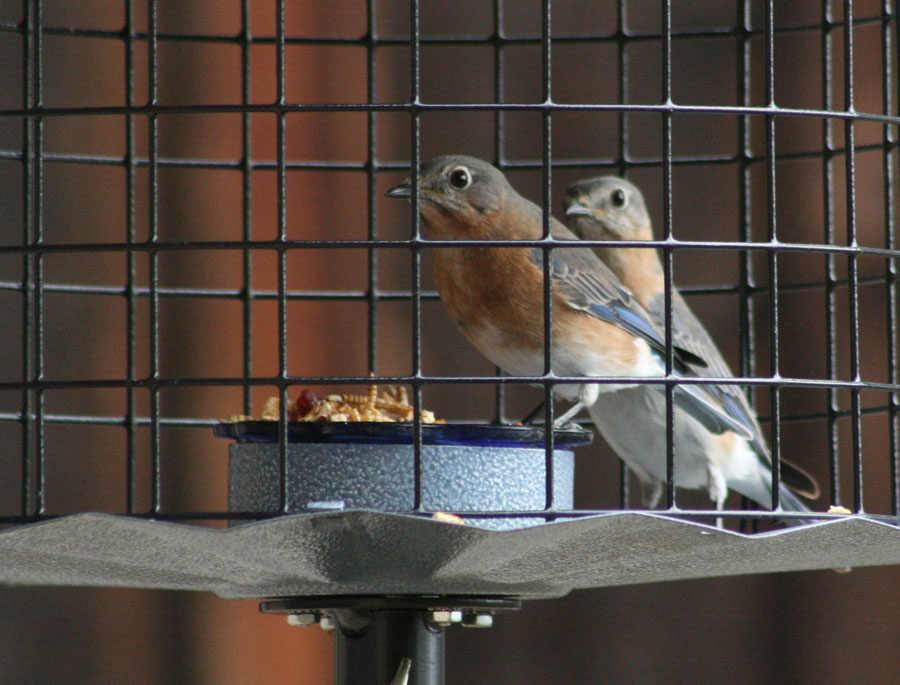
The mated pair of my nest box bluebird family was not familiar with a mealworm feeder prior to their exposure this past spring.  They did not approach it or show curiosity at the onset, even though the feeder is very close to the nestbox.  Neither, did they have any experience with a human offering mealworms (nor did I).  It was while watching their behavior as they exited the nest box that I noticed that they sometimes paused on the guard and looked down for insects.  This gave me the idea to place the blue dish of meal worms in their direct line of vision as they rested on the nest guard after feeding young.
It was the female who first discovered the mealworms and landed on the dish with excited chirps, and who readily began to associate the blue dish with mealworms where ever it was placed.  This eventually led her to understand and associate the blue dish in the feeder with mealworms.  The male followed her example.  Very quickly, using fine honed flight skills, the male and female flew into the mealworm feeder's guard with precision, flattening their feathers and barely touching the wire guard that serves to keep out larger birds.
Female adult feeding inside the feeder with young bluebird perched on top.

The first brood juveniles were less precise in their landings and entrance, but also became very adapt at entering the feeder and collecting mealworms both for themselves and to feed to the second brood nestlings.  They also were not bothered by my presence, having seen me many times while in the company of their parents.  I could still distinguish them from their parents by behavior.  The male and female adults both often faced me when they landed, sometimes flying to a closer perch when I was present, and stared at me and wing-waved to solicit more mealworms.  Their bond to me as a potential source of food has remained strong due to their exposure throughout their feeding of two nest broods during the summer.  This behavior sets them apart even now.
The younger bird pictured in the top and third images, finds her way into the feeder, above, and stands alert behind the older female, possibly watching for her reaction or waiting her turn.  Below, a second young bird does not attempt to enter the feeder, but teeters on the outer edge to grab home-made suet that has fallen onto the platform.
Having observed these feeding behaviors and able to distinguish the mated pair from the season's offspring even after the first brood youngsters began to molt and lose their juvenile spots,  I have assumed that the bluebirds now visiting the mealworm feeder are the nest box pair and their offspring.  Since the family left the immediate area after the second brood fledged, I have naturally assumed that the birds having difficulty entering the feeder through the guard are the second brood juveniles that had no opportunity to practice.  
Having said that, last night I opened my new and wonderful resource for bluebird information, Studying Eastern Bluebirds, A Biologist's Report and Reflections, by David Pitts, and began to partially unravel some of my assumptions, or at least cast doubt on them.  As always, with animal and bird observations, we try to make sense of what we are seeing based on what we know about a species or about individuals, but there are many variables and possibilities to consider.  
Some of the interesting information that I read about flocking in Pitt's chapter on wintering bluebirds gave me pause, raising questions but not necessarily answering them.  This is not a bad thing, of course.  Unanswered questions cause us to observe more closely and open our minds to many possibilities.
To summarize, Pitt's winter observations of bluebirds he had banded led him to suggest that each wintering bluebird flock usually contained one adult male, one adult female, and two to six young bluebirds that had hatched the previous summer.  The adults were often, but not always, the mated pair in the territory that included their nest box.  The juvenile bluebirds in a winter flock, on the other hand, were usually not the offspring of the adults in that flock.  However, fledglings from a late nest did sometimes remain with their parents into the winter.  (aha!)

That last statement made me chuckle.  Question answered, question unanswered.  Am I seeing the inexperienced second brood juveniles returning to the feeder with their parents?  Or am I seeing young birds from other local families or migrants that have joined this pair's flock for winter survival?  It is certain I will never know the answer, but it is also certain that I am seeing young birds, numbering four to six, accompanying the familiar adult pair to the feeder, and that all of them are better equipped to survive the winter in the company of each other.

In the last three images, above, you are seeing the same young bluebird attempting to enter the feeder. She ultimately did not go inside, choosing to grab morsels of food from the outer rim, instead.  

More observations on wintering bluebirds and flocking behavior in upcoming posts.  

Links and Resources:

Studying Eastern Bluebirds, A Biologist's Report and Reflections by T. David Pitts

Feeding mealworms to bluebirds
My blog posts on my bluebird family
Bluebird art found on my website watercolor gallery and in my online shop.
Related Posts Plugin for WordPress, Blogger...

Ocean Trail at Palos Verdes Nature Preserve, California--2015

Ocean Trail at Palos Verdes Nature Preserve, California--2015

Bird-banding at Seven Islands State Birding Park--2014

Bird-banding at Seven Islands State Birding Park--2014
Photo courtesy of Jody Stone

Bird-banding at Seven Islands

Bird-banding at Seven Islands
Photo courtesy of Karen Wilkenson

Enjoying Gray Jays in Churchill!--2014

Enjoying Gray Jays in Churchill!--2014
Photo courtesy of Blue Sky Expeditions

Smithsonian National Zoo with one of my Whooping Crane banners and son, John--2014

Smithsonian National Zoo with one of my Whooping Crane banners and son, John--2014

The Incredible Muir Woods near Stinson Beach, CA--2014

The Incredible Muir Woods near Stinson Beach, CA--2014
Photo courtesy of Wendy Pitts Reeves

Me and Denali--2012

Me and Denali--2012
Photo courtesy of Bob King

For the Love of It...

...the sage sees heaven reflected in Nature as in a mirror, and he pursues this Art, not for the sake of gold or silver, but for the love of the knowledge which it reveals.
Sendivogius (1750)

Your Uncapped Creativity...

Your Uncapped Creativity...
"There is a vitality, a life force, an energy, a quickening that is translated through you into action; and because there is only one of you in all time, this expression is unique. If you block it, it will never exist through any other medium and it will be lost. The world will not have it. You must keep that channel open. It is not for you to determine how good it is, nor how valuable. Nor how it compares with other expressions. It is for you to keep it yours, clearly and directly." ----the great dancer, Martha Graham