Saturday, October 10, 2015

Albino Ruby-throated Hummingbird in East Tennessee

On October 4th and 5th, Mark Armstrong, Master Bander of hummingbirds and songbirds, and Janie Kading traveled from Seymour, TN, to Oliver Springs, TN, to capture and band an albino Ruby-throated Hummingbird.  Their second trip was successful! 
The young female, hatched this summer and weighing 4.1 grams is pictured above and below in photos taken by Mark Armstrong to document her condition.   In the image above you can see the dark red of her eye, and the lack of pigment in her beak, normally black in coloration.  
Mark explains albinism this way:  Albinism is a sex linked recessive characteristic and carried on the X chromosome.  In birds males are XX and females XY, so if a female had the gene it would be expressed and if a male had the gene he could carry it as a recessive characteristic and look normal or if he inherited the characteristic from both parents the gene would be expressed and he would be albino.  
"I think most likely our bird was the product of two normal birds but she would have inherited the trait from her father.  There is a lot I don’t understand about the trait....This bird did have dark red eyes, pigment wasn’t present in the beak or feet.  She did have dark bases to the feathers on the back however.  In ruby-throats the trait is rare but there usually are a few every year.  Leucistic is more common and those birds will have patches of white or overall a faded appearance. The genetics of that trait is more complex and involves the synthesis of melanin or turns it on or off in different areas of the plumage.  It was 6 or 7 years ago I went after a white bird and asked Bob Sargent for some advice and if I should try to band it.  He said sure, he had banded 100 or so but none have ever returned."   
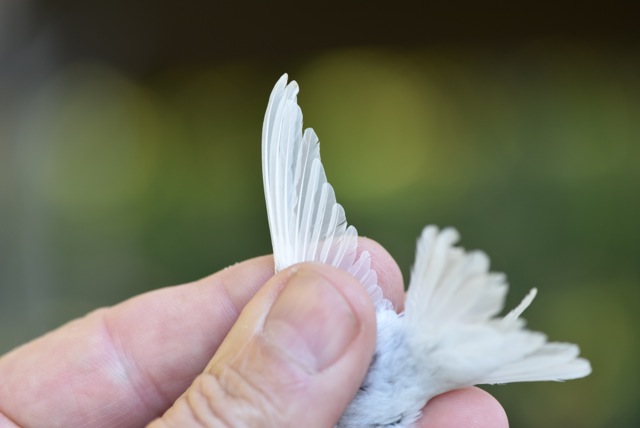
Mark adds, "They are pretty vulnerable.  This bird reminded me of a cicada flying with those white wings flashing. Melanin actually strengthens the feathers so white birds tend to have worn plumage, this bird was actually in pretty good shape.  She also weighed 4.1 grams so had a good fat load and was preparing to head out.  I talked with the host yesterday and she did not see the bird the following morning."
The image above captures the fairy-like quality of the hummer's tail feathers absent normal pigment. The absence of pigment allows feathers to wear rapidly, as well as, makes the hummingbird more visible to predators.
Photo credit:  Kathy Townsend

Kathy and Tom Townsend were the hosts to this beautiful hummingbird in Oliver Springs.  Kathy called her. Angel, and she writes the following:  "This is the picture [above] I took the last time I saw Angel on Oct. 6th.  She was truly a blessing from God and I am so thankful for the experience.  I sure do miss seeing her.  She was at our home for 9 days.  It was a wonderful experience that I will never forget and what made it more special was when Mark put her in my hand after he had done the measuring and weighing, and I was able to let her fly.  She stayed in my hand, it seemed like a minute, but I'm sure it was several seconds and then off she flew.  I didn't think she would be back.  I thought maybe she was traumatized from being captured, but she came back to the same feeder that evening.  Then I knew that it is a harmless procedure and so well worth it."   Kathy also reported that after speaking with Mark the next morning and reporting the hummer hadn't returned, she then saw the hummer later that morning.  That was the last day the hummer was seen at their home.  
In 2013, Cyndi and Steve Routledge hosted an albino Ruby-throated Hummingbird in Clarksville, TN.  The images directly above and below were taken by Cyndi Routledge in her yard.  Since that time, Cyndi has also become a Master Bander and bands hummingbirds and songbirds in Middle and West Tennessee and northern Mississippi.  To see more images visit:  Albino Ruby-throat

Links and Resources:

Visit this link to read more about Mark Armstrong and fall/winter hummingbird banding
More about summer hummingbird banding.
Mark Armstrong, Master Bander of songbirds and hummingbirds

Monday, September 7, 2015

American Redstart Among Birds Banded at Seven Islands

A busy morning of banding at Tennessee's Seven Islands State Birding Park resulted in 66 birds banded and 10 recaptures for a total of 76 birds processed by Mark Armstrong and his banding team on September 6th.
Eleven species were captured including a lovely female American Redstart shown below being held in a bander's grip..
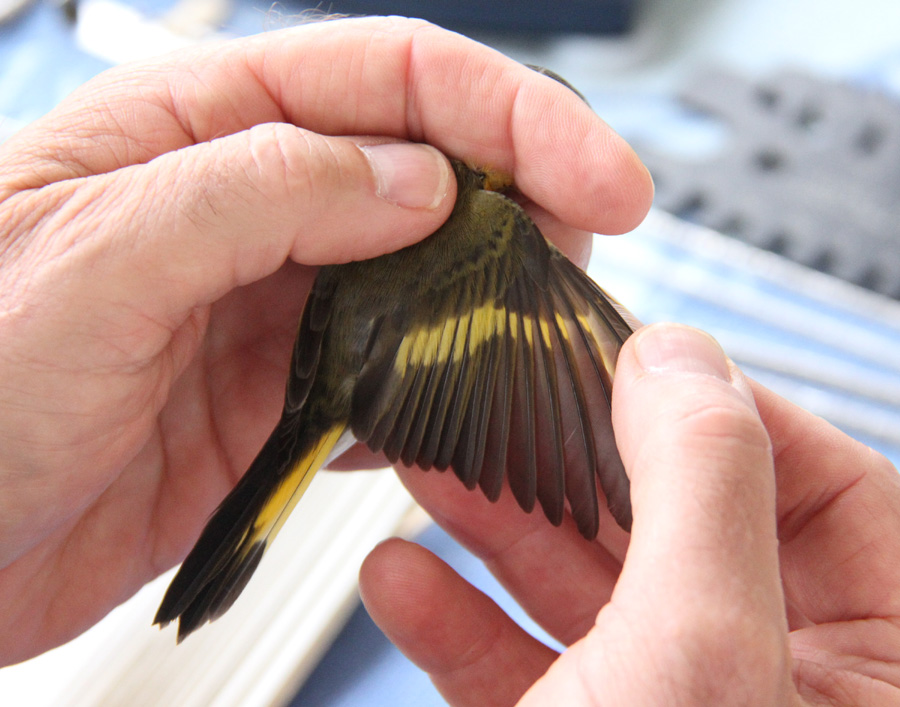
The female of the species has a gray head with olive back and wings.  She is beautifully marked with bright yellow areas and has a white underbelly.  The male of the species is black and marked with reddish-orange.

Above, Mark places a band on a female American Redstart, and below, a look at the yellow in her striking tail.
Redstarts, a species member of the wood warbler family, are frequently seen fanning their tails while foraging as illustrated in my sketch below.
The banding station is set up on the front porch of an historic farm house on the Seven Islands park property. Banding team members arrived at 6:30 a.m. to erect the nets before daylight.

The first "net run" occurs at 7:30 a.m. when members of the team check all of the nets to remove birds that have been captured.  Each bird is placed in a cloth bag and held until processed at the banding station.  Nets are checked at regular intervals through out the morning until the nets are taken down, usually at 11:00 a.m.
Above, Billie Cantwell (center) and Mark Armstrong process birds.
Birds are held in soft cloth bags that help to keep them calm while waiting to be processed.
After the band is attached to the bird's leg, the bird is examined for health and age. Measurements of the wing and tail are taken, the skull and belly are examined, and the bird is weighed before release. The information recorded helps to track the health and changes in the bird population at Seven Islands, as well as, contributes to grassland research.  
Above, Mark opens a band before placing it on the leg of a Field Sparrow.  25 field sparrows were banded, along with 3 recaptured for a total of 28 processed.  Field Sparrows are one of our year-around grassland species.  The second most common species was the Indigo Bunting for a total of 15 banded.  

Above and below, Billie Cantwell examines a female Blue Grosbeak.  This bird was recaptured and originally banded in May of this year.  Below, Mark and Billie discuss the molting pattern of the feathers to affirm the bird's age.  Female Blue Grosbeaks are brown with a hint of blue in their shoulder feathers, while the males are bright blue with orange bars.
Below, Gar Secrist brings a bird back from the net, accompanied by park visitors. Visitors are welcome to observe the banding process.

Mark measures the wing of a Brown Thrasher, above, one of the largest birds captured for the day. The size and personality of a thrasher makes it a fun bird for children to experience.
Richard Secrist shows a young visitor the bright yellow eyes of the thrasher.  Brown Thrashers have large curved beaks and beautiful rust plumage with a cream breast and belly with rust spots.  Very striking birds.

Another highlight of the morning was the capture of a young hummingbird.  Billie Cantwell banded the juvenile and recorded the details.
Above and below, she measures its wing and beak.
With a magnifying loop, she checks for grooving in the juvenile's beak.  Grooving helps the bander to age the bird.  The grooving indicates growth in the beak, a characteristic of juveniles.
For release, Billie places the hummingbird in the hand of one of our visitors.

An Eastern Kingbird was the second largest bird captured at the net.  Above, Mark is measuring her tail.  A flycatcher species that is always fun to see at close range, kingbirds breed in eastern North America and overwinter in South America, 
Situated on more than 410 acres along the French Broad River, Seven Islands State Birding Park includes raparian zones (where land and water meet) and open grassland habitat planted with native grasses, wildflowers, shrubby fruit-bearing plants, and trees, providing favored habitat and food sources for many grassland species and migrating warblers.
Mark Armstrong is a Master Bander of hummingbirds and songbirds.  Billie Cantwell is a banding apprentice and past president of the Knoxville Chapter of the Tennessee Ornithological Society.

Visit my previous posts on bird banding.
Blue Grosbeak
Bird Banding at Seven Islands State Birding Park
Knoxville Chapter, Tennessee Ornithological Society
Visit the Knoxville Chapter of TOS on Facebook
Seven Islands State Birding Park
Seven Islands Wildlife Refuge now Seven Islands State Birding Park

Wednesday, August 26, 2015

Wonder of Hummingbirds Festival Holds Outstanding Event!

Ruby-throated Hummingbird migration is in full swing in Tennessee making this an exciting time of year for hummingbird lovers!  
The male Ruby-throated Hummingbird shown above is molting feathers, meaning the old worn ones are falling out and being replaced with new ones.  Tiny white tubules, that become the feather's shaft, hold the feathers as they grow.  Molting during migration is a sign of health, according to Master Bander, Mark Armstrong.  It means the hummingbird has enough energy reserves, or fat stored, for both migration and healthy growth.
Photo credit:  Jody Stone

On Saturday, Aug 22nd, the Knoxville Chapter of the Tennessee Ornithological Society and Ijams Nature Center hosted their fifth annual Wonder of Hummingbirds Festival in Knoxville and the crowd of people attending were enthusiastic and eager to enjoy the many nature activities offered by the festival.

Photo credit:  Tom Howe

Organized by talented KTOS member, Billie Cantwell, the event attracted more than 1300 visitors who enjoyed hummingbird banding, nature walks, wildlife demonstrations, expert speakers, food and arts and crafts vendors and exciting children's activities!
Photo credit:  Susan Baumgardner

The popular highlight of the event is the hummingbird banding demonstrations offered by Mark Armstrong, Master Bander of hummingbirds and songbirds.
Photo credit:  Jody Stone.   Mark Armstrong examines a hummingbird.

Below, volunteer Andy Troutman removes a male Ruby-throated Hummingbird from one of the bander's traps.  Hummingbirds enter the trap to access the feeder and a door is lowered with an attached line.  

Photo credit:  Susan Baumgardner.  

Once removed from the trap, the hummer is placed in a mesh bag and transported to the bander.
Photo credit:  Jody Stone  

Photo credit:  Susan Baumgardner.

Mark first checks the hummers legs to be sure there is no current band.  He then secures a numbered band around its leg and examines the hummer for age, sex and health.  Measurements are recorded for the tail and beak and the belly is checked for fat to help determine overall health. If the individual is a juvenile male, he also records the number of red feathers on the throat.
Photo credit:  Jody Stone.

Above, Mark Armstrong attaches a numbered band to a hummingbird's leg.  The small stocking covers the hummers head and helps to keep it calm.  Watch the video below to see banding in progress.

 
Video credit:  Jody Stone

Photo credit:  Susan Baumgarder.

Above, Patty Ford gives visitors a close look at a hummingbird before release and below, she gently places a hummingbird in a child's hand for the release.    
Photo credit:  Jody Stone.

The banding station banded 28 hummingbirds and had one male re-capture that was originally banded at the festival three years ago.  The average life-span of a male hummingbird is 1.4 years and the oldest recorded male hummingbird was five years old.  Our re-captured bird is doing well!
I was introduced to hummingbird banding in 2009 at the first banding demonstration held at Ijams Nature Center, sponsored by KTOS, and it has been exciting to watch this event expand and attract the large crowds attending today.  
Photo credit:  Warren Hamlin.  

Above left, my exhibit table at the festival and (right) Stephen Lyn Bales, author, artist and naturalist discussing his natural history books.
             "Hummingbird and Million Bells" -- watercolor by Vickie Henderson

Links and Resources:

Tennessee Wildside video of 2013 festival

Saturday, June 20, 2015

A Tiny Hummingbird and a Great Big Trailer!

It was so much fun to see this brand new shiny Conestoga Trailer with my hummingbird image featured on its tail! 
Photo credit:  Melissa Carter

Conestoga has been putting wildlife images on the tails of its trailers for sometime now, featuring both birds and mammals.  You can see some of these images at their gallery featuring their "trailer tails".

One of my birding friends, Wallace Coffey of Bristol, TN, happened to see a trailer with three juvenile owls on the back.  He was so impressed, he asked the driver how the birds happened to be there.  The driver was very cordial and said he was asked about the wildlife art frequently.  He said the owner of the company was a conscientious conservationist and very environment-minded. Wallace, in turn, sent me an email, "Wouldn't it be fun to see a tiny hummingbird featured on the back of one of those big trailers?"  I thought it was a great idea, too!
This week it happened.  The hummingbird image was added to Conestoga's newest trailer by Creative Edge Graphics.  I went to see it yesterday and was wowed. It is stunning! Shiny and beautiful with red lettering matching the red Cardinal Flower visited by a tiny juvenile hummingbird.  This is what drivers on the road will see when they happen to be behind this trailer--a hummingbird traveling all over the country to remind everyone to take care of our environment!
As if hummingbirds visiting our feeders and flowers isn't enough, the timing of this trailer release just adds more excitement as we look forward to our upcoming hummingbird festival.

The Wonder of Hummingbird Festival takes place in Knoxville, Tennessee, at Ijams Nature Center on Saturday, August 22nd.  If you have not already done so, mark your calendar!  The festival features hummingbird banding, expert speakers, nature walks, wildlife demonstrations, and vendors selling food and drinks, native plants and arts and crafts.
                                                                                   Photo credit:  Jody Stone

I will be there with a table of my art.  Come by and say, hello!  Last year one group of hummingbird enthusiasts from Indiana planned their trip to the Smoky Mountains so they could also take in the festival.  Visit this link to see some of last year's festival fun:  Wonder of Hummingbirds.

To see more images of this hummingbird, visit:  Hummingbirds and Pollen

Also visit Wonder of Hummingbirds Festival at East Tennessee River Valley Geotourism
Related Posts Plugin for WordPress, Blogger...

Ocean Trail at Palos Verdes Nature Preserve, California--2015

Ocean Trail at Palos Verdes Nature Preserve, California--2015

Bird-banding at Seven Islands State Birding Park--2014

Bird-banding at Seven Islands State Birding Park--2014
Photo courtesy of Jody Stone

Bird-banding at Seven Islands

Bird-banding at Seven Islands
Photo courtesy of Karen Wilkenson

Enjoying Gray Jays in Churchill!--2014

Enjoying Gray Jays in Churchill!--2014
Photo courtesy of Blue Sky Expeditions

Smithsonian National Zoo with one of my Whooping Crane banners and son, John--2014

Smithsonian National Zoo with one of my Whooping Crane banners and son, John--2014

The Incredible Muir Woods near Stinson Beach, CA--2014

The Incredible Muir Woods near Stinson Beach, CA--2014
Photo courtesy of Wendy Pitts Reeves

Me and Denali--2012

Me and Denali--2012
Photo courtesy of Bob King

For the Love of It...

...the sage sees heaven reflected in Nature as in a mirror, and he pursues this Art, not for the sake of gold or silver, but for the love of the knowledge which it reveals.
Sendivogius (1750)

Your Uncapped Creativity...

Your Uncapped Creativity...
"There is a vitality, a life force, an energy, a quickening that is translated through you into action; and because there is only one of you in all time, this expression is unique. If you block it, it will never exist through any other medium and it will be lost. The world will not have it. You must keep that channel open. It is not for you to determine how good it is, nor how valuable. Nor how it compares with other expressions. It is for you to keep it yours, clearly and directly." ----the great dancer, Martha Graham