Showing posts sorted by relevance for query pileated woodpecker family. Sort by date Show all posts

Wednesday, March 21, 2012

A Glimpse of Pileated Woodpecker Love

It's impossible to hear that sound and not follow it out the door--the high-pitched ringing of a pileated woodpecker's call, especially when it comes from a tree right outside my window.  
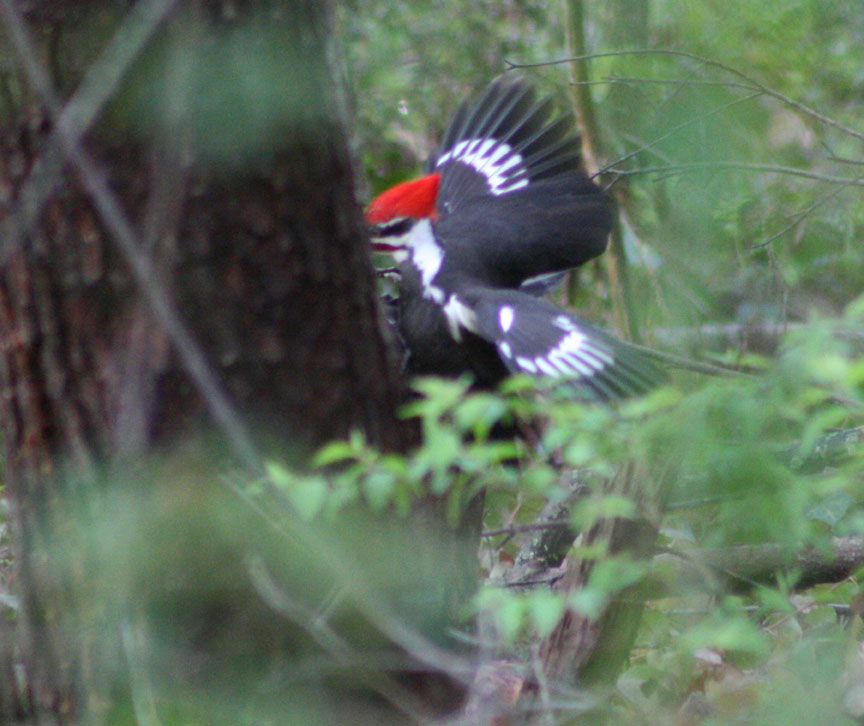
There is a family of three frequently foraging in my yard and around its wooded edges. Above you see the adult female. (I can distinguish her from the younger female only by the sequence of behaviors that followed.)
They visit older deciduous trees, prying the bark loose or excavating, feeding on larvae and insects, and sometimes foraging on the ground on decaying stumps and fallen limbs.  The three family members consist of two females and a male, which I assume to be the mature pair and one of the season's off-spring.  Needless-to-say, it is a real treat to spot one calling pileated woodpecker, and hear more calls from your left and your right, until you realize you are in the midst of a foraging family.   The male, showing his red facial stripe and red crest, is in the foreground in the images above and below.  The female with a lesser crest, black on her forehead, and black facial stripe, is in the background.
On this particular occasion, March 18th, I observed the male foraging among leaves and fallen branches in a wooded area at the edge of the lawn, flipping leaves in the air as he foraged. The females were foraging on nearby trunks.  One female, believed to be an off-spring, flew into a wooded edge to the east, while the other female remained near the male, foraging a nearby trunk, and subsequently, dropping to the ground to forage near him.  
It is well known that during breeding season many mated pairs of birds perform nuptial feedings, perch close to each other, or forage together to strengthen the pair bond during nesting and incubation. I realized after watching this pair for a while that there was more going on than simple feeding.
After foraging near the male for a while, the female hopped onto a stump, and then moved to a near trunk, landing close to the ground on the opposite side and only partially in view from where I stood.  Above you see her just after she's lands on the stump and is about to move again. Even though she is partially hidden by undergrowth, her body position gives you a good look at the length of her tail brace.  While the two foraged together, they exchanged whimpering calls, lower pitched, solicitous calls that seem to have a contact function.
The male continued to forage but frequently looked in the direction of the female.  In the following sequence of images you see him as he raises his crest in a courtship display and joins the female on the other side of the trunk for copulation.  
An updated listing of bird breeding chronology in Tennessee (2003), supplemental to the Atlas of Breeding Birds of Tennessee by Charles P. Nicholson (University of Tennessee Pres, 1997), lists nesting and eggs for pileated woodpeckers occurring from April 4 to May14.  The atlas nest and egg record is based on direct observation.

I am not optimistic about discovering this pair's nest, though I feel certain it is nearby (likely in the dead stub of a tree anywhere from 15-70 ft high).  The wooded areas that surround my yard are steep, their gradients likely what saved them from development, also saving some of the old growth that makes good nesting habitat for this family of woodpeckers.  This same characteristic, however, makes extensive wandering in search of a nest, impossible.    
Pileated woodpeckers are said to maintain a strong pair bond throughout the year, and that certainly seems the case with this pair.  I have observed this family foraging together on many occasions throughout the winter.  Since nesting season has begun, I will be interested in seeing how much longer the off-spring remains with the pair.
Above, male pileated woodpecker with raised crest and red cheek stripe.  Below, female with black forehead and black cheek stripe.
Links and Resources:

To hear one of the calls of a pileated woodpecker click here.  There are several other calls, one with a trailing echo, the other, a whimpering style call, that is lower in pitch and more solicitous.
Cornell's site on the pileated woodpecker.

Visit my other pileated woodpecker posts on this blog.

Friday, February 7, 2014

Pileated Woodpeckers in the Snow

Pileated woodpeckers are delightful birds to watch and it is an extraordinary experience to observe one at eye-level and have it linger for a while.
On January 28th, during a beautiful snow fall, I first heard, then located, two pileated woodpeckers foraging around the yard, visiting old growth trees both in the yard and its wooded edges.  It was 19 degrees F, COLD and windy.  
Above, you see the female (top) and the male below her after she briefly landed on the same tree and they foraged together for a few minutes.  Below, the male as he looks up from foraging.  This bird's woodpecker movements are jerky, alert, ever scanning the environment and checking movement above and below, even though they sometimes ignore humans.  Among their predators are Cooper's Hawks and the Great-horned owl.


I finally retreated inside because I was so cold and my view was obscured by other trunks and limbs. Within 30 minutes, as I stood looking out the window at the snow and feeder birds, I saw the female as she landed on a tree at the edge of the patio.  This is the sort of opportunity that calls for grabbing a coat and camera and maneuvering out the door as carefully as possible.
Above is a photo of her farther out in the yard.  Notice how she has her tummy feathers fluffed with air protecting her legs from the cold and adding to her overall warmth.  She has a very young face and I suspect that she is the male's offspring rather than his mate.  I have seen this family together in April in seasons past as they begin their breeding season.
I opened the door and was very surprised that she ignored me and continued with her foraging.  Clearly she was finding something of interest. I was torn between zooming to get close images, or pulling back to get her whole body in.  I adore seeing the expression on her face, but also like the image below that shows that long sturdy tail-brace, so important in her movement and balance.
Below you can see her tongue as she probes under the bark. Woodpeckers have sticky, barbed tongues that help retrieve the insects that are hidden in crevices and underneath the bark.
Communication among family members is as facinating as watching these woodpeckers scoot up a tree, as they periodically stop to probe, pound, and extract insects.  The bugle-like call can be heard on the Cornell All About Birds site (link below) and is their most famous and loudest call.

There are also more intimate calls that specifically occur when family members are together, most often attributed to mates, but also heard when juveniles are foraging with parents.  On this occasion, I only heard the bugle call and occasionally the "kuk-kuk-kuk" sequence.
The habitat here is old growth forest with decaying trees in a suburban area where home development is interrupted by undeveloped wooded slopes.  These are the kind of broken zones that support many woodpecker species and allow people and wildlife to peacefully co-exist together.


The winter months are exceptional woodpecker-viewing months in east Tennessee.  Woodpeckers are easily spotted on bare trunks and tree limbs.  They are busy foraging to keep warm and sustain their nutritional needs.  Some woodpeckers from the mountains come down to the Tennessee Valley to spend the winter, among them the yellow-bellied sapsucker.
Above, a male yellow-bellied sapsucker forages in the yard at the same time the pileated family was present. Below, the male pileated woodpecker among large decaying limbs.

Images were taken with a Canon Rebel T2i with 100-400 Canon zoom lens.

Links and Resources:

More pileated woodpecker family posts on this blog.
Cornell All About Birds--Pileated Woodpecker.  Be sure to listen to the calls.
Cornell on Yellow-bellied Sapsucker.  Be sure to also listen to this sapsucker's call.  He blends with tree bark so well, that the call will likely be how you learn of his presence.

Saturday, April 6, 2013

Pileated Woodpecker--Ground Foraging

Pileated woodpeckers are totally spectacular birds.  Most of the time, it's not by accident that I find this bird in the yard--I hear his call.
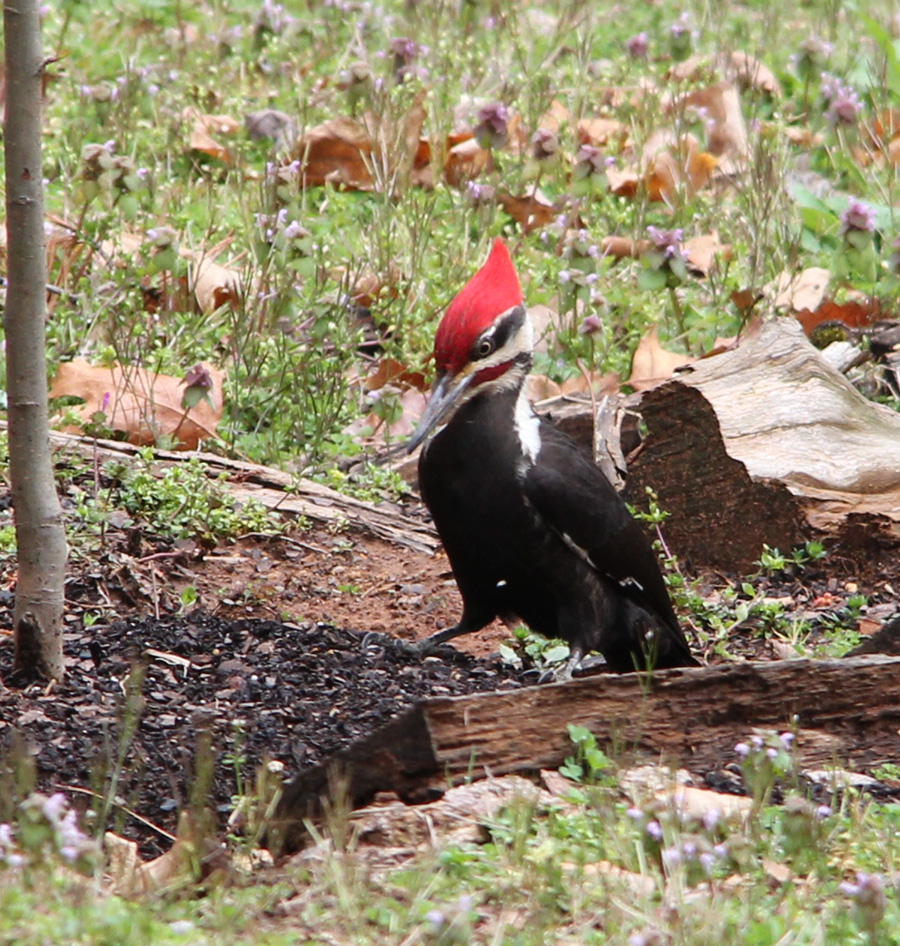
This time he was interested in foraging on the decaying logs on the ground which is always fun to watch.  As I opened the door in response to his call, I caught a glimpse of him as he disappeared below sight-level, landing on the ground in an area where I've known him to forage before.   
Pileated woodpeckers eat mostly insects--ants, beetle larvae, termites, flies, spruce budworms, caterpillars, cockroaches, grasshoppers--with their favorite food considered to be the carpenter ant.   They find the insects with hearing, sight, and by chiseling decayed wood and probing with their tongue.  
In the image above you can see a glimpse of his tongue, a long slender tool that wraps around his skull in a special design that enables long extension.  Additionally, woodpecker tongues are sticky and barbed with hair like appendages that make it easy to pick up tiny insects.  
Even so, I've wondered how they feed their young with their food source being so tiny. The answer is they are a regurgitant species, meaning they partially digest their food and regurgitate it into the young's gaping mouth.
The latin name for the Pileated Woodpecker is Dryocopus pileatus.  The word dryo comes from the Latin word for tree, and kopis is Latin for dagger.  The term "pileated" or "pileatus" means capped or crested, referring to the bird's bright red crest.  This woodpecker lives up to the name with his long, chisel-shaped beak and his large crest that becomes even more impressive when raised.   

Pileated woodpeckers are attracted to mature forests with dying and decaying limbs, and downed wood.  That is what attracted this male to the ground--the split logs that surround a small garden area in the yard.  These cut pieces of wood decay over time and the same insects that burrow in the dead limbs of a tree, may also be found in fallen limbs or logs.


He moves on the ground just like he moves on a tree trunk, a scooting type walking motion mixed with hops and jumps. These images were taken on March 31st, a very windy morning and he frequently stopped and froze for a few seconds to look and listen, mostly in the direction of the moving tree limbs.  He also pauses amd holds his head up to swallow the food collected on his tongue. 


Around the turn of the twentieth century, the pileated woodpecker was declining and biologists were afraid the species would disappear because of the clear cutting of old growth forests.  Fortunately, unlike the Ivory-billed Woodpecker, this species adapted to second growth forests and its population numbers are considered to be in good shape at the present.


Visit this link to see an earlier visit this month from the whole family:  Pileated Woodpecker Family Visit
To hear the pileated calls visit Cornell's site and listen to the sound recording:  Cornell's All About Birds

And to see some of my other visits with Pileated Woodpeckers on this blog, visit:  Pileated Woodpeckers
Related Posts Plugin for WordPress, Blogger...

Ocean Trail at Palos Verdes Nature Preserve, California--2015

Ocean Trail at Palos Verdes Nature Preserve, California--2015

Bird-banding at Seven Islands State Birding Park--2014

Bird-banding at Seven Islands State Birding Park--2014
Photo courtesy of Jody Stone

Bird-banding at Seven Islands

Bird-banding at Seven Islands
Photo courtesy of Karen Wilkenson

Enjoying Gray Jays in Churchill!--2014

Enjoying Gray Jays in Churchill!--2014
Photo courtesy of Blue Sky Expeditions

Smithsonian National Zoo with one of my Whooping Crane banners and son, John--2014

Smithsonian National Zoo with one of my Whooping Crane banners and son, John--2014

The Incredible Muir Woods near Stinson Beach, CA--2014

The Incredible Muir Woods near Stinson Beach, CA--2014
Photo courtesy of Wendy Pitts Reeves

Me and Denali--2012

Me and Denali--2012
Photo courtesy of Bob King

For the Love of It...

...the sage sees heaven reflected in Nature as in a mirror, and he pursues this Art, not for the sake of gold or silver, but for the love of the knowledge which it reveals.
Sendivogius (1750)

Your Uncapped Creativity...

Your Uncapped Creativity...
"There is a vitality, a life force, an energy, a quickening that is translated through you into action; and because there is only one of you in all time, this expression is unique. If you block it, it will never exist through any other medium and it will be lost. The world will not have it. You must keep that channel open. It is not for you to determine how good it is, nor how valuable. Nor how it compares with other expressions. It is for you to keep it yours, clearly and directly." ----the great dancer, Martha Graham