Sunday, October 13, 2013

Hummingbird Migration--Leave a Winter Feeder Out!

Ruby-throated hummingbird migration through Tennessee is winding down.  Most people assume all hummers are gone.  It is true that the majority of migrating hummers are well south of Tennessee now, but there are some late individuals coming through.  
Last night I had two in the evening, one perched next to the pineapple sage, nectaring and resting, nectaring and resting, with no feeder visits.  The second was perched high on a limb and made a brief visit to the flowers before being chased away by the first bird.
This morning I also had two ruby-throats visiting the pineapple sage. Both of these birds also visited the feeders briefly and were seen between 7:30 and 8:30 a.m.  In the days previous, the hummers I have observed have only been nectaring the salvia, both the black and blue variety and the pineapple sage.  
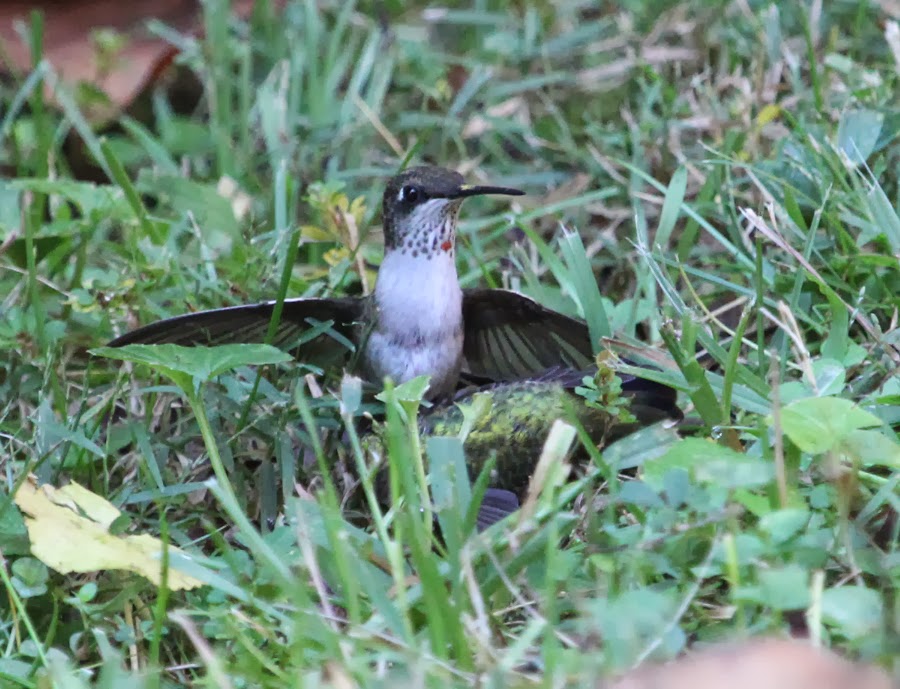
I have had good luck with the pineapple sage I planted this spring and it is blooming profusely right now. The salvia family seems to love the cooler season and the hummingbirds love the salvia. Below, a hummer visiting the pineapple sage yesterday, Oct 12th.
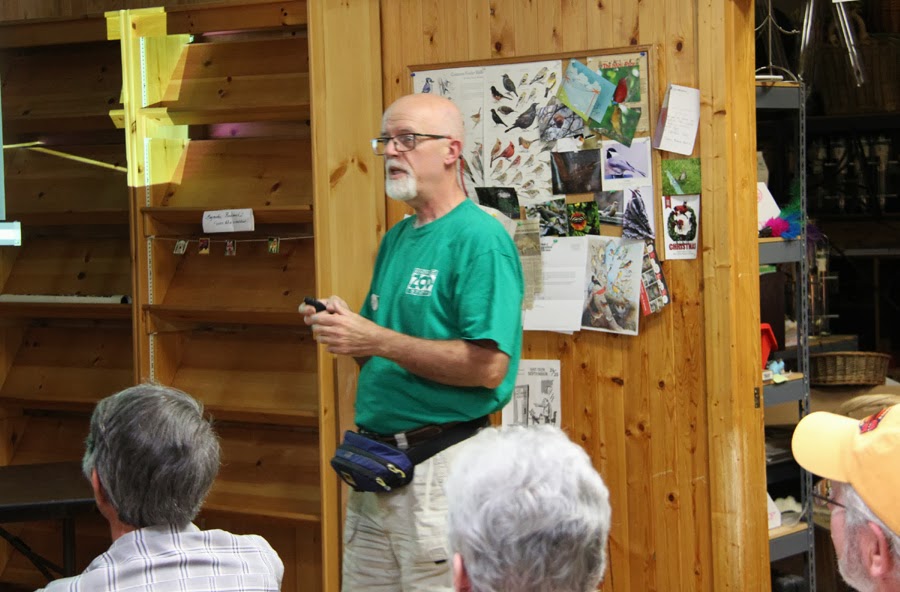
Yesterday, I also went to a presentation given by Mark Armstrong, a Master Bander of hummingbirds and the person in our area to contact when we have a wintering hummingbird. Leaving a feeder out is a good thing to do if you live in the southeast. It is not that the hummingbirds that winter in our area need our feeders, but having a feeder out enables us to see them more readily and learn about these birds.
Above you see an immature Rufous Hummingbird that was captured and banded in January of 2011 in west Knoxville.  This hummingbird returned to the same area and was recaptured in December of 2012 as a healthy mature male.  Below, a slide presented by Mark in his presentation at Wild Birds Unlimited in Knoxville with historical information about wintering Rufous Hummingbirds in the southeast.
Bob Sargent has been banding Rufous hummingbirds in the east since the 1980's and his research suggests that a hardy strain of Rufous Hummingbirds is developing that is genetically programmed to winter in the southeast.
Mark explained that there are always hummingbirds that deviate from the expected migration route but the increase in Rufous hummingbirds doesn't fit with random events.  Hummers will travel to areas where the climate and food is beneficial to their survival and some are clearly drifting east and returning on a regular basis. Mark reported that all of the Rufous Hummingbirds he has banded are healthy, molting and growing new feathers, have a good level of fat, and clearly are fairing very well in the east Tennessee winter climate. These hummers depend on natural sources of nectar, insects, and tree sap to sustain their diet in the winter.
Allen's Hummingbird that wintered in Russellville, TN in 2011 and 2012. Photo credit: Billie Cantwell.

There are several species of hummingbirds that have been recorded in Tennessee in addition to the Rufous: Black-chinned Hummingbird, Allen's Hummingbird, Anna's Hummingbird, Calliope Hummingbird, Broad-tailed Hummingbird, and Green Violetear. Unlike the Rufous, other hummingbirds are rare visitors and are not known to return for consecutive years. There are exceptions, such as the Allen's hummer that returned for a second season last year.  

There are many things that remain unknown about hummingbird migration.  Leaving a feeder out for wintering birds allows us to see the hummer and possibly band it so that biologists can learn more about hummingbird migration patterns, changes in these patterns, and about wintering species in the east.

If you live in the east and have a hummingbird visiting a feeder in your yard after November 15th report your observations. For information about who to contact if you have a wintering hummingbird, click this link.
Incubating female Allen's hummingbird sketched from a live webcam by Vickie Henderson.  The Allen's species breeds in coastal California and traditionally winters in northwest Mexico.

Links and Resources:

Mark Armstrong, Master Bander of hummingbirds and songbirds, Avian Curator at the Knoxville Zoo, and past president of the Knoxville Chapter of the Tennessee Ornithological Society

Blog posts on hummers wintering in Tennessee:
Allen's Hummingbird in east Russellville, TN
Calliope Hummingbird wintering in Nashville, TN
Rufous Hummingbird and Rufous Hummer in Knoxville
Migration Surprises
Hummingbird Study Group

Friday, October 4, 2013

Ruby-throat Combat is Serious Business

These are the final days of Ruby-throat migration.  The last of the juveniles and late female breeders will be gone from my area in east Tennessee in a little over a week, as they move southward and eventually arrive in their wintering areas in southern Mexico and Central America.
We often attribute Ruby-throated aggression to high testosterone levels during breeding season, but clearly some of that aggression is pure Ruby-throat personality. In fact, this young bird makes it appear they are born with this aggression and have a timing-mechanism that stimulates its expression by the time they migrate.
On most mornings recently, the hummers drink hurriedly and move on to feed on insects, paying little attention to each other, sometimes even settling on the same feeder to drink.  This morning was different, however, with two juveniles keeping up a relentless dispute over territory that lasted at least fifteen minutes, if not longer.  
Their combat included face to face flight moving high into the air and dropping low into foliage.  Once I saw them land on twigs in close proximity, each seeming to expect the other to leave before they finally tangled in defiance.  Sometimes they directed high speed dives at each other and many times I heard wing buzzing and in-flight "splats" like those you hear at the feeders, but neither would give up dominance.
Eventually, they ended up on the ground. Having seen this before, I expected a brief skirmish with both birds eager to return to the air.  What I saw surprised me.
One bird succeeded in pinning the other to the ground and seemed quite content to keep him there. His posture as he held the bird down gave every indication of victory, with wings spread, neck stretched, looking slowly from side-to-side, as if proud, giving the appearance of dominance posturing.  You can see the top bird's foot in the above image and some of the others. He appears to have the bird pinned by the shoulder and right wing.  It is also likely that his other foot is on the bird's beak since the pinned bird did not raise his head while on the ground.
While holding the downed bird firmly in place, the top hummer proceeded to alternately lift his feet up and down in a "kneading" pattern, his body rocking with the movement. The pace would be similar to the steady rhythm of kneading dough.  A hummer's version of stomping?  This movement and pin-down lasted approximately a full minute and I became concerned that the downed bird might not survive.
As you scroll through the images below, you will see that the bird on the bottom is trying to move, curving his back to struggle free and moving his left wing.


I can't be sure if the top bird was ready to leave and simply lifted off, or if the bird on the bottom wiggled free.  Since I couldn't see the bottom bird clearly while watching, after the top bird flew, I walked over to look at the ground and fully expected to see a dead hummingbird.  Much to my relief, he had flown too.

It is pretty amazing how quickly a hummingbird's life changes from timid fledgling to sword-carrying militant. Clearly this young male is wired for survival!

More about hummingbird aggression 
Bob Sargent on Ruby-throated Hummingbirds
Hummingbird Study Group
Other posts on Hummingbird migration

Sunday, September 22, 2013

Albino Ruby-throated Hummingbird in Tennessee

A snow white beauty with pink bill, pink skin and red eyes, this albino ruby-throated hummingbird is visiting the home of friends, Cyndi and Steve Routledge, in middle Tennessee. (I'm ready to jump in the car and drive the four hours to visit them!)
One can't be entirely certain of the species because rufous hummingbirds from the west have already appeared in Tennessee, but since albino pigmented hummingbirds are short lived, this is more than likely a juvenile ruby-throated hummingbird.
According to Mark Armstrong, our Master Bander of hummingbirds here in Knoxville, Tennessee, Bob Sargent has banded about 50 albino hummingbirds over his career as a bander, but none have ever returned in subsequent years.
Albinism is a genetic mutation that prevents the production of melanin in the body, which is required for pigmentation or color.  Albinistic birds have pink or red eyes because of this lack of pigmentation--the eyes are reflecting the red color of the blood vessels.  Albinistic birds seldom live long because they are more visible to predators. Their odd appearance makes it more difficult for them to attract a mate so the genetic mutation for albinism is seldom passed to the next generation, making the occurrence of albinism very rare.
Cyndi describes their surprise discovery of the bird. "Steve first spotted the white bird on late Thursday afternoon (9/19). It was high in the canopy in our side yard in the afternoon sun searching for insects. At first he thought it was a big white moth, but soon realized what it truly was. He called to me (I was making dinner) and I was able to get a quick glimpse of it as it flew up and over the tree into the neighbor's yard."

Steve and Cyndi set up watch at the front and back feeders of their house and soon their snow white visitor reappeared.  
Above, albino ruby-throated hummingbird scratching. All photo credits in this post: Cyndi Routledge

The albino bird has been at the Routledges for four days.  Cyndi says, "He/she likes to perch in our Snowball Hydrangea bush.  Because it's white we have no way of knowing male or female unless it's "in hand".   I sent the pictures to Bob Sargent Thursday night since we were not sure whether it was a true albino or leucistic. Bob believes it's a true albino because it has pink legs, a pink bill, a red eye and pink skin."
Cyndi describes the bird as very vocal, "chattering away" when another ruby-throat comes into view.   "He likes to sit in the sunshine and preen, and I had a wonderful time watching him as it began to rain on Friday afternoon.  It was like he was taking a shower--fluffing and shaking and getting a quick drink from the raindrops on the leaves of the hydrangea."
"Alby, as Steve calls it, is very territorial of the hummingbird feeder that hangs right at the base of the hydrangea bush.  He chases off all other ruby-throats and this morning was chasing off Tufted Titmice who at first were actually chasing him/her.  My best guess was they, like ourselves, thought it was a large moth!"
"He also very much likes the salvia guaranitica (a gift from Bob and Martha Sargent this past spring) that is planted along our front sidewalk." (pictured above)
"This tiny little white bird is truly an amazing sight…it's a tiny little white angel."
Cyndi Routledge

All photo credits in this blog post:  Cyndi Routledge, photographer and naturalist in Clarksville, TN.

Ruby-throated Hummingbirds
Hummingbird Study Group
Cornell on Albinism and Leucism
Banding hummingbirds
Hummingbird migration

Friday, September 20, 2013

Seven Islands Becomes Tennessee's First State Birding Park

Visits to Seven Islands Wildlife Refuge over the past several years rapidly turned this wildlife sanctuary into one of my all-time favorite Tennessee natural areas.
Encompassing more than 410 acres along the French Broad River, this open grassland habitat is planted with native grasses, wildflowers, shrubby fruit-bearing plants, and trees that provide the favored habitat and food sources for many declining grassland bird species.  It was here that I became acquainted with several new species of warblers and sparrows, learned about bird banding and participated with the Knoxville Chapter of the Tennessee Ornithological Society (KTOS) bird banding team in gathering information about the birds that breed and winter on the refuge.  

Today I had the pleasure of attending the Legacy Luncheon for the Parks which took place beside the French Broad River at Seven Islands Wildlife Refuge.  Speaking to a record crowd of over 700 people who were present to support the work of the Legacy Parks Foundation, special guest, Governor Bill Haslam, announced that Seven Islands Wildlife Refuge is becoming Tennessee's 56th state park and the first in an anticipated series of State Birding Parks to be established across Tennessee.

Legacy Parks Foundation Board Chair, Chad Youngblood (below left), honors Pete and Linda Claussen for their generous and dedicated efforts in developing the refuge and fostering its transformation into Seven Islands State Birding Park.  
Among others, Wayne Schacher (below left), former refuge land manager and KTOS member, was recognized for his years of work on the refuge restoring native warm-season grasses, enhancing riparian and wetland areas, and developing habitat diversification for the benefit of wildlife species on the refuge.  In addition to the recreation value of nature trails and a river ramp for launching kayaks and canoes, the refuge has historically offered educational and research opportunities. KTOS has conducted bird banding studies on the refuge for many years.  
It was a special honor to be asked to create a watercolor to commemorate this event for the Legacy Parks Foundation.  The subject of that watercolor is a beautiful warbler that we often see and hear on the refuge--a Common Yellowthroat.
Below you see one of the signed and numbered limited edition prints that decorated the tables at the luncheon.

Myself with Mark Armstrong, Master Bander of songbirds and hummingbirds, past president of the Knoxville Chapter of TOS, and Avian Curator at the Knoxville Zoo. Mark has lead bird banding studies on the refuge for the past several years.

The Legacy Parks Foundation works to assure that our community enjoys exceptional recreational opportunities, natural beauty and open spaces by securing funding for land acquisitions and park improvements, accepting gifts of land, providing maintenance for greenway and conservation easements, and advocating for parks and outdoor recreation.

Seven Islands Wildlife Refuge
Seven Islands - Outdoor Knoxville with map
Legacy Parks Foundation
Seven Islands articles published in The Tennessee Conservationist Magazine
Bird banding at Seven Islands Wildlife Refuge
Knoxville Chapter, Tennessee Ornithological Society
Tennessee State Parks
WATE news coverage with video
Report from Chattanoogan
WBIR video coverage

Friday, September 13, 2013

A Peek into the Life of a Chimney Swift

Mark Armstrong, master bander of both songbirds and hummingbirds, and his wife Janie Kading, have a chimney swift tower that Mark constructed in their back yard   
For several years swifts have nested in the tower.  Small holes are drilled in the bottom of the base so that you can look up and actually see how many nestlings have their heads over the nest edge and how many swifts are roosting on the chimney wall.
This breeding season a pair of chimney swifts raised at least three young in the tower. The nests are shallow and when considering its small size, it is hard to imagine how three nestlings can fit into it.  Both the male and female bring sticks to build the nest, breaking them off with their feet and carrying them to the nest site in their beak.  The twigs are then sealed with sticky saliva from the swift's seasonally enlarged sublingual glands
Even more fascinating is the description found in the account of Birds of North America notating the timing of egg-laying.  "Egg-laying begins when nest half-finished at about 3-6 d, and new twigs and saliva added during incubation...."  The pair stops adding sticks shortly before the eggs hatch.
On July 1st, Mark and Jane set up traps to capture and band hummingbirds in their yard.  In addition, to the hummingbird traps, a mist net was set up to capture hummingbirds and possibly a swift as it left the tower after feeding young.    
Above, you see the band being attached to a swift's leg.  A swift's feet and legs are weak, similar in structure to those of the hummingbird, and are used for gripping and grasping but not for perching.  The chimney swift is airborne most of its life and uses its sharp claws to cling to vertical surfaces while roosting.  Also, notice how long the wings are in relation to the body.
The swift's interesting tail structure also is clearly an additional support while roosting. The feathers end in sharp barbs that help to support the bird while clinging to the roosting surface.  

Below you see two adult swifts resting after feeding young in the nest.  Though the image is not exceptionally clear, you can see that the birds are not just clinging with their feet but are using their tail as support while resting.
After the young fledged, other swifts in the area joined the family in the tower at roosting time and as many as 15 were counted before all the swifts departed on migration.  Presently, swifts are migrating through our area and known communal roosts are being monitored to count the number of swifts as they enter the chimney. The highest count from one chimney that I've seen reported to date was 10,000 in the Nashville area (reported last week).

Saturday, September 7, 2013

Swift Night Out--Lenoir City, Tennessee

Swift Night Out is a fun and amazing way to spend an evening.  Not only are participants helping to count chimney swifts during migration but they personally experience one of nature's avian wonders--the high-speed roosting ritual of chimney swifts.

The show begins at dusk and lasts about 30 minutes. When we first arrived at the site, the historic War Memorial Building in Lenoir City, Tennessee, it was about 8:10 pm. We saw and heard one swift overhead but in less than five minutes, hundreds appeared flying overhead, some coming down near the tops of our heads and curving past us. Suddenly, they seemed to be everywhere. Swifts initially swirled around the chimney in fly-bys, until eventually, one by one, they began dropping into the chimney. And that's what it looks like, as though they've turned off the "engine", and with heads pointed downward, allow gravity to propell them into the chimney.

The mass momentum builds until dozens of birds may descend in rapid succession.  At one point, the sky suddenly became silent.  No sound.  No birds.  Denise described it as happening routinely, "as though someone turned off a faucet" and I agreed.  Another burst of activity followed beginning a few minutes after the pause, and lasting only a few minutes more until the flock was settled in for the night.


My videos will introduce you to the phenomenon but it is definitely one of those events that you will want to experience in person.  In the video background you can hear a generator but the chirping of the swifts overhead can still be clearly heard.  Just how swifts synchronize this roosting frenzy so that everyone lands safely inside is beyond comprehension.  One wonders how they know about the chimney and judge its walls to be safe.  How can over 500 swifts find roosting space in a chimney that does not appear all that large? How do the birds manage to grab a perch while in the midst of communal high-speed descent?  Are these birds local birds gathering prior to migration or migrants passing through or both?


Denise and Tony King, of Lenoir City, members of the Knoxville Chapter of the Tennessee Ornithological Society, have been watching and counting chimney swifts in Lenoir City for about six years. They first became interested when they noticed the large numbers of swifts coming to roost in a chimney in their neighborhood.  That roost site is no longer there but it spawned their interest and a search around town revealed other migration roosting sites.  The historic War Memorial Building chimney is the largest and most active they've found in the area.  
Above, a chimney swift held in a banders grip.

Denise and Tony participate in a Swift Night Out, an effort to increase interest in swifts and to locate and count migrating Chimney Swifts and Vaux Swifts.  Chimney swifts are believed to be declining due to the destruction of old chimneys commonly used for roosting sites and required for nesting.  Old chimneys found at industrial sites, churches and older homes are likely places for a communal roost.

To find a known swift roosting site near you visit the website's list of 2012 roost sites all across the country and click this link to see reports thus far in 2013 . A phone call to your local birding organization may also help you get acquainted with members who can introduce you to a roost site.

Next:  A look at Chimney Swifts from the banding table

Links and Resources:

Chimney Swifts at Cornell All About Birds
Swift Night Out
Chimney Swifts.org
War Memorial Bldg--Lenoir City
Knoxville Chapter, Tennessee Ornithological Society
Related Posts Plugin for WordPress, Blogger...

Ocean Trail at Palos Verdes Nature Preserve, California--2015

Ocean Trail at Palos Verdes Nature Preserve, California--2015

Bird-banding at Seven Islands State Birding Park--2014

Bird-banding at Seven Islands State Birding Park--2014
Photo courtesy of Jody Stone

Bird-banding at Seven Islands

Bird-banding at Seven Islands
Photo courtesy of Karen Wilkenson

Enjoying Gray Jays in Churchill!--2014

Enjoying Gray Jays in Churchill!--2014
Photo courtesy of Blue Sky Expeditions

Smithsonian National Zoo with one of my Whooping Crane banners and son, John--2014

Smithsonian National Zoo with one of my Whooping Crane banners and son, John--2014

The Incredible Muir Woods near Stinson Beach, CA--2014

The Incredible Muir Woods near Stinson Beach, CA--2014
Photo courtesy of Wendy Pitts Reeves

Me and Denali--2012

Me and Denali--2012
Photo courtesy of Bob King

For the Love of It...

...the sage sees heaven reflected in Nature as in a mirror, and he pursues this Art, not for the sake of gold or silver, but for the love of the knowledge which it reveals.
Sendivogius (1750)

Your Uncapped Creativity...

Your Uncapped Creativity...
"There is a vitality, a life force, an energy, a quickening that is translated through you into action; and because there is only one of you in all time, this expression is unique. If you block it, it will never exist through any other medium and it will be lost. The world will not have it. You must keep that channel open. It is not for you to determine how good it is, nor how valuable. Nor how it compares with other expressions. It is for you to keep it yours, clearly and directly." ----the great dancer, Martha Graham