Friday, May 11, 2012

Feeding Hungry Bluebird Juveniles

Early morning feedings can be mass confusion at times.  Especially when eastern bluebirds juveniles are cold and hungry.  
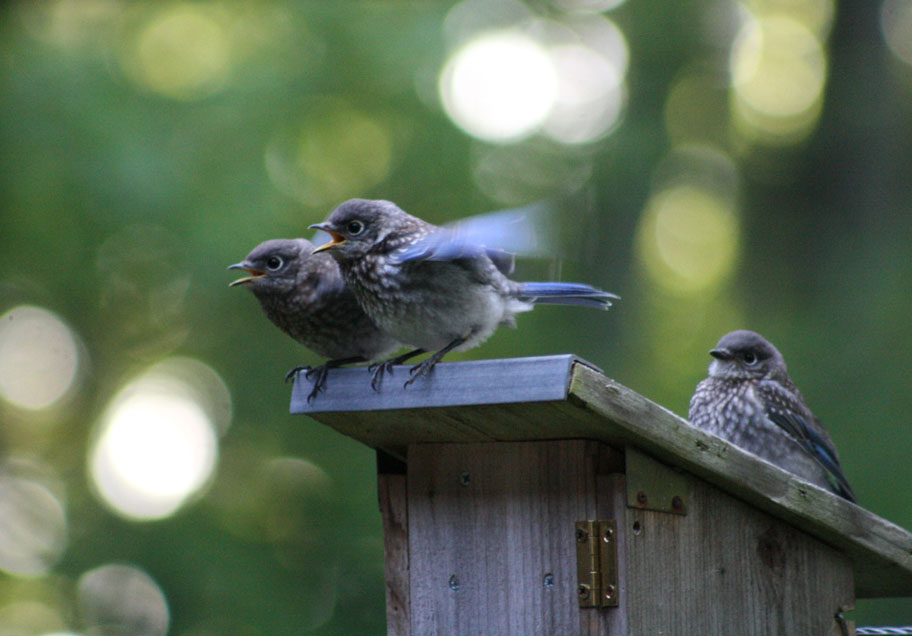
Such was the case on this 49° F May morning with the air so much colder than the summer-like weather we had been having.  The juveniles' feathers were fluffed up for warmth and when the male appeared with mealworms, three juveniles descended from overhead limbs, each vying for position--wings fluttering, eager cheeping, and even landing on top of a sibling if that's what it took to get near the food.    

In this case, I think the closest mouth won the meal.  Each of the above images includes three juveniles, though its not easy to sort them out, and eventually two fell off the perch during the scramble.  You have to admire the steady perseverance of parents under these circumstances.  The male fed his mealworms quickly, hopped clear, returned to the feeder, and came back with a fresh supply, feeding until calm was restored.    


Though the female was near and even landed on the garden shepherd's perch near the feeder, she did not participate in the feeding on this occasion.  A little later she flew into the nestbox.  The male was quite interested in this and flew down to the nestbox guard to peek inside and see what was happening.  

I was interested too, and later, after the family left to hunt elsewhere and the nestbox area was quiet, I checked to see if we had eggs.  And yes, we have two eggs!  
Above, three juveniles rest on a limb after being fed, huddled together to take advantage of the extra warmth.

Links and resources:

Visit my previous post, Landlord or Local Diner?  My yard and its nestboxes and mealworm feeder were part of the wintering territory of a small flock of bluebirds with one dominate male and female pair.  However, the pair did not select one of my yard's nestboxes for their first nesting this season.  I later realized that the red-shouldered hawk that had been seen perched in the yard on several occasions during early spring was the likely reason the pair chose a different nest site.  Red-shouldered hawks have fledged their young by now and are wandering beyond their nesting territories.  And, I am happy to have a nesting pair of bluebirds in my yard again!  

To see my posts on last season's nesting bluebirds, visit:  Bluebird Family

Friday, May 4, 2012

Brown Thrashers Nesting!

What a treat!  
A "skulking" bird, according to Cornell's website description, and I agree.  The thrashers in my yard have not been easily observed at close range, concealing themselves in underbrush, singing from the tip-top of poplars and oaks, and generally departing as quickly as I spot them at eye level.
But I have seen a pair of them on many occasions, sometimes hanging out in the holly near the bird bath but rarely with enough light and visibility for me to capture a good image.  Whatever has changed, I couldn't be more delighted, because they are lately making themselves visible, hunting on the lawn in front of my patio, near the holly and the birdbath, in the same vicinity as the bluebird nestbox and the mealworm feeder.
I have even witnessed at close range, one of the pair flying down to the edge of the patio to pick up a sunflower seed that had dropped from the feeder.

And on several occasions I've been treated to a hunting observation--neck out stretched, head cocked, pounding the ground like a woodpecker, then popping up with a beetle or a grub.  I have even wondered how much hearing plays a part in the location of prey.  Do they hear the movement of grubs and beetles under the ground or is it sight alone that guides their hunting?
On Wednesday, the 2nd of May, I began to wonder if the pair was nesting near by.  On several occasions I have heard the male singing on the east side of the gazebo.  Not his full song, but short, soft phrases.  And not from the top of a tree, but lower.
On the east side of the gazebo there is a dead dogwood, now covered by exotic wisteria that has draped its boughs over the dogwood branches year after year.  The wisteria is frequently cut back, but the vines grow rapidly.  I walked around to see if the thrashers might be building a nest in that dogwood.  And yes!  They are.  On Wednesday, there was a nice large nest of sticks already in place in a limb crotch of the dogwood, completely sheltered by the wisteria canopy.
The pair was observed successively flying in and out of the nest site several times, and once when the male left the nest, he preceded his departure with a soft series of song notes.  Lovely.  Cornell also says that the brown thrasher can be as aggressive as a mockingbird when it comes to defending its territory and has been known to "strike people and dogs hard enough to draw blood."  Yikes.  I've been forewarned.

References:
Cornell All about Birds:  Brown Thrasher
To read about other nesting birds in this blog visit:  Red-shouldered Hawks, Eastern Bluebird Family, Carolina Chickadees, Purple Martins

Tuesday, April 10, 2012

Red-shouldered Hawk Territory

Wow.  My books arrived today!  What a delight to see the finished product.  
My reaction was like a five-year-old's excitement at Christmas, only maybe it even topped that because of all the hard work that went into it.  Not just the many hours of observations and sketching, but the actual making of the printed book.
  
I'm a person who loves books, the books with a spine and pages you can leaf through, the ones you curl up with in a comfortable chair.  I think they are precious.  And when it comes time to part with them to make room for more, hesitation is large.  I love reading them and writing them.  And, I love sketching and creating them.
The making of a book in print is a complex endeavor, one of determined cooperation and negotiation, as much about patience, communication, and team work, as the artistic vision that conceived the idea and moved the project forward.   And now I've found the right team (see links and resources).  The book is beautiful, so life-like in its replication of the sketchbook itself, that it's hard to tell the difference between the original book and it's mirror in print.    
And that makes me smile.  It is the greatest hurdle you go through in printing art in any form.  And this book is about art and nature, about observing and capturing what you've observed in words and drawings, and about learning what your subject has to teach you, even the parts you are not allowed to know.

It's a tiny book, by book standards, replicating the size of the sketchbook, but enormous in heart and inspiration.  I look back on this endeavor--the observing of hawks, most secretive and illusive of creatures--and wonder at the energy and patience that got me through this season of observation.  But I also remember the incredible excitement and beauty of seeing this pair of hawks during our first encounter.  The combination of their accessibility and the unlikeliness of encountering them in such a casual way produced more intrigue than I could ignore.  That they could be so close, and so ever present sent me into a spin.  That I could sit in the shade of a gazebo, and watch their activity as though I were a plant in the garden, astounded me from the beginning.
The observations you see in the book took dedication, the commitment to sit through non-activity hours, make regular visits a priority, the ability to remain still until my subjects appeared and to use my creative mind and curiosity to withstand lulls in activity.  Waiting for the chance to see a hawk and watch its behavior, now that might be an activity some would call a waste of time.  The thought crossed my mind more than once.  But even the wait can be an act of labor, something that keeps you deeply rooted to the project and makes you as determined as ever to see it through.
Art is not an activity for the faint of heart.  It challenges you inside and out, especially when that art is about something real, and alive and moving, and unpredictable.  You, the artist, are the same, alive, moving,  unpredictable.  But you have trained yourself to be still, knowing what treasures are found while remaining invisible.  And just when you think you might evaporate into nothingness with the waiting, a hawk appears, opens your heart and heightens all your senses.  And a sketch is born, a visual story of all that you've taken in.  Into your heart the hawk flies, and out through your hand and onto the paper.  

This is the essence of Red-shouldered Hawk Territory, A sketchbook journey through nesting season--the story of one season's natural wonder through the heart and hand of an artist.  I hope it inspires you to pick up a sketchbook and let your own story unfold.  

Links and Resources: 

It takes a talented team to create a book and Colin Hoffman, at High Resolutions, was tops to work with.  He also lead the production of my boxed set of note cards, Autumn Birds.  Visit High Resolutions to learn about the many printing services they offer.   

My other partner in this endeavor was Nan Rudd of Rudd Designs, in New Glarus, WI.  Nan was also the layout wizard for my joint venture with Operation Migration in the creation of the Craniac Kid's Whooping Crane Activity Book.  

For more details about Red-shouldered Hawk Territory and to order visit:  Red-shouldered Hawk Territory.  

You will find all my posts on my experiences in Red-shouldered Hawk territory by clicking this link.  The last post will appear first.  Scroll to the bottom and click "older" to move backward to the first post.  

For more information about the species, visit Cornell's site on Red-shouldered Hawks.    

Sunday, April 1, 2012

Eastern Bluebirds--Landlord or Local Diner?

Bluebirds can leave you scratching your head from day to day, wondering what their plans are for that empty nest box.
This morning a pair of Eastern bluebirds landed on the limbs overhead almost instantly when I signaled with a whistle that the mealworm diner was now open for customers.  I had barely closed the feeder top when the pair appeared, singing softly.  I sat on the patio and watched as first the male and then the female visited the dish of mealworms. It was especially gratifying to hear the female's contented chirps as she fed.

The male patiently waited for her to finish, and then, poof, they were gone, the nest box serving as nothing more than a perch in route to the feeder.
After they left, I watched a male tufted titmouse repeatedly visit the feeder and return to a limb to feed his waiting mate.  This was definitely a smile-worthy observation.  I have no idea where they are nesting but it is certainly somewhere nearby.  The male frequently declares his territory with song and raspy scolding notes.  The bluebirds, on the other hand, make me wonder if they are nesting elsewhere and simply stopping by for a snack at the local diner.
As recently as a week ago, the male and female landed on the nest box together and exchanged excited communications, both chattering and wing-waving.  Above, you see the male wing-waving to encourage the female to join him on the next box.  And below, she has landed on the guard, preparing to check out the nest box.  Wing-waving, an alternating series of wing lifts, is expressed by both the male and the female and seems to signal a greeting and encouragement that reinforces the pair bond during the breeding season.
If it were not for last year's records, I would have given up hope that I will have a nesting pair of bluebirds this season.  My notes show that on April 8th of 2011, the pair that raised two broods last season in this nest box had not yet claimed it.  In mid March the wintering flock dispersed as one pair of bluebirds in their midst vigorously chased away flock mates and flock members dispersed in search of breeding territories and mates.  And while some bluebirds may still be searching for nest sites, many pairs in our area have already nested and are incubating eggs.
On the other hand, I have a decisive pair of chickadees in charge of my second nest box.  A Carolina chickadee (above) is building her nest right on schedule with last year's nesting record.  When I last checked the box on March 30th, the female had completed her thick base of moss and was placing a layer of soft grasses, hair, downy feathers, and other soft materials over it to begin forming the nest cup.
Chickadee nests are so soft and neat, astoundingly lovely.

Links and resources:

For stories and images of last season's nesting bluebirds, visit:  Bluebird Family.  And for more on Carolina chickadees visit my chickadee posts.

Also please visit my new book:  Red-shouldered Hawk Territory, A sketchbook journey through nesting season.  The book will be ready for shipping by April 12th and contains my sketches, field notes and the stories and photos that unfolded during four-months of observing a nesting pair of red-shouldered hawks.  You can visit some of those stories and images on this blog by clicking: Red-shouldered hawks. Scroll to the bottom to read earliest posts first.

Wednesday, March 21, 2012

A Glimpse of Pileated Woodpecker Love

It's impossible to hear that sound and not follow it out the door--the high-pitched ringing of a pileated woodpecker's call, especially when it comes from a tree right outside my window.  
There is a family of three frequently foraging in my yard and around its wooded edges. Above you see the adult female. (I can distinguish her from the younger female only by the sequence of behaviors that followed.)
They visit older deciduous trees, prying the bark loose or excavating, feeding on larvae and insects, and sometimes foraging on the ground on decaying stumps and fallen limbs.  The three family members consist of two females and a male, which I assume to be the mature pair and one of the season's off-spring.  Needless-to-say, it is a real treat to spot one calling pileated woodpecker, and hear more calls from your left and your right, until you realize you are in the midst of a foraging family.   The male, showing his red facial stripe and red crest, is in the foreground in the images above and below.  The female with a lesser crest, black on her forehead, and black facial stripe, is in the background.
On this particular occasion, March 18th, I observed the male foraging among leaves and fallen branches in a wooded area at the edge of the lawn, flipping leaves in the air as he foraged. The females were foraging on nearby trunks.  One female, believed to be an off-spring, flew into a wooded edge to the east, while the other female remained near the male, foraging a nearby trunk, and subsequently, dropping to the ground to forage near him.  
It is well known that during breeding season many mated pairs of birds perform nuptial feedings, perch close to each other, or forage together to strengthen the pair bond during nesting and incubation. I realized after watching this pair for a while that there was more going on than simple feeding.
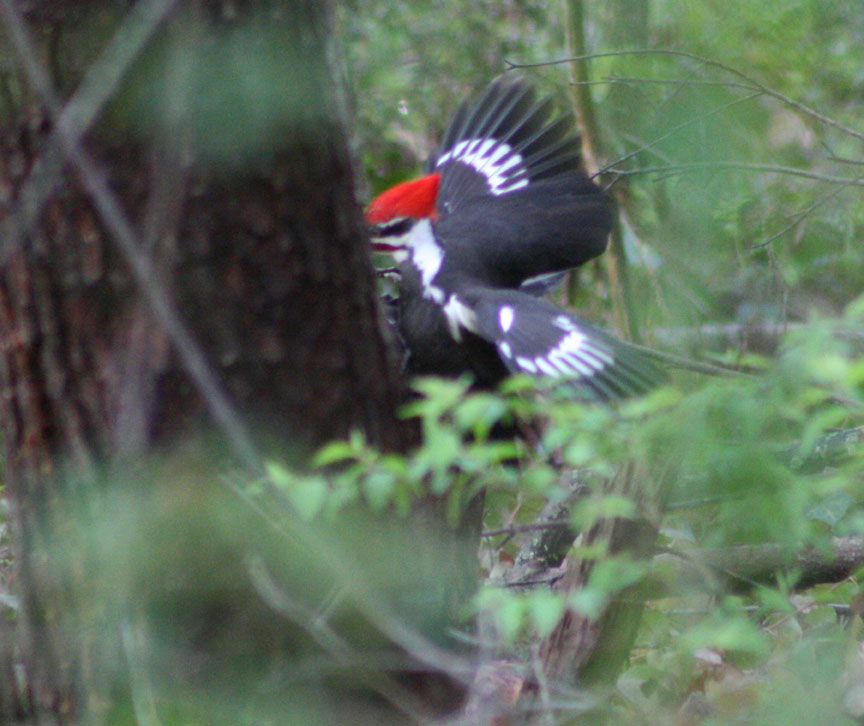
After foraging near the male for a while, the female hopped onto a stump, and then moved to a near trunk, landing close to the ground on the opposite side and only partially in view from where I stood.  Above you see her just after she's lands on the stump and is about to move again. Even though she is partially hidden by undergrowth, her body position gives you a good look at the length of her tail brace.  While the two foraged together, they exchanged whimpering calls, lower pitched, solicitous calls that seem to have a contact function.
The male continued to forage but frequently looked in the direction of the female.  In the following sequence of images you see him as he raises his crest in a courtship display and joins the female on the other side of the trunk for copulation.  
An updated listing of bird breeding chronology in Tennessee (2003), supplemental to the Atlas of Breeding Birds of Tennessee by Charles P. Nicholson (University of Tennessee Pres, 1997), lists nesting and eggs for pileated woodpeckers occurring from April 4 to May14.  The atlas nest and egg record is based on direct observation.

I am not optimistic about discovering this pair's nest, though I feel certain it is nearby (likely in the dead stub of a tree anywhere from 15-70 ft high).  The wooded areas that surround my yard are steep, their gradients likely what saved them from development, also saving some of the old growth that makes good nesting habitat for this family of woodpeckers.  This same characteristic, however, makes extensive wandering in search of a nest, impossible.    
Pileated woodpeckers are said to maintain a strong pair bond throughout the year, and that certainly seems the case with this pair.  I have observed this family foraging together on many occasions throughout the winter.  Since nesting season has begun, I will be interested in seeing how much longer the off-spring remains with the pair.
Above, male pileated woodpecker with raised crest and red cheek stripe.  Below, female with black forehead and black cheek stripe.
Links and Resources:

To hear one of the calls of a pileated woodpecker click here.  There are several other calls, one with a trailing echo, the other, a whimpering style call, that is lower in pitch and more solicitous.
Cornell's site on the pileated woodpecker.

Visit my other pileated woodpecker posts on this blog.

Monday, March 5, 2012

Join Me! Bird Attitudes: Inspiring Art and Conservation

Join me,  Wednesday, March 7th, at the Knoxville Tennesseee Ornithological Society meeting (KTOS) for an evening of photos, art and stories as I show you how birds inspire my art and my passion for conservation.
Birds are funny, fun and fascinating.  From the top of their heads to the pads on their feet, a birds size, color and shape offer many clues into its life style and habits.   Add to that, the personality revealed through behavior and you have the inspiration for all kinds of bird-related pursuits, including advocacy and conservation.
Join me as I share my photography, art and stories, and show you just what inspires me to pick up my brushes and paint.

KTOS Meeting information--Wednesday evening, March 7th, 6:45 pm.
Directions

Sunday, February 26, 2012

Keeping an Informed Eye on America's Hooded Crane

The appearance of an Asian hooded crane in southeast Tennessee in December of 2011, came as a surprise to everyone, raising much speculation about how this individual crane came to be so far from its native habitat and whether it was actually a wild crane or a previously captive one.  Questions also arose about whether this was the same individual seen at the Platte River in April (2011), or in Idaho the previous year, or whether it was a different individual.  (More on this discussion provided in the links at the end of this post.)
Hooded Crane in a corn field with staging Greater Sandhill Cranes, Goose Pond Wildlife Management Area, Green County, Indiana, February 2012.   Photo credit: Marty L. Jones

Dr. Guo Yumin, of Beijing Forestry University, a chief researcher of the hooded crane and its breeding biology, advises us that we can actually come closer to distinguishing hooded crane individuals by studying the white/gray neck line of the individual, confirming similarities and differences through photographic record.

To that end, he has sent the following slide show to demonstrate how researchers have used this distinctive neck line characteristic to help identify individuals in mated pairs as they are observed on their breeding territory and while nesting in different locations from season to season.  

(Note:  Picasa has a quirky interface. When you open this blog post, the slide show may already be in progress.  The first slide is entitled:  "How to Discriminate Different Individuals of Hooded Crane." If your browser shows distortion or disorientation of slides, or if you want to see a larger view, click on the image.   This will open a separate window and take you to the Picasa website.  Click on the words "full screen" at the top left over the image to see a larger view of the slides.  In either location, you may manually move the slides forward or set the time lapse to a preferred time by using the controls at the bottom of the screen.)

Jeff and Amy Davis traveled from Pennsylvania to Tennessee to see the Hooded Crane in December while the crane was staging with sandhill cranes at the Hiwassee Wildlife Refuge from December 14th, 2011 to February 5th, 2012.
Hooded crane among Greater Sandhill Cranes at the Hiwassee Wildlife Refuge, Tennessee, December 2011.  Photo credit:  Amy and Jeff Davis

The images they captured give nice views of the Hiwassee Hooded Crane's distinctive white/gray neckline from all sides.  I say, distinctive, because the patterns are pronounced and irregular in an identifiable way.  Below, you see a front, left and back view of the crane's white/gray neck line.  Each view holds a pattern that has the potential for identification.  Any two views would allow further confirmation that you are viewing the same individual.
I suspect that the appearance of the Hooded Crane in Idaho in the spring of 2010, and subsequently, at the Platte River in April of 2011, stirred interest similar to that experienced in Tennessee.  And I would imagine there were many images taken as a result of that interest.  These images can affirm whether this Hooded Crane is the same individual that has appeared in all three locations, or whether these sightings represent more than one individual.
Hooded Crane flying with Greater Sandhill Cranes at the Goose Pond Wildlife Management Area, Green County, Indiana, February 2012.  Photo credit:  Marty L. Jones.

This comparative data would give us more information about vagrant migration and tell us whether more than one individual has wandered into North America.  It is amazing enough that this individual has found its way into the eastern United States.  It would be even more informative to be able to track its journey, backward and forward, through photographic records, affirming its identity in each location, so we can learn what it has to teach us as it travels through North America.

No matter what combination of circumstances came together to bring our rare crane visitor to the Hiwassee Wildlife Refuge this past December, the event has ambassador qualities.  Without a doubt, the crane's appearance has raised interest and awareness for the species, its survival, and the inherent value of saving our wetland ecosystems for the benefit of wildlife, and, ultimately, for ourselves.
Above, Hooded Crane (top) and Greater Sandhill Crane in flight, showing intact primaries on the Hooded Crane and a good size comparison between the two species.  Goose Pond Wildlife Management Area, Green County, Indiana, February 2012.  Photo credit:  Ryan J. Sanderson.

"Cranes are ubiquitous in the earliest legends of the world's peoples, where they often figure as sentinels of heaven and omens of longevity and good fortune.  For their great beauty and imposing size--they are the largest of all flying birds on earth--they are held near-sacred in many lands.  Their broad wilderness habitat requirements make them "umbrella species"; protecting them ensures that other creatures and the earth and water of the ecosystem are also protected.  In addition, the enormous spans of cranes' migrations have encouraged international conservation efforts."   Peter Matthiessen, The Birds of Heaven:  Travels with Cranes

Where ever you find them, our world's cranes are ambassadors of peace, health and good will, for the earth, its wetlands, and for human kind.   Where cranes flourish, so also, the world around them will flourish.

Links and Resources:

Hooded Crane sketch by Vickie Henderson.

A special thank you to Dr. Guo Yumin, College of Nature Conservation, Beijing Forestry University, for the use of his beautiful images in this series and his slides describing the use of the white/gray neck line as an identification tool.   My appreciation also, to the photographers who have photographed the Hooded Crane in North America and granted permission for the use of their images in this series.

This is the third post in a three-part series on the endangered Hooded Crane and its appearance in North America.  To see all the posts in this series visit:  America's Hooded Crane.  The first post will appear last.

Chinese ornithologist, Guo Yumin, win's Whitley Award for his research on hooded crane.
Study of Hooded crane breeding habitat

Photography credits and information:
Amy and Jeff Davis Flickr Photostream
Marty L. Jones--Birds of Indiana Photostream and Marty Jones Photography
Ryan J. Sanderson Photostream
Mike Nelson's Flicker site with Hooded Crane video and photo stream

Peter Matthiessen:  The Birds of Heaven, Travels with Cranes

More about the Hooded Crane's appearance in the USA and opinions about this occurrence:
Saga of the Hooded Crane ABA
ABA Rare Hooded Crane in Indiana

Tennessee Watchable Wildlife on Sandhill Cranes
Hiwassee Wildlife Refuge

Top Crane Posts on this blog:  Hooded Crane at the Hiwassee Wildlife Refuge in TN
Crane Magic--Three Crane Species at Hiwassee.  Other posts on:  the Tennessee Sandhill Crane FestivalHiwassee Wildlife Refuge and sandhill cranes.

At my companion blog, Vickie's Sketchbook:  Sandhill Cranes and Art
Whooping cranes in watercolor, and America's Hooded Crane

Friday, February 24, 2012

What is Causing the Decline of the Hooded Crane?

A secretive bird whose breeding territories were only first discovered in 1974, the Hooded Crane is described as one of the least understood large birds in the world. And that is primarily because it nests in the remote and inaccessible sphagnum bogs scattered through the taiga in southeastern Russia, and in China, in forested wetlands in mountain valleys.
Hooded Cranes on their breeding territory in China.  Photo credit:  Guo Yumin

Throughout history the divergence, degradation and destruction of wetland ecosystems have threatened crane habitat around the world, including the Platte River in Nebraska, and the Guadalupe and San Antonio Rivers in Texas, USA, vital migration and wintering habitats for sandhill cranes and the world's endangered Whooping Cranes. Wetlands are often considered wastelands, areas to be modified for human consumption, development, and agriculture, despite the wetland ecosystem's important role in maintaining water quality and environmental health.
Hooded crane wetland ecosystem in Xing'an Mountains.  Photo credit:  Guo Yumin

The Ussuri, Lena, and Amur Rivers of North East Asia, are fed by the boreal wetland ecosystems of the Xang'an Mountains, which remain one of the last remote wildernesses of the area.  But wetlands are being lost in China faster than any other land type, especially lands desired for agriculture.  The greatest increase in agricultural lands, through the conversion of wetlands to agricultural usage, between 1990 to 2000, occurred in the Xing'an Mountains, a primary breeding habitat for the Hooded Crane.
Hooded Crane at its nest.   Photo credit:  Guo Yumin

Dr Guo Yumin, of the Beijing Forestry University, and his team of Chinese and Russian scientists, are studying  the breeding biology of the hooded crane and teaching area communities about the value of this species.  Below, you see one of the hundreds of annual calendars distributed in local communities to educate and raise awareness about Hooded cranes and their habitat.

The chief threats to the Hooded Crane and its habitat include:  Russia and Mongolia--loss of habitat due to the construction of gold mines and reservoirs; China--illegal hunting, poisoning and reclamation of forest wetlands; Japan--over crowding of the species on wintering grounds threatening disease.

The good news is, Dr Yumin and his team, in partnership with the Whitley Fund for Nature and Grus Monacha International Aid, have been influencing change in the hooded crane's habitat through research and the education of local governments, communities, and businesses.

Successful strategies for influencing gold mining in China are now helping scientists influence relevant parties in Russia, reducing the impact of mining on the Hooded Crane's habitat. The State Forestry Bureau of China has established two Nature Reserves in Hooded Crane breeding habitat with the goal of management for the long-term as a result of Dr Yumin's team's conservation efforts. And in Japan, scientists are studying methods of decentralization for the hooded crane population on its wintering grounds and determining ways to improve habitat management.

Hooded cranes at a wintering feeding station in Japan.  Photo credit:  Walter Sturgeon

Though much has been accomplished over the past several years, Dr Yumin affirms that hard work is yet to come. "The hooded crane still faces many threats, our protection work [has] a long way to go."

Next:  Keeping and Informed Eye on America's Hooded Crane.  Dr Yumin shows us how to distinguish individual Hooded cranes.

This is the second post in a three-part series on the endangered Hooded Crane and its appearance in North America.  To see all the posts in this series visit:  America's Hooded Crane.  The first post will appear last.

Links and Resources:

WFN--Whitley Fund for Nature
Chinese ornithologist, Guo Yumin, win's Whitley Award for his research on hooded crane.
Study of Hooded crane breeding habitat

Saga of the Hooded Crane ABA
ABA Rare Hooded Crane in Indiana
A Hooded Crane and a Local Economy--Birding is Fun blog

Recent articles on wetland habitat conservation and the whooping crane:
Crane Count Murky as Cranes Search for Food--Feb 2012, San Antonio Bay, TX
Whooping Crane Survivors--Whooping Crane's role in preservation of Platte River habitat

Whooping crane and sandhill crane posts on this blog

Hiwassee Wildlife Refuge
Top Crane Posts on this blog:  Hooded Crane at the Hiwassee Wildlife Refuge in TN
Crane Magic--Three Crane Species at Hiwassee.  Other posts on:  the Tennessee Sandhill Crane FestivalHiwassee Wildlife Refuge and sandhill cranes.

At my companion blog, Vickie's Sketchbook:  Sandhill Cranes and Art
Whooping cranes in watercolor
Related Posts Plugin for WordPress, Blogger...

Ocean Trail at Palos Verdes Nature Preserve, California--2015

Ocean Trail at Palos Verdes Nature Preserve, California--2015

Bird-banding at Seven Islands State Birding Park--2014

Bird-banding at Seven Islands State Birding Park--2014
Photo courtesy of Jody Stone

Bird-banding at Seven Islands

Bird-banding at Seven Islands
Photo courtesy of Karen Wilkenson

Enjoying Gray Jays in Churchill!--2014

Enjoying Gray Jays in Churchill!--2014
Photo courtesy of Blue Sky Expeditions

Smithsonian National Zoo with one of my Whooping Crane banners and son, John--2014

Smithsonian National Zoo with one of my Whooping Crane banners and son, John--2014

The Incredible Muir Woods near Stinson Beach, CA--2014

The Incredible Muir Woods near Stinson Beach, CA--2014
Photo courtesy of Wendy Pitts Reeves

Me and Denali--2012

Me and Denali--2012
Photo courtesy of Bob King

For the Love of It...

...the sage sees heaven reflected in Nature as in a mirror, and he pursues this Art, not for the sake of gold or silver, but for the love of the knowledge which it reveals.
Sendivogius (1750)

Your Uncapped Creativity...

Your Uncapped Creativity...
"There is a vitality, a life force, an energy, a quickening that is translated through you into action; and because there is only one of you in all time, this expression is unique. If you block it, it will never exist through any other medium and it will be lost. The world will not have it. You must keep that channel open. It is not for you to determine how good it is, nor how valuable. Nor how it compares with other expressions. It is for you to keep it yours, clearly and directly." ----the great dancer, Martha Graham