Monday, June 11, 2012

Bluebirds Adapt to Single Parenting

As I have watched this family of nine adapt to the loss of the female parent, I have marveled at how quickly they have reorganized their family behavior.
Prior to the loss of the female, the juveniles have wandered to hunt, but returned throughout the day to be near their parents.  Often they've perched in overhead limbs to watch the parents feed the nestlings, and on several occasions in the past week, the male juvenile has brought food to the nestlings.
On June 8th, the last day the female was present, the juveniles made quick visits to the mealworm feeder while the parents were away.  Often the female was not tolerant of them sharing that space with her and they avoided meeting either parent inside the feeder.  Later that same morning, they were seen overhead foraging for insects in the leaves trapped in the gutters.  They flipped leaves, followed each other around, ran to see what had been stirred up by a sibling, and generally entertained themselves while the parents fed the nestlings at a steady pace.
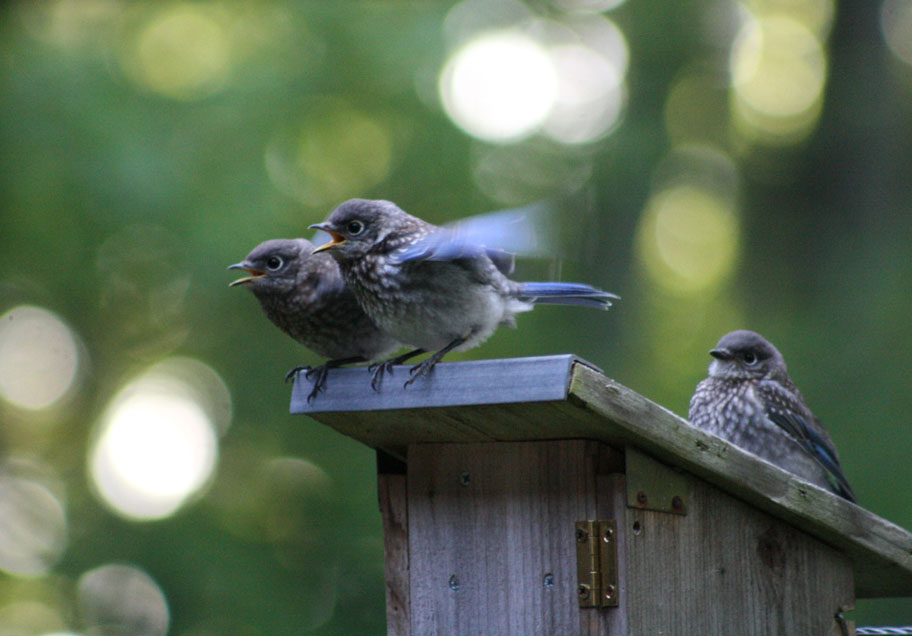
In the images above, taken yesterday, you see two juveniles arriving at the nestbox predator guard at the same time.  The one inside is the male juvenile.  I believe he is encouraging the female juvenile (who at this point had not learned how to enter the predator guard) to hand off her food.  But she didn't like that idea.

Since the female has been absent (last seen June 8th), these juveniles have rallied around the male.  Not only are they steadily present, they are keeping watch over the nest area, sounding alerts, chasing away intruders (titmice primarily).  And as of yesterday, everyone of them is feeding the nestlings and with greater proficiency.

In yesterday's video below, watch as one of the juvenile females, the last to begin feeding the nestlings, struggles to figure out how to reach the nestlings with the food she has brought.  While she is figuring this out, you will see the juvenile male enter to feed first, followed by the adult male.  The female juvenile is determined and persistent and tries every angle available to reach the nestlings from her position.

This is the stuff that tugs at the heart-strings.  It certainly suggests that there are complex emotions and motivations driving her effort.  The male is patient with juvenile efforts, waiting for them to feed, watching as they try to contribute and encouraging with chattering and wing-waving.  
The nestlings are popping their heads out of the nestbox to receive food now and are calling when they are hungry.  This call is only heard when they haven't been fed for a while and stops soon after feeding begins.  I am feeding generous quantities of mealworms several times a day and the family arrives immediately, sometimes before I leave the feeder, eager to begin feeding.  Family members are not dependent on the mealworms, however.  They are also hunting individually and bringing a variety of other foods.

Today the nestlings are sixteen days old, an age that falls within the 15-18 day range for expected fledging.

To see last year's juvenile's bathing visit:  Juvenile Bluebirds Enjoy the Water, and to see last year's juveniles feeding their younger siblings, visit:  Juveniles Helping Parents.  To see all my bluebird posts visit:  Bluebird Family.


Visit this link to learn how to make the predator guard that protects my nestbox residents from cats and raccoons.  

Sunday, June 10, 2012

Bluebird Juvenile Feeding Young

Attachments are a part of enjoying nature.  And without a doubt, that brings with it both joys and disappointments
Yesterday I watched the bluebirds throughout the morning.  About an hour into my observations, I realized the female was absent.  The male was feeding alone and the female, whom I at first assumed was out hunting, did not return to the nesting area.  

This, of course, is sad news and she is missed.  The male alternately perched, sang, and fed young throughout the day, but activity was considerably subdued without the female's persistent vigilance in both feeding and protecting the nest area.

The male stayed near the nest site and chased away intruders, clacking his beak, protecting both the nest area and the main perching tree in the yard.  At one point, as I refilled the feeder, he flew in wing-waving and chattering and brought along the male first brood juvenile.  The juvenile immediately entered the feeder and fed and then carried a mealworm to the nestlings to feed them.  He repeated this several times, while the male returned to his guard perch to survey the area.

Below is a video of the juvenile male as he brings food to the nestlings, but meets with some confusion when his sister tries to eat his worm.  He did not actually enter the guard and feed on this occasion but does so efficiently at other times.
To see last year's juvenile's bathing visit:  Juvenile Bluebirds Enjoy the Water, and to see juveniles feeding their younger siblings, visit:  Juveniles Helping Parents.  To see all my bluebird posts visit:  Bluebird Family.


Visit this link to learn how to make the predator guard that protects my nestbox residents from cats and raccoons.  

Thursday, June 7, 2012

Eastern Bluebirds Feeding Young

Falling in love with Eastern Bluebirds is the natural outcome of living near these birds.  
The bluebird's ability to adapt to human presence, and accept the closeness that you see in these images and the video is part of the reason they have gained so much popularity in past decades.  This female chirps as she eats, contented chirps, as though expressing her delight at seeing so many grubs every time she encounters them in the feeder.  And the most endearing behavior of all happens when she lands on the shepherd's perch only a few feet away, looks directly at me and wing-waves. This is her greeting in bluebird language, and among the finest greetings I've ever received!

Obviously her tolerance of me is a result of my relationship to the mealworms.  I appear and they appear. And this bluebird pair is committed to feeding their five twelve-day-old nestlings at frequent intervals. Typically bluebird nestlings fledge at around 15-18 days, so we are nearing the count down.  
First brood juvenile male in this family of ten (five in the nest, three fledglings and two parents).

This, of course, gives me mixed feelings.  When the nestlings fledge, there is no reason for the family to remain in the yard.  The fledglings will roost high in the trees and the parents will lead them away from the nesting area to avoid predators.

Below you are seeing my first video taken with my new Canon Rebel SLR with HD video capacity. You'll see both the male and female bringing mealworms to the young and leaving the nestbox a bit cleaner as they depart.      
And while the parents were feeding the nestlings, the three juveniles were hanging out together on the gutters overhead, flipping leaves and debris to stir up the insects underneath.
To see last year's juvenile's bathing visit:  Juvenile Bluebirds Enjoy the Water, and to see juveniles feeding their younger siblings, visit:  Juveniles Helping Parents.  To see all my bluebird posts visit:  Bluebird Family.

Friday, June 1, 2012

Bluebird Family Life

Breeding season is a very busy time for Eastern bluebirds.   
The adult pair, three juveniles from their first brood, and five hatchlings (hatched on May 27 and 28th) make up the bluebird family of ten that are living in and around the nestbox and mealworm feeder in my yard.  Above you see the hatchlings on May 28th. Consider that the nest cup is approximately 2.5 inches across and you will get a better sense of the size of these tiny, newly hatched babies.  
By this time, the fledged juveniles are feeding themselves.  They have received firm warnings from both parents, beginning well before the eggs hatched, so that they no longer expect to be fed when a parent arrives with food.  In fact, the juveniles are very curious about what's happening in the nest box and are watching as their parents bring food to the young in the nest.  
And the foods offered to the nestlings are very particular and tender.  In the first few days, the parents bring the tiniest spiders, worms and insects to the young.  One wonders how they ever see and capture anything that small, especially when the feeding intervals can be as frequent as four times a minute with both parents feeding.  
Above the female pauses before entering the nestbox entrance, and below she takes a break for a cool bath.  
One of the juveniles considers taking a bath, below, but was too timid on this occasion to jump in.  Perhaps she was a bit camera shy.  I suspect she drinks and bathes frequently at other times during the day since we've been having 90 F degree temperatures, much warmer than is typical for this time of year in Tennessee.  
To see last year's juvenile's bathing visit:  Juvenile Bluebirds Enjoy the Water, and to see juveniles feeding their younger siblings, visit:  Juveniles Helping Parents.  To see all my bluebird posts visit:  Bluebird Family.

Friday, May 11, 2012

Feeding Hungry Bluebird Juveniles

Early morning feedings can be mass confusion at times.  Especially when eastern bluebirds juveniles are cold and hungry.  
Such was the case on this 49° F May morning with the air so much colder than the summer-like weather we had been having.  The juveniles' feathers were fluffed up for warmth and when the male appeared with mealworms, three juveniles descended from overhead limbs, each vying for position--wings fluttering, eager cheeping, and even landing on top of a sibling if that's what it took to get near the food.    

In this case, I think the closest mouth won the meal.  Each of the above images includes three juveniles, though its not easy to sort them out, and eventually two fell off the perch during the scramble.  You have to admire the steady perseverance of parents under these circumstances.  The male fed his mealworms quickly, hopped clear, returned to the feeder, and came back with a fresh supply, feeding until calm was restored.    


Though the female was near and even landed on the garden shepherd's perch near the feeder, she did not participate in the feeding on this occasion.  A little later she flew into the nestbox.  The male was quite interested in this and flew down to the nestbox guard to peek inside and see what was happening.  

I was interested too, and later, after the family left to hunt elsewhere and the nestbox area was quiet, I checked to see if we had eggs.  And yes, we have two eggs!  
Above, three juveniles rest on a limb after being fed, huddled together to take advantage of the extra warmth.

Links and resources:

Visit my previous post, Landlord or Local Diner?  My yard and its nestboxes and mealworm feeder were part of the wintering territory of a small flock of bluebirds with one dominate male and female pair.  However, the pair did not select one of my yard's nestboxes for their first nesting this season.  I later realized that the red-shouldered hawk that had been seen perched in the yard on several occasions during early spring was the likely reason the pair chose a different nest site.  Red-shouldered hawks have fledged their young by now and are wandering beyond their nesting territories.  And, I am happy to have a nesting pair of bluebirds in my yard again!  

To see my posts on last season's nesting bluebirds, visit:  Bluebird Family

Friday, May 4, 2012

Brown Thrashers Nesting!

What a treat!  
A "skulking" bird, according to Cornell's website description, and I agree.  The thrashers in my yard have not been easily observed at close range, concealing themselves in underbrush, singing from the tip-top of poplars and oaks, and generally departing as quickly as I spot them at eye level.
But I have seen a pair of them on many occasions, sometimes hanging out in the holly near the bird bath but rarely with enough light and visibility for me to capture a good image.  Whatever has changed, I couldn't be more delighted, because they are lately making themselves visible, hunting on the lawn in front of my patio, near the holly and the birdbath, in the same vicinity as the bluebird nestbox and the mealworm feeder.
I have even witnessed at close range, one of the pair flying down to the edge of the patio to pick up a sunflower seed that had dropped from the feeder.

And on several occasions I've been treated to a hunting observation--neck out stretched, head cocked, pounding the ground like a woodpecker, then popping up with a beetle or a grub.  I have even wondered how much hearing plays a part in the location of prey.  Do they hear the movement of grubs and beetles under the ground or is it sight alone that guides their hunting?
On Wednesday, the 2nd of May, I began to wonder if the pair was nesting near by.  On several occasions I have heard the male singing on the east side of the gazebo.  Not his full song, but short, soft phrases.  And not from the top of a tree, but lower.
On the east side of the gazebo there is a dead dogwood, now covered by exotic wisteria that has draped its boughs over the dogwood branches year after year.  The wisteria is frequently cut back, but the vines grow rapidly.  I walked around to see if the thrashers might be building a nest in that dogwood.  And yes!  They are.  On Wednesday, there was a nice large nest of sticks already in place in a limb crotch of the dogwood, completely sheltered by the wisteria canopy.
The pair was observed successively flying in and out of the nest site several times, and once when the male left the nest, he preceded his departure with a soft series of song notes.  Lovely.  Cornell also says that the brown thrasher can be as aggressive as a mockingbird when it comes to defending its territory and has been known to "strike people and dogs hard enough to draw blood."  Yikes.  I've been forewarned.

References:
Cornell All about Birds:  Brown Thrasher
To read about other nesting birds in this blog visit:  Red-shouldered Hawks, Eastern Bluebird Family, Carolina Chickadees, Purple Martins

Tuesday, April 10, 2012

Red-shouldered Hawk Territory

Wow.  My books arrived today!  What a delight to see the finished product.  
My reaction was like a five-year-old's excitement at Christmas, only maybe it even topped that because of all the hard work that went into it.  Not just the many hours of observations and sketching, but the actual making of the printed book.
  
I'm a person who loves books, the books with a spine and pages you can leaf through, the ones you curl up with in a comfortable chair.  I think they are precious.  And when it comes time to part with them to make room for more, hesitation is large.  I love reading them and writing them.  And, I love sketching and creating them.
The making of a book in print is a complex endeavor, one of determined cooperation and negotiation, as much about patience, communication, and team work, as the artistic vision that conceived the idea and moved the project forward.   And now I've found the right team (see links and resources).  The book is beautiful, so life-like in its replication of the sketchbook itself, that it's hard to tell the difference between the original book and it's mirror in print.    
And that makes me smile.  It is the greatest hurdle you go through in printing art in any form.  And this book is about art and nature, about observing and capturing what you've observed in words and drawings, and about learning what your subject has to teach you, even the parts you are not allowed to know.

It's a tiny book, by book standards, replicating the size of the sketchbook, but enormous in heart and inspiration.  I look back on this endeavor--the observing of hawks, most secretive and illusive of creatures--and wonder at the energy and patience that got me through this season of observation.  But I also remember the incredible excitement and beauty of seeing this pair of hawks during our first encounter.  The combination of their accessibility and the unlikeliness of encountering them in such a casual way produced more intrigue than I could ignore.  That they could be so close, and so ever present sent me into a spin.  That I could sit in the shade of a gazebo, and watch their activity as though I were a plant in the garden, astounded me from the beginning.
The observations you see in the book took dedication, the commitment to sit through non-activity hours, make regular visits a priority, the ability to remain still until my subjects appeared and to use my creative mind and curiosity to withstand lulls in activity.  Waiting for the chance to see a hawk and watch its behavior, now that might be an activity some would call a waste of time.  The thought crossed my mind more than once.  But even the wait can be an act of labor, something that keeps you deeply rooted to the project and makes you as determined as ever to see it through.
Art is not an activity for the faint of heart.  It challenges you inside and out, especially when that art is about something real, and alive and moving, and unpredictable.  You, the artist, are the same, alive, moving,  unpredictable.  But you have trained yourself to be still, knowing what treasures are found while remaining invisible.  And just when you think you might evaporate into nothingness with the waiting, a hawk appears, opens your heart and heightens all your senses.  And a sketch is born, a visual story of all that you've taken in.  Into your heart the hawk flies, and out through your hand and onto the paper.  

This is the essence of Red-shouldered Hawk Territory, A sketchbook journey through nesting season--the story of one season's natural wonder through the heart and hand of an artist.  I hope it inspires you to pick up a sketchbook and let your own story unfold.  

Links and Resources: 

It takes a talented team to create a book and Colin Hoffman, at High Resolutions, was tops to work with.  He also lead the production of my boxed set of note cards, Autumn Birds.  Visit High Resolutions to learn about the many printing services they offer.   

My other partner in this endeavor was Nan Rudd of Rudd Designs, in New Glarus, WI.  Nan was also the layout wizard for my joint venture with Operation Migration in the creation of the Craniac Kid's Whooping Crane Activity Book.  

For more details about Red-shouldered Hawk Territory and to order visit:  Red-shouldered Hawk Territory.  

You will find all my posts on my experiences in Red-shouldered Hawk territory by clicking this link.  The last post will appear first.  Scroll to the bottom and click "older" to move backward to the first post.  

For more information about the species, visit Cornell's site on Red-shouldered Hawks.    

Sunday, April 1, 2012

Eastern Bluebirds--Landlord or Local Diner?

Bluebirds can leave you scratching your head from day to day, wondering what their plans are for that empty nest box.
This morning a pair of Eastern bluebirds landed on the limbs overhead almost instantly when I signaled with a whistle that the mealworm diner was now open for customers.  I had barely closed the feeder top when the pair appeared, singing softly.  I sat on the patio and watched as first the male and then the female visited the dish of mealworms. It was especially gratifying to hear the female's contented chirps as she fed.

The male patiently waited for her to finish, and then, poof, they were gone, the nest box serving as nothing more than a perch in route to the feeder.
After they left, I watched a male tufted titmouse repeatedly visit the feeder and return to a limb to feed his waiting mate.  This was definitely a smile-worthy observation.  I have no idea where they are nesting but it is certainly somewhere nearby.  The male frequently declares his territory with song and raspy scolding notes.  The bluebirds, on the other hand, make me wonder if they are nesting elsewhere and simply stopping by for a snack at the local diner.
As recently as a week ago, the male and female landed on the nest box together and exchanged excited communications, both chattering and wing-waving.  Above, you see the male wing-waving to encourage the female to join him on the next box.  And below, she has landed on the guard, preparing to check out the nest box.  Wing-waving, an alternating series of wing lifts, is expressed by both the male and the female and seems to signal a greeting and encouragement that reinforces the pair bond during the breeding season.
If it were not for last year's records, I would have given up hope that I will have a nesting pair of bluebirds this season.  My notes show that on April 8th of 2011, the pair that raised two broods last season in this nest box had not yet claimed it.  In mid March the wintering flock dispersed as one pair of bluebirds in their midst vigorously chased away flock mates and flock members dispersed in search of breeding territories and mates.  And while some bluebirds may still be searching for nest sites, many pairs in our area have already nested and are incubating eggs.
On the other hand, I have a decisive pair of chickadees in charge of my second nest box.  A Carolina chickadee (above) is building her nest right on schedule with last year's nesting record.  When I last checked the box on March 30th, the female had completed her thick base of moss and was placing a layer of soft grasses, hair, downy feathers, and other soft materials over it to begin forming the nest cup.
Chickadee nests are so soft and neat, astoundingly lovely.

Links and resources:

For stories and images of last season's nesting bluebirds, visit:  Bluebird Family.  And for more on Carolina chickadees visit my chickadee posts.

Also please visit my new book:  Red-shouldered Hawk Territory, A sketchbook journey through nesting season.  The book will be ready for shipping by April 12th and contains my sketches, field notes and the stories and photos that unfolded during four-months of observing a nesting pair of red-shouldered hawks.  You can visit some of those stories and images on this blog by clicking: Red-shouldered hawks. Scroll to the bottom to read earliest posts first.
Related Posts Plugin for WordPress, Blogger...

Ocean Trail at Palos Verdes Nature Preserve, California--2015

Ocean Trail at Palos Verdes Nature Preserve, California--2015

Bird-banding at Seven Islands State Birding Park--2014

Bird-banding at Seven Islands State Birding Park--2014
Photo courtesy of Jody Stone

Bird-banding at Seven Islands

Bird-banding at Seven Islands
Photo courtesy of Karen Wilkenson

Enjoying Gray Jays in Churchill!--2014

Enjoying Gray Jays in Churchill!--2014
Photo courtesy of Blue Sky Expeditions

Smithsonian National Zoo with one of my Whooping Crane banners and son, John--2014

Smithsonian National Zoo with one of my Whooping Crane banners and son, John--2014

The Incredible Muir Woods near Stinson Beach, CA--2014

The Incredible Muir Woods near Stinson Beach, CA--2014
Photo courtesy of Wendy Pitts Reeves

Me and Denali--2012

Me and Denali--2012
Photo courtesy of Bob King

For the Love of It...

...the sage sees heaven reflected in Nature as in a mirror, and he pursues this Art, not for the sake of gold or silver, but for the love of the knowledge which it reveals.
Sendivogius (1750)

Your Uncapped Creativity...

Your Uncapped Creativity...
"There is a vitality, a life force, an energy, a quickening that is translated through you into action; and because there is only one of you in all time, this expression is unique. If you block it, it will never exist through any other medium and it will be lost. The world will not have it. You must keep that channel open. It is not for you to determine how good it is, nor how valuable. Nor how it compares with other expressions. It is for you to keep it yours, clearly and directly." ----the great dancer, Martha Graham