Showing posts sorted by relevance for query northern cardinal. Sort by date Show all posts

Saturday, August 29, 2009

A Day-Making Family of Cardinals!

Yesterday, after the morning drizzle stopped, we had a very pleasant soft-light day of clouds in Knoxville (east Tennessee). I sat outside for a while and read, enjoying the moderate air, camera handy, of course.
I also wanted to see how the molting Northern cardinal family looked, Mom with her heavily molting head, and Dad, last seen with a disarray of crest feathers and gray down showing here and there.
Above you see the male on August 11th, with many of his crest feathers already missing. And below you can see how he appeared yesterday, on August 28th. In a little over two weeks he had molted all his crest feathers, many head and facial feathers and had produced feather sheaths to protect newly growing feathers. The tiny feathers poking up on his crown in the image below are the brand new ones growing out beyond the sheath. And what looks like gray whiskers are the sheaths for his new black facial feathers.
It's the 'tween time for cardinals and many other birds, the molting season, a time when juveniles are still following parents around begging, but the hectic pace of nesting and fledging season is over. Young can now fly and are learning to forage for themselves.
Molting female cardinal with juvenile perched below her.

It's also a time when molting birds need a bounty of food to help nourish them through the energy-demanding task of producing new feathers. And for year-around residents in Tennessee, these new feathers include a thicker layer of down, making ready for the winter months.
Molting, or the shedding and replacing of worn feathers with new ones, occurs in all birds but at different times, with different frequency and rates, all of which perfectly matches the bird's habits, seasonal cycles, available food sources and migration patterns. And despite the look of disarray, molting occurs in an orderly and gradual fashion with most birds retaining their ability to fly while molting. Waterfowl are an exception, rendered temporarily flightless with a complete postbreeding molt due to body aerodynamics.
Northern Cardinal juvenile.
Besides having fun watching this cardinal family interact, I noticed the juveniles were molting, too. So I checked my new book, National Geographic Birding Essentials by Jonathan Alderfer and Jon L. Dunn that I purchased through Wild Birds Unlimited and delved into it a little more.
There is a great deal of variation among species as to how long a juvenile keeps its first plumage.
Molting may occur for some juveniles before leaving the nest! In other species, such as the Bald Eagle, a series of partial molts over a five year period changes the plumage appearance several times before the young eagle reaches breeding age and acquires the distinctive white head and tail of the mature adult.
For these two juvenile cardinals trying to share a perch, the wait will not be so long. In only a few months they will have acquired the distinctive orange beak and brighter adult plumage that we all enjoy in our backyard cardinals.
Linked to Bird Photography Weekly #53 at Birdfreak.com to celebrate the conservation of our world's birds and Bird Photography Weekly's second anniversary.

Monday, May 18, 2009

A Cardinal Fledgling?

Do Northern cardinal fledglings really look like this? I would have known this was a fledgling even without the parents nearby. It's persistent peepish rattling was of the cannot-be-ignored variety. But if I had seen him alone, I never would have guessed this was a juvenile cardinal. Wouldn't you expect olive or brownish feathers? [Don't miss the last paragraph of this post. It explains this unexpected occurrence!]
Me too. But I took a jog around the internet (where else?) and found some images that looked just like this one. Some of the juveniles had rust feathers but there were also these gray little guys. (The above images were taken through the window.)
And here's proud papa. He was singing in these first two images but I was a second or two too late to capture it. He's perched in the spot where many birds pause to look around before advancing to feed.
Both he and the female have been coming to the plate for suet and sunflower seeds and today I happened to hear the juvenile and looked out to see him sitting under the plate being fed.

The plate is pictured here with a blue jay patron.
And below papa is back to hunting up meals for that fledgling.
Busy time of year!
Note: Jeff Gordon to the rescue again. Jeff is a very experienced bird field guide expert and presenter from Delaware. This is not the first time Jeff's seen something amiss in the bird ID department on my blog. I'm grateful he noticed this one and straightened out who this strange looking fledgling actually belongs to. Read Jeff's note in the comment section. The fledgling pictured above is not a cardinal at all, but a very hungry cowbird fledgling, a species that parasitizes other bird's nests, that is, removes the other bird's egg and lays their own in its place. Sigh. Thanks Jeff...
Take in some interesting field experiences, fun humor and beautiful images at Jeffery A Gordon's blog.
Linked to Bird Photography Weekly #38 and Birdfreak. com to promote the conservation of our world's birds.

Friday, July 3, 2009

A Real Cardinal Juvenile Meets His Neighbors

I use the term "real" in reference to my first experience with watching papa cardinal feed a juvenile. The fledgling turned out to be not a cardinal at all, but a hungry cowbird juvenile.Northern cardinals are one of 44 species in our area that are known to be predated by cowbirds. In the cardinal's case, a conservative estimate is 10 percent of the time. This frequency is increasing as habitat is more and more broken by development. All the more reason why I was happy to notice this for real cardinal juvenile being fed by papa on a limb near the feeder. After observing the titmouse family, I'm finding the cardinals so much more cautious and timid, though they enjoy suet and seeds no less. On this particular day, the juvenile accompanied his Dad and eagerly but silently, waited to be fed. And speaking of titmice, the juvenile cardinal landed on a limb in the hemlock that is frequented by the foraging titmice family. When he did, three of the titmice juveniles surrounded him, making their squealing juvenile calls. Looking a bit overwhelmed, the cardinal ruffled his feathers, made himself look bigger, and gave a big leap. The titmous juveniles scattered.Now, don't we look innocent.

Monday, February 21, 2011

A Spring Head-dress and a Heart-stopping Thrush

This female northern cardinal visiting the bird bath for a drink gave me my first belly laugh of the day.     
Her plumes on her crest stood up like flames in the wind.  Despite the winter-y blast of heavy snow in the mid-western states, we're having mild temperatures and blustery pre-March winds in Tennessee.  And if that weren't enough to hint of spring, birds are showing signs of spring molting.  Just twelve days ago, I snapped the image below, of a female cardinal in the snow.  She was fluffed and warm in her thick winter plumage.   But in the days since, we've had more moderate weather with some days reaching as high as the 70's F.
My Atlas of the Breeding Bird of Tennessee says, "In late February and March, cardinals form stable, monogamous pair bonds. Both the male and female defend the territory with song, displays, and mild combat."   Females pick the nest site usually in April but as early as mid-March, meaning that the tolerance of communal winter foraging is about to end, replaced by freshened spring plumage and territorial attitudes.
Along with the tattered and comical appearance of her crest, feathers have molted around this cardinal's face. New feather sheaths will emerge quickly where old feathers have been shed and fresh ones will rapidly grow to replace the lost ones.  This female's colors are beautiful, nonetheless, even though she wears a wind-blown look.  I couldn't be sure if she was on the alert or if the wind was standing her remaining crest feathers up so tall.
The watering hole is definitely a fun place to hang out, a good place to watch the tall pines, oak and maples waving in the gusting wind, as well as, to see birds that may otherwise go unseen as they come for a drink.  Several times I've seen a yellow-rumped warbler both drink and forage near the feeders but, so far, not when I'm outside with the camera.
Today I enjoyed a better look at the beautiful streaking and contrast in an American robin's plumage as she braved the birdbath for a drink.  When she flew, my heart picked up a beat, as a hermit thrush popped in to replace her, its 7-inch stature seeming exceptionally petite next to that of a robin, ranging from 9 to 11 inches.
It was special to get lingering looks at this shy bird, standing tall on tiny legs.  More often I notice her hanging out in the shadows of the hemlock, impossible conditions for a good photo, and visits to the birdbath are usually glimpsed through the window.  This made today's surprise visit exceptionally appreciated and I fell in love with the wind-blown look below!
Hermit thrushes are best known in Tennessee as a migrant and wintering resident, generally arriving in October and departing by early April.  Breeding seasons have only been sparsely recorded in Tennessee in the higher elevations of Roan Mountain and the Great Smoky Mountains (Atlas of the Breeding Birds of TN, ed. Charles P Nicholson.)

When this thrush turned, giving me nice looks at her body proportions and rust tail, I thought she was leaving.      
But she lingered a few minutes longer and reached from the side to take several more drinks.  Sigh.  One of many special moments enjoyed in the backyard.  
Links and Resources:
Atlas of the Breeding Birds of Tennessee, edited by Charles P. Nicholson.  This book is out of print and pricey on the secondary market, but with patience, you may find lowered pricing on Amazon with time.  
And more about cardinals and molting in A Day-making Family of Cardinals

If you have not already signed the petition requesting a new management plan for the Eastern Population of Sandhill cranes, visit the petition site right now and voice your opinion on this important conservation issue.  Kentucky is battling a sandhill crane hunting proposal similar to the one deferred in Tennessee.  We have a lot of work left to do to protect this population that has only recently recovered from near extirpation.  To read more visit A New Plan for Eastern Sandhills.    

Linked to Bird Photography Weekly #130 at Birdfreak.com to promote the conservation of our world's birds.

Sunday, July 20, 2014

Bird Banding at Seven Islands State Birding Park

Seven Islands Willdife Refuge officially became Tennesee's Seven Islands State Birding Park on July 1st. Five days later I drove the thirty-minute drive to my first banding session after the official change and was happy to see the interstate sign with symbols that indicate the park is a good place for birding, wildlife watching, hiking, canoeing and kayacking.
Above, bird-banding team members Eddy Whitson, Patty Ford, Billie Cantwell, Mark Armstrong, Janie Kading and Colin Leonard walk back to the banding station on July 6th after an early morning net-run.   

I couldn't take a picture of the interstate sign without risking my life and those around me, so I satisfied my urge by snapping an image of the sign pointing out the park direction as I turned off the interstate.

Above and below, Master Bander, Mark Armstrong, processes a Yellow-breasted Chat, a warbler common to the park.  Banding sessions this summer will help document how habitat changes have impacted the numbers and species of breeding birds in the area.
Historically, the banding station collected MAPS breeding bird data.   MAPS stands for the Monitoring Avian Productivity and Survivorship Program, a program conducted by The Institute for Bird Populations in Point Reyes Station, California.  The MAPS program is conducted from May to August during breeding season and has specific data collection requirements with a goal of analyzing data to understand how bird populations are changing over time.  The information collected and reported by MAPS banding stations helps scientists to determine causes and effects of environmental change.
MAPS banding data requires that the net locations and habitat remain the same, however, and recent changes have impacted this continuity.  Mark is using this opportunity to determine how these changes are impacting the breeding birds and to provide a continuous history of species breeding activity for the park. Above, Janie Kading records data while Mark Armstrong and Billie Cantwell examine birds.
Mark examines a male Common Yellow-throat, a warbler that is far from common in appearance, but whose song is frequently heard in the park during summer months.  The Common Yellow-throat was the subject of a painting I created for the announcement of the new state park earlier this year.
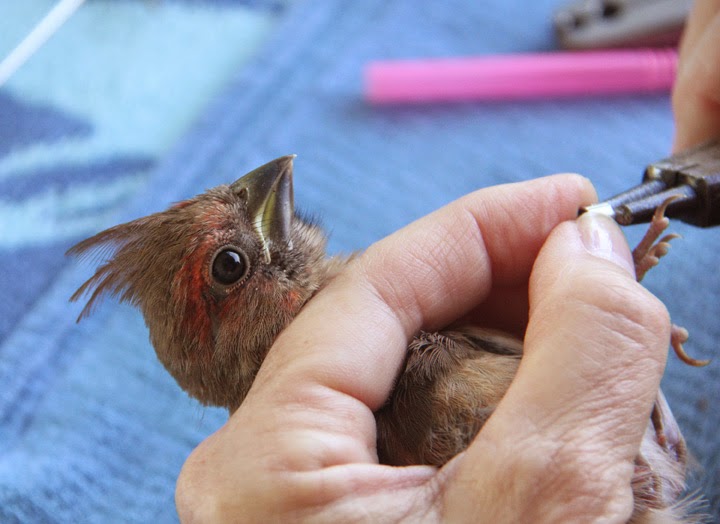
Above and below, Billie bands a juvenile Northern Cardinal.
You can see the yellow, stretchy corners of the juveniles beak that are his remaining "gape".  This young bird is still being fed by parents.  Notice that the juvenile's beak is dark or brown and has not yet developed the bright orange that is characteristic of adult cardinal beaks.

Above and below, another view of the dark beak and yellow gape of the juvenile.  It is impossible to tell at this stage of plumage whether the juvenile is male or female.  With young birds like this one, frequently encountered during the breeding season, juveniles are walked back to the area where they were netted to reunite with their parents.

Below, Colin Leonard extracts a bird from one of the nets.
We had the good fortune of processing some vireos along with more common birds found in the nets. Below, a Red-eyed Vireo and a good look at the thick vireo beak.
Very soon after this bird was banded, we also had a White-eyed Vireo giving a good comparison of the two species.
Above, Mark and Bille consult the Pyle reference to determine the age using the vireo's plumage and eye color.
Above, a White-eyed Vireo has its tail measured.
In the above image, you can see the two species side by side.  The Red-eyed Vireo is closer and larger than the White-eyed Vireo.  The White-eyed Vireo is more colorful, with its yellow markings and white wing bars.
Vireos are incredibly curious and spunky birds.  After being banded, this White-eyed Vireo sat on Mark's fingers for a while before flying.  This gave me an opportunity to get some good images of its thick beak and that beautiful white eye.

Above, banding team members return from a net run with birds held in bags.
Black-eyed Susans sprinkle the fields around the park's grassland.

One of the youngest birds netted was a newly fledged Yellow-breasted Chat.  It is hard to even identify the species when the bird is so young with mostly gray plummage.
This youngster was quickly banded and walked back to the net to rejoin its parents and carry on with morning feeding activities.
Above you can see the newly fledged bird's short primary feathers, downy body and newly developing, short tail.
Many feathers are still growing on the throat and face.

Mark, Master Bander of both songbirds and hummingbirds, will be banding hummingbirds at Knoxville's upcoming Wonder of Hummingbirds Festival  held at Ijams Nature Center on Saturday, August 23rd.  Mark your calendars!  Festival visitors will have the opportunity to see hummingbirds upclose, learn more about their nesting and migration habits and enjoy the many expert speakers and vendors that will be present for the event.


Links and Resources:
Hummingbird banding will occur from 8:00 a.m. to 2:00 p.m. at the festival, Saturday, August 23rd
For more information visit:  Wonder of Hummingbirds Festival
Hummingbird festival Speaker and Event Schedule
My previous posts on bird banding.
Knoxville Tennessee Ornithological Society
Seven Islands Wildlife Refuge, now Seven Islands State Birding Park
Related Posts Plugin for WordPress, Blogger...

Ocean Trail at Palos Verdes Nature Preserve, California--2015

Ocean Trail at Palos Verdes Nature Preserve, California--2015

Bird-banding at Seven Islands State Birding Park--2014

Bird-banding at Seven Islands State Birding Park--2014
Photo courtesy of Jody Stone

Bird-banding at Seven Islands

Bird-banding at Seven Islands
Photo courtesy of Karen Wilkenson

Enjoying Gray Jays in Churchill!--2014

Enjoying Gray Jays in Churchill!--2014
Photo courtesy of Blue Sky Expeditions

Smithsonian National Zoo with one of my Whooping Crane banners and son, John--2014

Smithsonian National Zoo with one of my Whooping Crane banners and son, John--2014

The Incredible Muir Woods near Stinson Beach, CA--2014

The Incredible Muir Woods near Stinson Beach, CA--2014
Photo courtesy of Wendy Pitts Reeves

Me and Denali--2012

Me and Denali--2012
Photo courtesy of Bob King

For the Love of It...

...the sage sees heaven reflected in Nature as in a mirror, and he pursues this Art, not for the sake of gold or silver, but for the love of the knowledge which it reveals.
Sendivogius (1750)

Your Uncapped Creativity...

Your Uncapped Creativity...
"There is a vitality, a life force, an energy, a quickening that is translated through you into action; and because there is only one of you in all time, this expression is unique. If you block it, it will never exist through any other medium and it will be lost. The world will not have it. You must keep that channel open. It is not for you to determine how good it is, nor how valuable. Nor how it compares with other expressions. It is for you to keep it yours, clearly and directly." ----the great dancer, Martha Graham