Showing posts sorted by date for query cardinal. Sort by relevance Show all posts

Saturday, June 20, 2015

A Tiny Hummingbird and a Great Big Trailer!

It was so much fun to see this brand new shiny Conestoga Trailer with my hummingbird image featured on its tail! 
Photo credit:  Melissa Carter

Conestoga has been putting wildlife images on the tails of its trailers for sometime now, featuring both birds and mammals.  You can see some of these images at their gallery featuring their "trailer tails".

One of my birding friends, Wallace Coffey of Bristol, TN, happened to see a trailer with three juvenile owls on the back.  He was so impressed, he asked the driver how the birds happened to be there.  The driver was very cordial and said he was asked about the wildlife art frequently.  He said the owner of the company was a conscientious conservationist and very environment-minded. Wallace, in turn, sent me an email, "Wouldn't it be fun to see a tiny hummingbird featured on the back of one of those big trailers?"  I thought it was a great idea, too!
This week it happened.  The hummingbird image was added to Conestoga's newest trailer by Creative Edge Graphics.  I went to see it yesterday and was wowed. It is stunning! Shiny and beautiful with red lettering matching the red Cardinal Flower visited by a tiny juvenile hummingbird.  This is what drivers on the road will see when they happen to be behind this trailer--a hummingbird traveling all over the country to remind everyone to take care of our environment!
As if hummingbirds visiting our feeders and flowers isn't enough, the timing of this trailer release just adds more excitement as we look forward to our upcoming hummingbird festival.

The Wonder of Hummingbird Festival takes place in Knoxville, Tennessee, at Ijams Nature Center on Saturday, August 22nd.  If you have not already done so, mark your calendar!  The festival features hummingbird banding, expert speakers, nature walks, wildlife demonstrations, and vendors selling food and drinks, native plants and arts and crafts.
                                                                                   Photo credit:  Jody Stone

I will be there with a table of my art.  Come by and say, hello!  Last year one group of hummingbird enthusiasts from Indiana planned their trip to the Smoky Mountains so they could also take in the festival.  Visit this link to see some of last year's festival fun:  Wonder of Hummingbirds.

To see more images of this hummingbird, visit:  Hummingbirds and Pollen

Also visit Wonder of Hummingbirds Festival at East Tennessee River Valley Geotourism

Sunday, July 20, 2014

Bird Banding at Seven Islands State Birding Park

Seven Islands Willdife Refuge officially became Tennesee's Seven Islands State Birding Park on July 1st. Five days later I drove the thirty-minute drive to my first banding session after the official change and was happy to see the interstate sign with symbols that indicate the park is a good place for birding, wildlife watching, hiking, canoeing and kayacking.
Above, bird-banding team members Eddy Whitson, Patty Ford, Billie Cantwell, Mark Armstrong, Janie Kading and Colin Leonard walk back to the banding station on July 6th after an early morning net-run.   

I couldn't take a picture of the interstate sign without risking my life and those around me, so I satisfied my urge by snapping an image of the sign pointing out the park direction as I turned off the interstate.

Above and below, Master Bander, Mark Armstrong, processes a Yellow-breasted Chat, a warbler common to the park.  Banding sessions this summer will help document how habitat changes have impacted the numbers and species of breeding birds in the area.
Historically, the banding station collected MAPS breeding bird data.   MAPS stands for the Monitoring Avian Productivity and Survivorship Program, a program conducted by The Institute for Bird Populations in Point Reyes Station, California.  The MAPS program is conducted from May to August during breeding season and has specific data collection requirements with a goal of analyzing data to understand how bird populations are changing over time.  The information collected and reported by MAPS banding stations helps scientists to determine causes and effects of environmental change.
MAPS banding data requires that the net locations and habitat remain the same, however, and recent changes have impacted this continuity.  Mark is using this opportunity to determine how these changes are impacting the breeding birds and to provide a continuous history of species breeding activity for the park. Above, Janie Kading records data while Mark Armstrong and Billie Cantwell examine birds.
Mark examines a male Common Yellow-throat, a warbler that is far from common in appearance, but whose song is frequently heard in the park during summer months.  The Common Yellow-throat was the subject of a painting I created for the announcement of the new state park earlier this year.
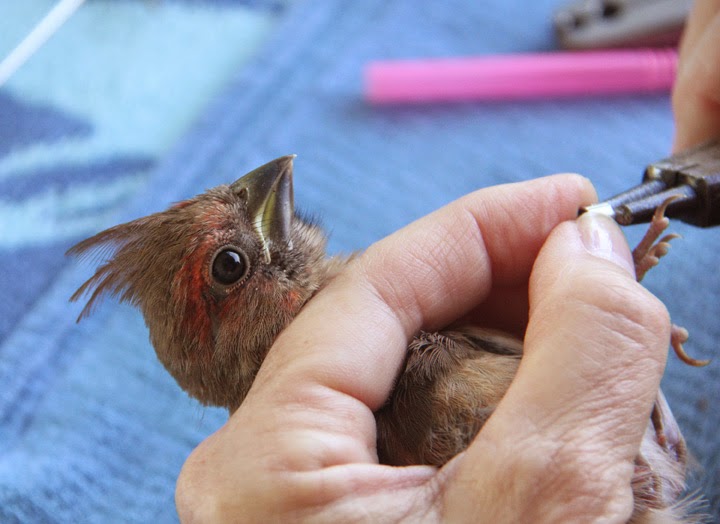
Above and below, Billie bands a juvenile Northern Cardinal.
You can see the yellow, stretchy corners of the juveniles beak that are his remaining "gape".  This young bird is still being fed by parents.  Notice that the juvenile's beak is dark or brown and has not yet developed the bright orange that is characteristic of adult cardinal beaks.

Above and below, another view of the dark beak and yellow gape of the juvenile.  It is impossible to tell at this stage of plumage whether the juvenile is male or female.  With young birds like this one, frequently encountered during the breeding season, juveniles are walked back to the area where they were netted to reunite with their parents.

Below, Colin Leonard extracts a bird from one of the nets.
We had the good fortune of processing some vireos along with more common birds found in the nets. Below, a Red-eyed Vireo and a good look at the thick vireo beak.
Very soon after this bird was banded, we also had a White-eyed Vireo giving a good comparison of the two species.
Above, Mark and Bille consult the Pyle reference to determine the age using the vireo's plumage and eye color.
Above, a White-eyed Vireo has its tail measured.
In the above image, you can see the two species side by side.  The Red-eyed Vireo is closer and larger than the White-eyed Vireo.  The White-eyed Vireo is more colorful, with its yellow markings and white wing bars.
Vireos are incredibly curious and spunky birds.  After being banded, this White-eyed Vireo sat on Mark's fingers for a while before flying.  This gave me an opportunity to get some good images of its thick beak and that beautiful white eye.

Above, banding team members return from a net run with birds held in bags.
Black-eyed Susans sprinkle the fields around the park's grassland.

One of the youngest birds netted was a newly fledged Yellow-breasted Chat.  It is hard to even identify the species when the bird is so young with mostly gray plummage.
This youngster was quickly banded and walked back to the net to rejoin its parents and carry on with morning feeding activities.
Above you can see the newly fledged bird's short primary feathers, downy body and newly developing, short tail.
Many feathers are still growing on the throat and face.

Mark, Master Bander of both songbirds and hummingbirds, will be banding hummingbirds at Knoxville's upcoming Wonder of Hummingbirds Festival  held at Ijams Nature Center on Saturday, August 23rd.  Mark your calendars!  Festival visitors will have the opportunity to see hummingbirds upclose, learn more about their nesting and migration habits and enjoy the many expert speakers and vendors that will be present for the event.


Links and Resources:
Hummingbird banding will occur from 8:00 a.m. to 2:00 p.m. at the festival, Saturday, August 23rd
For more information visit:  Wonder of Hummingbirds Festival
Hummingbird festival Speaker and Event Schedule
My previous posts on bird banding.
Knoxville Tennessee Ornithological Society
Seven Islands Wildlife Refuge, now Seven Islands State Birding Park

Saturday, May 24, 2014

NEW! Hummingbird Gardening in Tennessee

Just in time for the return of our Ruby-throated Hummingbirds, a new publication is available free as a pdf download!

Hummingbird Gardening in Tennessee is published by the University of Tennessee Institute of Agriculture.  The book is co-authored by Marcia Davis, Master Gardener, member of the Knoxville bird club (Knoxville Chapter of the Tennessee Ornithological Society) and the Bird Life columnist for the Knoxville News Sentinel, and Emily Gonzalez of the UT Extension.

The fifteen page booklet is full of useful information about creating hummingbird habitat in your garden and lists the kinds of flowers and native plants that are particularly attractive to hummingbirds.  I am excited to have my hummingbird image of a juvenile Ruby-throat nectaring a Cardinal Flower featured on the cover and three more images included inside!

The free pdf can be downloaded from this link:  Hummingbird Gardening in Tennessee.

Links and resources:

Hummingbird Art
Hummingbird Notes
More about Ruby-throated Hummingbirds
Tennessee's wintering hummingbirds

Friday, August 2, 2013

Hummingbirds, Pollination and Knoxville's Hummingbird Festival

From flower to flower, hummingbirds accidently carry pollen from one blossom to another.  The pollen sticks to their beak and feathers, and if the flower they visit next happens to be the same species, pollination occurs. 
This series of images tells one story of how that pollination happens.  The red flowers are cardinal flower blossoms and the stigma which releases the flower's pollen sits in a perfect place to rub against the hummingbirds crown as it nectars the flower.

The hummers feathers and the stigma rub against each other, and as the hummer backs out of the flower, the stigma is stimulated to release its pollen, shooting it out as if from a faucet.  


Below, a layer of pale yellow pollen covers the top of the hummer's head, ready to pollinate the next flower visited.


Hummingbirds are fascinating for many reasons.  Next to size and speed, pollination and migration are two of the intriguing qualities of these tiny birds.  On August 24th, when fall migration is at its peak in Tennessee, the Knoxville Chapter of the Tennessee Ornithological Society is celebrating hummingbirds with the Wonder of Hummingbirds Festival featuring hummingbird banding demonstrations by master bander, Mark Armstrong. The festival will also include expert speakers on hummingbirds and other nature topics, nature related vendors, great food, and, of course, I will be there exhibiting art, so come by and visit!

Links and Resources:
Wonder of Hummingbird Festival
Hummingbird Banding
Information about hummingbird gardening and taking care of your feeders below:
Ruby-throated Hummingbird Fish and Wildlife Habitat Management Leaflet

Saturday, December 17, 2011

Eastern Bluebird Family Pays a Visit

The female eastern bluebird that nested in the nest box during the 2011 breeding season paid me a visit this morning and brought her juveniles along.  I could not be more delighted than when this family pays a visit.  The parent female is indistinguishable from her daughter in plumage, but I can recognize her behavior. 
Above you see her staring at me from the nest box.  She had just checked the mealworm feeder and found it empty.  There is a message in that look.
When the family arrives, they flutter up to gazebo shelves to take a look around from up high before approaching the feeder.  Sometimes they arrive chattering, but this morning they were silent.  I just happened to be outside.  On this occasion, the parent female identified herself by what she did next.  She flew to the shepherd's hook closer to where I was standing and wing waved.  Can you imagine what pleasure that gives me?!
I gladly went inside to get mealworms and suet.  I put both out from time to time and the titmice and wrens happily check the feeder every morning and empty it of all contents, including the cornmeal crumbs.  The bluebirds scattered when I walked to the feeder, so after adding food, I whistled.  Never worry that you can't whistle very well.  Your whistle will be recognizable and birds will associate it with you and the food you bring.  
Above you see the female feeding and I believe the other two are her juveniles.  The male typically joins her inside the feeder.    
Along with the bluebirds, I had dark-eyed juncos and white-throated sparrows visiting, in addition to the titmice, chickadees, red-bellies and downies.  And the sweet little yellow-rumped warbler that likes to hang around made an appearance today.  I rarely catch him/her in an image, so I was doubly delighted when she paused long enough to allow this one.
A bluebird, titmouse, cardinal and robin are all featured in my Autumn Birds note card set, a boxed set of 4 x 5 blank cards featuring new watercolor images of some favorite birds in autumn settings.  Creating these cards and working with a printer has been a fun project and I am excited about the beautiful results.  
Visit my cards online at my Vickie Henderson Art website.  If you are near the Knoxville area, you can also find them at Knoxville's Wild Birds Unlimited.

Links and Resources:

Recommended for quality printing:  High Resolutions

The Hooded Crane is still at the Hiwassee Wildlife Refuge near Dayton TN.  Visit my post about this unusual crane appearance.  And check out the young birders in the Chattanooga Times Free Press article on the crane.

Visit my bluebird family posts about the fun experience I had watching this family during the 2011 nesting season.  You will also enjoy seeing the gazebo and the fun action that happens around it from time to time that I call "magic". 

In 2009 I followed the nesting season of a pair of red-shouldered hawks.  Watch for my Red-shouldered Hawk sketchbook to be in print soon!  

Monday, February 21, 2011

A Spring Head-dress and a Heart-stopping Thrush

This female northern cardinal visiting the bird bath for a drink gave me my first belly laugh of the day.     
Her plumes on her crest stood up like flames in the wind.  Despite the winter-y blast of heavy snow in the mid-western states, we're having mild temperatures and blustery pre-March winds in Tennessee.  And if that weren't enough to hint of spring, birds are showing signs of spring molting.  Just twelve days ago, I snapped the image below, of a female cardinal in the snow.  She was fluffed and warm in her thick winter plumage.   But in the days since, we've had more moderate weather with some days reaching as high as the 70's F.
My Atlas of the Breeding Bird of Tennessee says, "In late February and March, cardinals form stable, monogamous pair bonds. Both the male and female defend the territory with song, displays, and mild combat."   Females pick the nest site usually in April but as early as mid-March, meaning that the tolerance of communal winter foraging is about to end, replaced by freshened spring plumage and territorial attitudes.
Along with the tattered and comical appearance of her crest, feathers have molted around this cardinal's face. New feather sheaths will emerge quickly where old feathers have been shed and fresh ones will rapidly grow to replace the lost ones.  This female's colors are beautiful, nonetheless, even though she wears a wind-blown look.  I couldn't be sure if she was on the alert or if the wind was standing her remaining crest feathers up so tall.
The watering hole is definitely a fun place to hang out, a good place to watch the tall pines, oak and maples waving in the gusting wind, as well as, to see birds that may otherwise go unseen as they come for a drink.  Several times I've seen a yellow-rumped warbler both drink and forage near the feeders but, so far, not when I'm outside with the camera.
Today I enjoyed a better look at the beautiful streaking and contrast in an American robin's plumage as she braved the birdbath for a drink.  When she flew, my heart picked up a beat, as a hermit thrush popped in to replace her, its 7-inch stature seeming exceptionally petite next to that of a robin, ranging from 9 to 11 inches.
It was special to get lingering looks at this shy bird, standing tall on tiny legs.  More often I notice her hanging out in the shadows of the hemlock, impossible conditions for a good photo, and visits to the birdbath are usually glimpsed through the window.  This made today's surprise visit exceptionally appreciated and I fell in love with the wind-blown look below!
Hermit thrushes are best known in Tennessee as a migrant and wintering resident, generally arriving in October and departing by early April.  Breeding seasons have only been sparsely recorded in Tennessee in the higher elevations of Roan Mountain and the Great Smoky Mountains (Atlas of the Breeding Birds of TN, ed. Charles P Nicholson.)

When this thrush turned, giving me nice looks at her body proportions and rust tail, I thought she was leaving.      
But she lingered a few minutes longer and reached from the side to take several more drinks.  Sigh.  One of many special moments enjoyed in the backyard.  
Links and Resources:
Atlas of the Breeding Birds of Tennessee, edited by Charles P. Nicholson.  This book is out of print and pricey on the secondary market, but with patience, you may find lowered pricing on Amazon with time.  
And more about cardinals and molting in A Day-making Family of Cardinals

If you have not already signed the petition requesting a new management plan for the Eastern Population of Sandhill cranes, visit the petition site right now and voice your opinion on this important conservation issue.  Kentucky is battling a sandhill crane hunting proposal similar to the one deferred in Tennessee.  We have a lot of work left to do to protect this population that has only recently recovered from near extirpation.  To read more visit A New Plan for Eastern Sandhills.    

Linked to Bird Photography Weekly #130 at Birdfreak.com to promote the conservation of our world's birds.
Related Posts Plugin for WordPress, Blogger...

Ocean Trail at Palos Verdes Nature Preserve, California--2015

Ocean Trail at Palos Verdes Nature Preserve, California--2015

Bird-banding at Seven Islands State Birding Park--2014

Bird-banding at Seven Islands State Birding Park--2014
Photo courtesy of Jody Stone

Bird-banding at Seven Islands

Bird-banding at Seven Islands
Photo courtesy of Karen Wilkenson

Enjoying Gray Jays in Churchill!--2014

Enjoying Gray Jays in Churchill!--2014
Photo courtesy of Blue Sky Expeditions

Smithsonian National Zoo with one of my Whooping Crane banners and son, John--2014

Smithsonian National Zoo with one of my Whooping Crane banners and son, John--2014

The Incredible Muir Woods near Stinson Beach, CA--2014

The Incredible Muir Woods near Stinson Beach, CA--2014
Photo courtesy of Wendy Pitts Reeves

Me and Denali--2012

Me and Denali--2012
Photo courtesy of Bob King

For the Love of It...

...the sage sees heaven reflected in Nature as in a mirror, and he pursues this Art, not for the sake of gold or silver, but for the love of the knowledge which it reveals.
Sendivogius (1750)

Your Uncapped Creativity...

Your Uncapped Creativity...
"There is a vitality, a life force, an energy, a quickening that is translated through you into action; and because there is only one of you in all time, this expression is unique. If you block it, it will never exist through any other medium and it will be lost. The world will not have it. You must keep that channel open. It is not for you to determine how good it is, nor how valuable. Nor how it compares with other expressions. It is for you to keep it yours, clearly and directly." ----the great dancer, Martha Graham