Seven Islands Willdife Refuge officially became Tennesee's Seven Islands State Birding Park on July 1st. Five days later I drove the thirty-minute drive to my first banding session after the official change and was happy to see the interstate sign with symbols that indicate the park is a good place for birding, wildlife watching, hiking, canoeing and kayacking.
Above, bird-banding team members Eddy Whitson, Patty Ford, Billie Cantwell, Mark Armstrong, Janie Kading and Colin Leonard walk back to the banding station on July 6th after an early morning net-run.
 I couldn't take a picture of the interstate sign without risking my life and those around me, so I satisfied my urge by snapping an image of the sign pointing out the park direction as I turned off the interstate.
Above and below, Master Bander, Mark Armstrong, processes a Yellow-breasted Chat, a warbler common to the park. Banding sessions this summer will help document how habitat changes have impacted the numbers and species of breeding birds in the area.
Historically, the banding station collected
MAPS breeding bird data. MAPS stands for the
Monitoring Avian Productivity and Survivorship Program, a program conducted by The Institute for Bird Populations in Point Reyes Station, California. The MAPS program is conducted from May to August during breeding season and has specific data collection requirements with a goal of analyzing data to understand how bird populations are changing over time. The information collected and reported by MAPS banding stations helps scientists to determine causes and effects of environmental change.
MAPS banding data requires that the net locations and habitat remain the same, however, and recent changes have impacted this continuity. Mark is using this opportunity to determine how these changes are impacting the breeding birds and to provide a continuous history of species breeding activity for the park. Above, Janie Kading records data while Mark Armstrong and Billie Cantwell examine birds.
Mark examines a male Common Yellow-throat, a warbler that is far from common in appearance, but whose song is frequently heard in the park during summer months. The Common Yellow-throat was the subject of a painting I created for the
announcement of the new state park earlier this year.
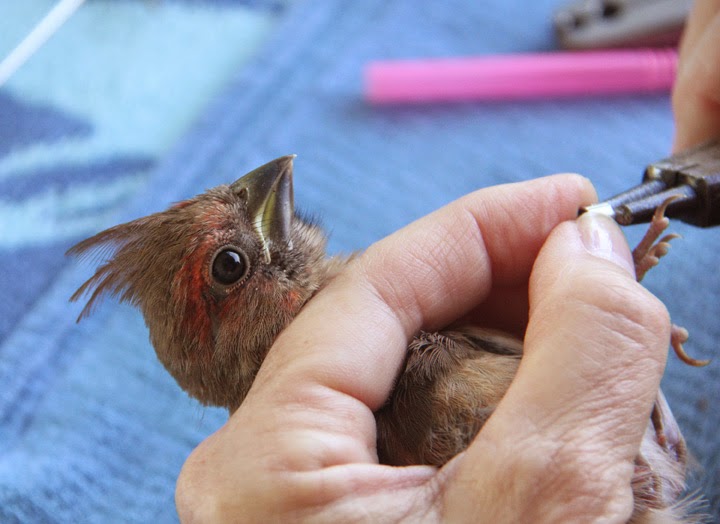
Above and below, Billie bands a juvenile Northern Cardinal.
You can see the yellow, stretchy corners of the juveniles beak that are his remaining "gape". This young bird is still being fed by parents. Notice that the juvenile's beak is dark or brown and has not yet developed the bright orange that is characteristic of adult cardinal beaks.
Above and below, another view of the dark beak and yellow gape of the juvenile. It is impossible to tell at this stage of plumage whether the juvenile is male or female. With young birds like this one, frequently encountered during the breeding season, juveniles are walked back to the area where they were netted to reunite with their parents.
Below, Colin Leonard extracts a bird from one of the nets.
We had the good fortune of processing some vireos along with more common birds found in the nets. Below, a Red-eyed Vireo and a good look at the thick vireo beak.
Very soon after this bird was banded, we also had a White-eyed Vireo giving a good comparison of the two species.
Above, Mark and Bille consult the Pyle reference to determine the age using the vireo's plumage and eye color.
Above, a White-eyed Vireo has its tail measured.
In the above image, you can see the two species side by side. The Red-eyed Vireo is closer and larger than the White-eyed Vireo. The White-eyed Vireo is more colorful, with its yellow markings and white wing bars.
Vireos are incredibly curious and spunky birds. After being banded, this White-eyed Vireo sat on Mark's fingers for a while before flying. This gave me an opportunity to get some good images of its thick beak and that beautiful white eye.
Above, banding team members return from a net run with birds held in bags.
Black-eyed Susans sprinkle the fields around the park's grassland.
One of the youngest birds netted was a newly fledged Yellow-breasted Chat. It is hard to even identify the species when the bird is so young with mostly gray plummage.
This youngster was quickly banded and walked back to the net to rejoin its parents and carry on with morning feeding activities.
Above you can see the newly fledged bird's short primary feathers, downy body and newly developing, short tail.
Many feathers are still growing on the throat and face.
Mark, Master Bander of both songbirds and hummingbirds, will be banding hummingbirds at Knoxville's upcoming
Wonder of Hummingbirds Festival held at Ijams Nature Center on Saturday, August 23rd. Mark your calendars! Festival visitors will have the opportunity to see hummingbirds upclose, learn more about their nesting and migration habits and enjoy the many expert speakers and vendors that will be present for the event.
Links and Resources:
Hummingbird banding will occur from 8:00 a.m. to 2:00 p.m. at the festival, Saturday, August 23rd
For more information visit:
Wonder of Hummingbirds Festival
Hummingbird festival
Speaker and Event Schedule
My previous posts on
bird banding.
Knoxville Tennessee Ornithological Society
Seven Islands Wildlife Refuge, now Seven Islands State Birding Park




 I also wanted to see how the molting
 Above you see the male on August 11th, with many of his crest feathers already missing. And below you can see how he appeared yesterday, on August 28th. In a little over two weeks he had molted all his crest feathers, many head and facial feathers and had produced feather sheaths to protect newly growing feathers. The tiny feathers poking up on his crown in the image below are the brand new ones growing out beyond the sheath. And what looks like gray whiskers are the sheaths for his new black facial feathers.


 Molting, or the shedding and replacing of worn feathers with new ones, occurs in all birds but at different times, with different frequency and rates, all of which perfectly matches the bird's habits, seasonal cycles, available food sources and migration patterns. And despite the look of disarray, molting occurs in an orderly and gradual fashion with most birds retaining their ability to fly while molting. Waterfowl are an exception, rendered temporarily flightless with a complete postbreeding molt due to body aerodynamics.

 For these two juvenile cardinals trying to share a perch, the wait will not be so long. In only a few months they will have acquired the distinctive orange beak and brighter adult plumage that we all enjoy in our backyard cardinals.

 Northern cardinals are one of 44 species in our area that are known to be predated by cowbirds. In the cardinal's case, a conservative estimate is 10 percent of the time. This frequency is increasing as habitat is more and more broken by development. All the more reason why I was happy to notice this for real cardinal juvenile being fed by papa on a limb near the feeder.
 After observing the


 And speaking of titmice, the juvenile cardinal landed on a limb in the hemlock that is frequented by the foraging titmice family. When he did, three of the titmice juveniles surrounded him, making their squealing juvenile calls. Looking a bit overwhelmed, the cardinal ruffled his feathers, made himself look bigger, and gave a big leap. The titmous juveniles scattered.


